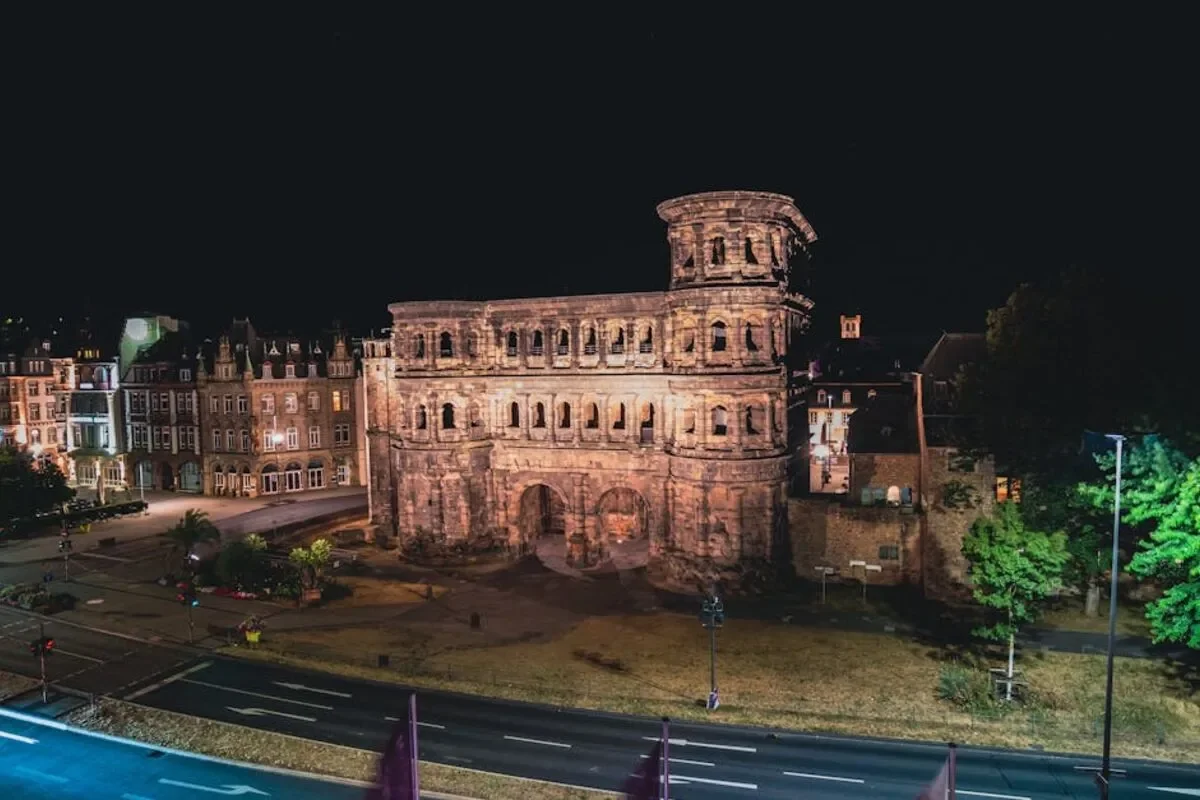
Trier
Germany's oldest city with impressive Roman monuments including the Porta Nigra, founded over 2,000…

Rhineland-Palatinate (Rheinland-Pfalz) is a federal state in southwestern Germany, created in 1946 from Prussian, Hessian, and Bavarian territory. Its capital is Mainz, and it covers roughly 19,858 square kilometers with about 4.1 million residents.
The state holds a distinction no other German region can claim: seven of Germany’s thirteen official wine regions lie within its borders, alongside seven UNESCO World Heritage Sites and the country’s oldest cities. Trier was founded by the Romans, Speyer Cathedral was Germany’s second site ever inscribed by UNESCO, and the Upper Middle Rhine Valley carries castles along a 65-kilometer gorge.
Travelers often confuse three overlapping names. The Rhineland is a loose historical term for German land along the middle Rhine. The Palatinate (Pfalz) is a historic territory in the state’s south. Rhineland-Palatinate is the modern political unit that contains parts of both.
The state sits in Germany’s southwest, wrapped around the middle course of the Rhine and the full German stretch of the Moselle. Its terrain divides between deep, terraced river valleys and forested uplands that rise on either side.
Rhineland-Palatinate shares German borders with four states and international borders with three countries.
| Direction | Neighbor |
|---|---|
| North | North Rhine-Westphalia |
| East | Hesse (Hessen) |
| Southeast | Baden-Württemberg |
| Southwest | Saarland |
| West and south | France, Luxembourg, Belgium |
That western border makes the state a practical entry point for cross-border travel. Luxembourg City sits under an hour from Trier by road.
The Rhine River enters the state near Worms, runs north past Mainz, and cuts a narrow gorge between Bingen and Koblenz. This stretch is the Middle Rhine, distinct from the broader Upper Rhine to the south.
The Moselle River joins the Rhine at Koblenz after winding past Cochem and Trier. Smaller valleys, including the Nahe in the Naheland, feed the same system and carry their own vineyards.
Four upland massifs frame the rivers: the Eifel to the northwest, the Hunsrück between the Moselle and the Nahe, the Westerwald north of the Lahn, and a small share of the Taunus in the east.
South of Mainz, the land flattens into the Upper Rhine Plain, one of Germany’s warmest agricultural zones. Forests cover a large share of the state, giving it some of the densest woodland cover in the country.
Two thousand years of shifting control explain why this state has four cathedral cities and no single historic capital. Roman military planning built the first urban network, while church princes governed for centuries.
French, Prussian, and Bavarian rule then redrew the map repeatedly before 1946.
The Roman Empire treated the Rhine as a frontier and built garrisons and administrative centers along it. Trier, founded as Augusta Treverorum, became an imperial residence and holds the largest concentration of Roman monuments north of the Alps.
Mainz began as the legionary base Mogontiacum. Worms and Speyer also trace their urban origins to Roman settlement, and that shared foundation shapes the cultural heritage visitors encounter today.
From the Middle Ages, much of the territory belonged to the Holy Roman Empire as a patchwork of church states and secular holdings. The archbishops of Mainz and Trier were prince-electors, giving them a vote in imperial elections.
The County Palatine of the Rhine grew into the Electoral Palatinate (Kurpfalz), a separate electorate whose western lands, the Rhenish Palatinate, sit inside the modern state. The historic Palatinate and the Rhineland were never a single administrative unit.
The Treaty of Campo Formio in 1797 confirmed French control of the left bank of the Rhine, and French administration reshaped law and land ownership. The Congress of Vienna in 1815 then divided the area among Prussia, Bavaria, Nassau, and Hesse.
After World War II, the French military administration merged Prussian Rhineland and Nassau districts, Bavaria’s Palatinate, and Rhenish Hesse (Rheinhessen) from the People’s State of Hesse. A referendum on 18 May 1947 confirmed the new state.
Four cities carry most of the state’s heritage weight: Mainz, Trier, Koblenz, and Speyer. Between them they hold Roman monuments, two Romanesque imperial cathedrals, the Gutenberg legacy, and the northern gateway to the Upper Middle Rhine Valley.
Johannes Gutenberg developed printing with movable type in Mainz around 1450. The Gutenberg Museum holds original Gutenberg Bibles, and Johannes Gutenberg University carries his name.
Mainz Cathedral (Mainzer Dom) is a red sandstone Romanesque building begun in the tenth century. The city also anchors Rheinhessen, Germany’s largest wine region by area.
Trier holds nine UNESCO-listed structures, including the Porta Nigra, the imperial baths, the basilica, St Peter’s Cathedral, and the Church of Our Lady. UNESCO inscribed them together in 1986.
The city sits on the Moselle near the Luxembourg border, making it a logical start or end point for a Moselle valley route toward Cochem and Koblenz.
Koblenz stands at the Deutsches Eck (German Corner), the confluence where the Moselle meets the Rhine. It marks the northern end of the Upper Middle Rhine Valley, a UNESCO World Heritage Site running south to Bingen.
That 65-kilometer corridor holds dozens of castles and palaces above terraced vineyards. Everything About Germany’s guide to the Rhine Valley and Middle Rhine covers the Lorelei rock and the towns along the gorge in more detail.
Speyer Cathedral became the first UNESCO site in Rhineland-Palatinate in 1981 and remains the largest surviving Romanesque church in the world. The Historical Museum of the Palatinate sits beside it.
Worms holds its own imperial cathedral and Reformation history. Ludwigshafen, Kaiserslautern, Pirmasens, Frankenthal, Idar-Oberstein, and Neuwied round out the state’s urban network, with Idar-Oberstein known for gemstone cutting.
Rhineland-Palatinate produces roughly two-thirds of Germany’s wine and contains seven of the country’s thirteen designated wine-growing regions. Viticulture here dates to Roman settlement, and it still shapes village layouts, festival calendars, and everyday meals.
Six of the state’s regions dominate visitor interest:
Riesling dominates the Moselle and Middle Rhine. The Palatinate also grows Muscatel, Pinot Blanc, Pinot Gris, and Pinot Noir.
The German Wine Route (Deutsche Weinstraße) opened in 1935 and runs about 85 kilometers through the Palatinate. It links wine villages from Bockenheim in the north to the French border in the south.
Neustadt an der Weinstraße serves as the route’s central town and hosts the German Grape Harvest Festival each autumn. Bad Dürkheim and Landau anchor other stretches of the road.
Palatine German (Pfälzisch) dialect names many local dishes. Saumagen (stuffed pork stomach) and Spundekäs (a whipped cheese spread) appear on menus across the Rheinpfalz.
Beyond vines, the Upper Rhine Plain supports fruit, vegetables, and tobacco. Chestnuts grow along the forest edge of the Wine Route and appear in autumn cooking and festival stalls.
The state markets itself as a hiking destination with twelve certified long-distance trails. Its ten holiday regions each combine walking routes, wine villages, and wellness facilities.
River cruises and driving routes connect the same landscapes at a slower pace.
The northern uplands carry the state’s best-known long-distance routes. Volcanic maar lakes in the Eifel, forest ridges in the Hunsrück, and stream valleys in the Westerwald give each range its own character.
German hiking culture supports these trails with waymarking, huts, and village accommodation. That means multi-day walking works without a support vehicle. The Nürburgring motorsport circuit also sits in the Eifel, which suits travelers who want to combine hiking with racing history.
The Palatinate Forest (Pfälzerwald) is one of Germany’s largest continuous woodlands. It joins France’s Northern Vosges in the Palatinate Forest-North Vosges Biosphere Reserve, a UNESCO transboundary designation.
Sandstone outcrops, ruined castles, and the Donnersberg summit to the north give the area varied walking. The Lauter and Glan rivers drain parts of this southern upland zone.
Frankfurt Airport lies about 30 minutes by train from Mainz, making it the standard arrival point. Regional trains follow both banks of the Rhine, running south to Bingen and north to Koblenz.
Rhine cruise operators run scheduled and chartered sailings between Mainz and Koblenz, with Moselle services continuing to Cochem. Check sailing schedules, castle opening hours, and rail timetables with official operators before traveling, since seasonal changes are common. Everything About Germany’s planning a trip to Germany resource covers wider logistics across the regions.
Rhineland-Palatinate sits in southwestern Germany along the Rhine and Moselle rivers. Within Germany, it borders North Rhine-Westphalia, Hesse, Baden-Württemberg, and Saarland. To the west and south, it borders France, Luxembourg, and Belgium.
Yes, u003cemu003eRheinland-Pfalzu003c/emu003e is the German name for the same federal state. The English form translates the two historic components: the Rhineland and the Palatinate.
Mainz is the capital and largest city, followed by Ludwigshafen am Rhein, Koblenz, Trier, Kaiserslautern, Worms, and Neuwied. Trier and Mainz have the deepest Roman heritage, while Speyer and Worms carry major Romanesque cathedrals.
The state is known for wine, containing seven of Germany’s thirteen official wine regions, and for its castles along the Upper Middle Rhine Valley. It also holds seven UNESCO World Heritage Sites and Germany’s oldest Roman cities.
Trains from Frankfurt am Main reach Mainz in about 30 to 40 minutes. Frankfurt Airport also connects directly to the state’s rail network. By car, take the A60 or A61 to reach Bingen, Koblenz, and the Wine Route. Check the latest timetables with the rail operator before you travel.