Frankfurt am Main
Germany's financial powerhouse surprises visitors with its intimate charm despite hosting Europe's banking elite.…
Hesse (German: Hessen) is a landlocked federal state in west-central Germany. Its capital is Wiesbaden, its largest city is Frankfurt am Main, and it covers about 21,115 square kilometers with roughly 6.4 million residents.
The state sits at the geographic center of the country. It borders Lower Saxony to the north, Thuringia to the east, Bavaria to the southeast, Baden-Württemberg to the south, Rhineland-Palatinate to the west, and North Rhine-Westphalia to the northwest.
That position made Hesse a crossroads for trade, armies, and rail lines for centuries.
Most visitors meet Hesse through Frankfurt Airport, but the state stretches far past the skyline: thermal spa towns, a UNESCO-listed hillside park in Kassel, the Rheingau wine region, and Germany’s densest forest cover.
Hesse is also where the Brothers Grimm collected and published their fairy tales. Several small principalities with confusingly similar names once ruled side by side here.
Hesse occupies the middle of Germany, with the Rhine forming part of its western edge and the Main River cutting through its southern half. About 40 percent of the state is forested, making it one of Germany’s most wooded regions.
The southwest also contains one of Europe’s busiest metropolitan areas. The state divides roughly into three travel zones: the urban south around Frankfurt, the university and river country of the center, and the quieter uplands of the north and east.
The Frankfurt Rhine-Main region is the state’s economic core. It takes in Frankfurt, Wiesbaden, Darmstadt, Offenbach, and Hanau, while rail, road, and air connections converge here.
South and west of the city sit two contrasting landscapes: the Rheingau wine region, a narrow strip of vineyards along the Rhine, and the Odenwald, a wooded low mountain range shared with Baden-Württemberg and Bavaria.
The Bergstraße, the old road along the Odenwald’s western edge, blooms earlier than most of Germany.
Central Hesse follows the Lahn River as it winds west toward the Rhine. Marburg, Gießen, Wetzlar, Weilburg, and Limburg an der Lahn line the valley, each with a compact old town of half-timbered houses.
The Taunus mountains rise between the Lahn and the Main, separating the wine country and the metropolis from the quieter interior. The Kellerwald and Burgwald forests fill much of the ground to the north.
Northern Hesse centers on Kassel and reaches into open, hilly farmland and beech forest. The Vogelsberg, an extinct volcanic massif, sits in the state’s middle and forms one of the largest basalt formations in Central Europe.
Further east, the Rhön straddles the border with Bavaria and Thuringia. Its highest point, the Wasserkuppe at 950 meters, is Hesse’s tallest summit and a long-standing center for gliding.
The Spessart hills lie southeast, mostly in Bavaria but reaching into Hesse near Gelnhausen.
Four rivers organize the state: the Rhine along the western border, the Main across the south, the Lahn through the center, and the Fulda through the north and east. The Fulda and the Werra meet just outside Hesse to form the Weser.
Between them run a series of Mittelgebirge (low mountain ranges), none exceeding 1,000 meters. Their modest heights make Hesse well suited to walking rather than alpine sport, and marked trails cross nearly every range.
Hesse’s urban character comes from six or seven cities of real substance, plus a scattering of small historic towns. Frankfurt supplies the skyline and the airport, Wiesbaden the government and thermal springs, Kassel the art and Grimm heritage, and Darmstadt the science institutions and Jugendstil architecture.
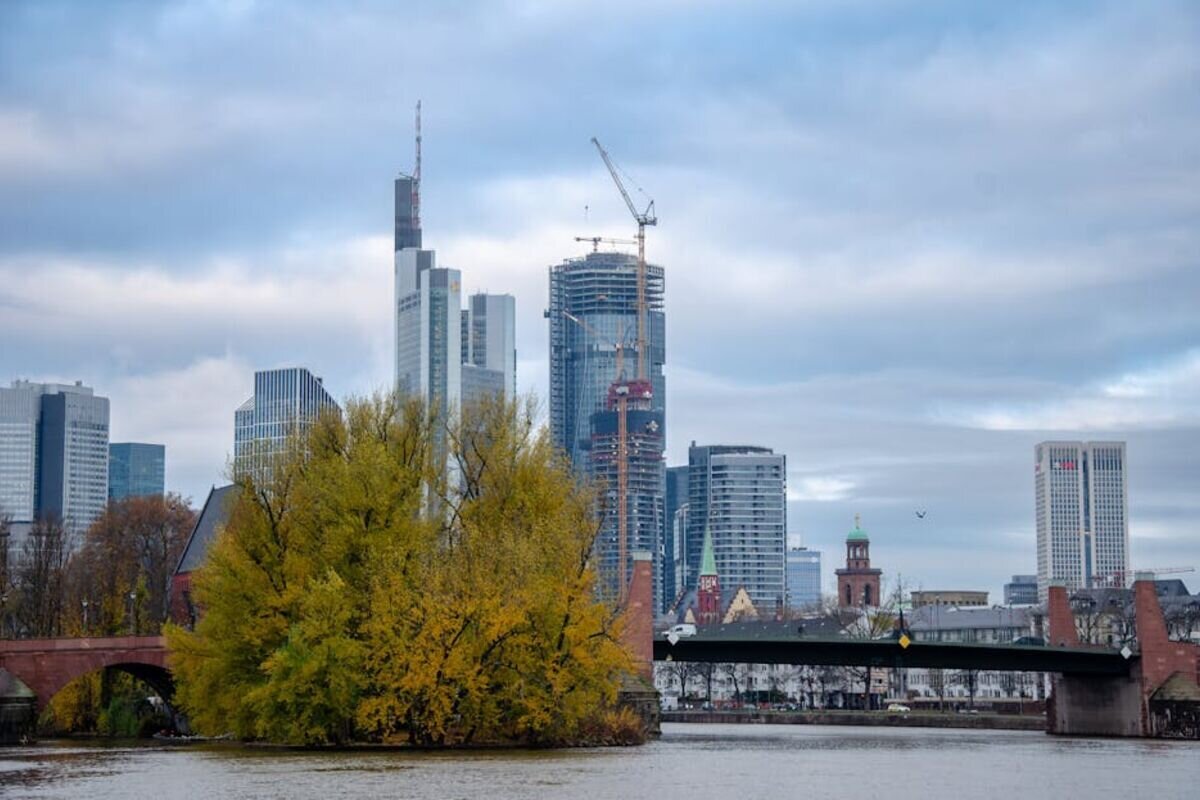
Frankfurt is Germany’s financial center and home to the European Central Bank, which explains its nickname Mainhattan. Its high-rise cluster is unusual for a German city.
The Museumsufer (Museum Embankment) along the Main holds more than a dozen institutions, including the Städel Museum, whose collection spans seven centuries of European painting.
The reconstructed Neue Altstadt (New Old Town) between the cathedral and the Römer reopened in 2018 on the footprint of the pre-war lanes.
Frankfurt Airport is Germany’s largest by passenger numbers and a primary transatlantic entry point.
Wiesbaden is the state capital and one of Europe’s oldest spa towns, built on 26 hot springs. The Kochbrunnen fountain still runs at around 66°C.
The city’s 19th-century layout, wide boulevards, the Kurhaus, and the Hessisches Staatstheater reflect its era as an imperial resort. From here the Rheingau begins immediately downstream, with Riesling vineyards running to Rüdesheim.
Kassel hosts documenta, the contemporary art exhibition held every five years since 1955. It turns the whole city into a venue for around 100 days.
The next edition follows the established five-year cycle; dates are published on the exhibition’s official site.
The Brothers Grimm worked in Kassel for decades, and the GRIMMWELT museum covers their linguistic and folkloric work. Our Kassel city guide covers the museums and the hillside park in more detail.
Darmstadt calls itself a Wissenschaftsstadt (city of science). It is home to the Technical University of Darmstadt, the European Space Operations Centre, and the GSI heavy ion research facility.
The chemical element darmstadtium is named after the city. The Mathildenhöhe artists’ colony, founded in 1899, is a UNESCO World Heritage Site.
Its Wedding Tower (Hochzeitsturm), with five rounded finger-like peaks, is the city’s emblem. The Hessisches Landesmuseum holds art, natural history, and archaeology under one roof.
Marburg is a hillside university town whose Elisabethkirche, begun in 1235, is among the earliest purely Gothic churches in Germany. The Brothers Grimm studied law here.
Wetzlar has an unfinished cathedral and a strong optics industry; Goethe’s stay here shaped The Sorrows of Young Werther. Fulda centers on a baroque cathedral and palace quarter built over the grave of Saint Boniface.
Limburg an der Lahn is known for its seven-towered late-Romanesque cathedral above the river.
Hanau is the Grimms’ birthplace and the eastern anchor of the German Fairy Tale Route. Offenbach sits directly east of Frankfurt and holds the German Leather Museum.
Several spa towns carry the Bad prefix: Bad Homburg vor der Höhe, with its Kurpark and casino, and Bad Nauheim, where Elvis Presley was stationed in 1958.
Rüsselsheim is the historic Opel factory town, Gelnhausen has an imperial palace ruin from Barbarossa’s reign, and Bensheim and Lampertheim sit in the warm southern lowlands.
Hesse’s history is a story of division and recombination. The Landgraviate of Hesse split repeatedly from the 13th century onward, producing a set of small states whose names all began with the same word.
The modern state took shape only in 1945.
The Chatti, a Germanic tribe recorded by Roman writers in the first century AD, lived north of the Main and are considered the ancestors of the Hessians. The name Hesse derives from theirs.
Saint Boniface Christianized the region in the early 8th century and founded the monastery at Fulda in 744. The area later fell under Franconia within the Holy Roman Empire.
The Landgraviate of Hesse was created in 1264, split off from the Landgraviate of Thuringia after the War of the Thuringian Succession. It gained the wealthy County of Katzenelnbogen in 1479.
In 1567 the landgraviate divided among the sons of Philip the Magnanimous, creating Hesse-Kassel, Hesse-Darmstadt, Hesse-Marburg, and Hesse-Rheinfels. Later branches included Hesse-Homburg and Hesse-Hanau.
| Historic state | Capital | Later status |
|---|---|---|
| Hesse-Kassel | Kassel | Became the Electorate of Hesse; annexed by Prussia 1866 |
| Hesse-Darmstadt | Darmstadt | Became the Grand Duchy of Hesse in 1806 |
| Hesse-Homburg | Bad Homburg | Absorbed by Hesse-Darmstadt, then Prussia |
| Free City of Frankfurt | Frankfurt | Independent city-state until 1866 |
| Nassau and Waldeck | Wiesbaden / Arolsen | Separate territories later merged into Hesse |
The Thirty Years’ War (1618-1648) devastated the region. Hesse-Kassel and Hesse-Darmstadt fought on opposite sides.
The French Revolution and Napoleon redrew the map. In 1806 both main Hessian states joined the Confederation of the Rhine. Hesse-Darmstadt became a grand duchy, while Hesse-Kassel became an electorate.
The Congress of Vienna in 1815 confirmed these titles and placed both states in the German Confederation. In the Austro-Prussian War of 1866, Hesse-Kassel, Nassau, and the Free City of Frankfurt backed Austria. Prussia annexed them and combined them into the Province of Hesse-Nassau.
Hesse-Darmstadt kept its independence and joined the North German Confederation, then the German Empire.
After 1918 the grand duchy became the People’s State of Hesse. In 1945 the American occupation authorities merged it with most of Hesse-Nassau to create today’s state, choosing Wiesbaden as capital.
Jacob and Wilhelm Grimm gathered many of their tales in and around Kassel. The German Fairy Tale Route runs from their birthplace in Hanau north through Marburg and Kassel.
Apfelwein (apple wine, locally Ebbelwoi) is Hesse’s signature drink. People serve it in a ribbed glass called a Geripptes, often alongside a blue-grey ceramic jug known as a Bembel. Sachsenhausen in Frankfurt is its traditional home.
Grüne Soße (green sauce), a cold herb sauce made with seven specific herbs, is the region’s best-known dish. Goethe, born in Frankfurt, is said to have been fond of it. His life and work are covered in our profile of Johann Wolfgang von Goethe.
Hesse holds several UNESCO World Heritage Sites, including a baroque hillside park, a Carolingian abbey gate, a fossil quarry, ancient beech forest, an artists’ colony, and part of the Rhine gorge. Outdoor travel centers on the Kellerwald, the Rhön, the Taunus, and the river valleys.
Bergpark Wilhelmshöhe in Kassel is the largest hillside park in Europe, covering about 2.4 square kilometers. Construction began in 1689 and continued for roughly 150 years.
The Hercules Monument crowns the slope. An octagonal stone structure supports a copper statue of the hero. On scheduled days, water cascades down the baroque stairway and channels below by gravity alone, without pumps. The park entered the World Heritage list in 2013.
Lorsch Abbey, founded in 764, became a power and learning center of the Holy Roman Empire. It once held one of the largest medieval libraries.
Its surviving Königshalle (King’s Hall) is a rare piece of Carolingian architecture. UNESCO listed it in 1991.
The Messel Pit near Darmstadt is a former oil shale quarry with exceptionally preserved fossils from about 47 million years ago. These include complete mammals with fur outlines. It became Germany’s first natural World Heritage Site in 1995.
Mathildenhöhe in Darmstadt joined the list in 2021 for its Jugendstil buildings.
The Upper Middle Rhine Valley runs 65 kilometers between Bingen and Koblenz. UNESCO listed it in 2002 for its castles, terraced vineyards, and river towns.
Hesse holds its right bank around Rüdesheim and Assmannshausen. Our guide to the Rhine Valley and Middle Rhine covers the gorge, the Lorelei rock, and river cruise options; the valley is open around the clock.
The Rheingau wine region occupies a rare east-west bend of the Rhine, giving its south-facing slopes ideal conditions for Riesling. Kloster Eberbach, a 12th-century Cistercian monastery, still produces wine and served as a filming location for The Name of the Rose.
Kellerwald-Edersee National Park protects one of the largest remaining stands of old beech forest in Central Europe. Part of it belongs to the transnational UNESCO listing for ancient beech forests.
Lake Edersee is one of Germany’s biggest reservoirs, formed by a dam completed in 1914. It draws sailors, swimmers, and cyclists.
In very dry summers, the water drops far enough to expose the foundations of villages flooded when the valley was dammed.
The Taunus carries the Limes, the Roman frontier wall and a World Heritage Site. The Saalburg near Bad Homburg is a fully reconstructed Roman fort, rebuilt around 1900. It now houses a museum and research library.
Hessenpark near Neu-Anspach is an open-air museum of more than 100 relocated historic buildings from across the state. It shows rural construction and crafts from five centuries.
Long-distance walking routes such as the Rheinsteig and the Lahnwanderweg cross the region. The Lahn cycle path follows the river for about 245 kilometers.
Hesse is one of the easiest German states to reach and cross because Frankfurt sits at the junction of the country’s main rail and motorway corridors. Most visitors can see the state’s contrasts from one base, with day trips.
Frankfurt Airport (FRA) handles more long-haul routes than any other German airport. It also has its own long-distance rail station under Terminal 1. Trains from there reach Cologne in about an hour and Munich in around three and a half.
A separate regional station serves S-Bahn lines into Frankfurt city center in about 11 minutes and Wiesbaden in roughly 35. Frankfurt-Hahn Airport, despite the name, sits in Rhineland-Palatinate about 120 kilometers away.
Deutsche Bahn ICE services connect Frankfurt, Kassel, and Fulda on the high-speed line north. Frankfurt to Kassel-Wilhelmshöhe takes about 90 minutes.
A Hessenticket covers up to five people on regional trains and local transport across the state for one day at a fixed price. The state transport authority lists current fares. The A3, A5, and A7 motorways cross Hesse and carry heavy freight traffic, so allow extra time on weekday afternoons.
Frankfurt suits travelers who want museums, air connections, and short trips to Mainz and Heidelberg in Baden-Württemberg, or Würzburg in Bavaria.
Wiesbaden or Rüdesheim work better for vineyards, river boats, and castles. Kassel serves as a base for northern Hesse, the national park, and Grimm sites.
Marburg or Fulda suit slower trips through half-timbered towns. Broader route ideas appear in the guide to planning a trip to Germany.
May through October brings the most reliable weather for hiking and cycling. Grape harvests and wine festivals fill the Rheingau in September and October. Frankfurt’s Museumsuferfest takes place in late August.
December brings Christmas markets to Frankfurt’s Römerberg, Wiesbaden, and Marburg. Winter suits museums and thermal baths, while the Rhön gets enough snow for cross-country skiing in some years.
Confirm opening hours and event dates on official venue sites before traveling.
Yes. Hesse (u003cemu003eHessenu003c/emu003e in German) is one of Germany’s 16 federal states, located in the west-central part of the country. It took its current shape in 1945 from the People’s State of Hesse and most of the Prussian province of Hesse-Nassau.
u003cstrongu003eWiesbadenu003c/strongu003e is the capital of Hesse and the seat of the state parliament and government. It isn’t the largest city. u003cstrongu003eFrankfurt am Mainu003c/strongu003e holds that position with roughly 775,000 residents, more than double Wiesbaden’s population.
Frankfurt am Main, Wiesbaden, Kassel, and Darmstadt cover the state’s main urban attractions, from museums and finance to Jugendstil architecture and contemporary art. Smaller towns such as Marburg, Fulda, and Limburg an der Lahn offer well-preserved medieval centers within easy rail reach.
Frankfurt is inside Hesse, so the distance is zero. From Frankfurt, most points in the state lie within a two-hour drive. Kassel in the far north is about 190 kilometers away, while the Rhön in the east lies roughly 130 kilometers away.
Several do. The u003cstrongu003eRhineu003c/strongu003e forms part of the western border, and the Main crosses the south through Frankfurt. The u003cstrongu003eLahnu003c/strongu003e runs through the center toward the Rhine, while the Fulda flows north past Kassel.
In English, u0022Hesseu0022 is pronounced HESS-uh. The German form, u003cemu003eHessenu003c/emu003e, is pronounced [ˈhɛsn̩], with a short u0022eu0022 like the one in u0022bedu0022 and a soft final syllable that’s almost swallowed.