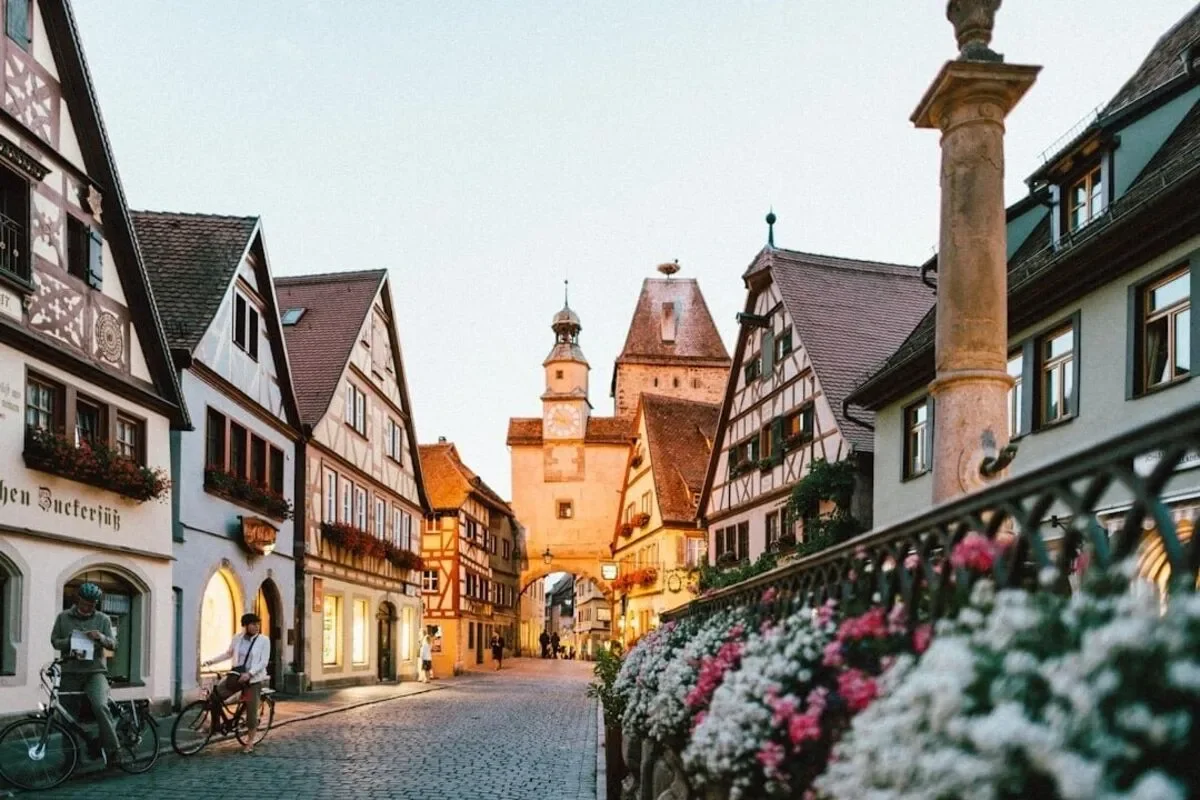
Stuttgart
The cradle of the automobile combines engineering excellence with cultural refinement in Germany's southwest.…

Baden-Württemberg is a federal state in southwest Germany, formed in 1952 when three postwar states voted to merge. It remains the only German state created by referendum, and that beginning still shapes how its regions look and sound today.
The state covers Germany’s southwestern corner, touching France, Switzerland, and Austria. Locals call it Ländle (little land), while abbreviations such as BaWü and BW appear everywhere from license plates to news broadcasts.
Travelers who understand the difference between historic Baden and Württemberg can read the whole region more clearly: the wine villages of the Upper Rhine, the Swabian towns along the Neckar, the Black Forest uplands, and the lake towns on the Bodensee each carry a separate past.
Deutschland’s third-largest state by area brings Mercedes-Benz factories, medieval university towns, spa resorts, and Germany’s oldest nature parks within a few hours’ drive of one another.
Baden-Württemberg sits in Germany’s southwest corner. France and Switzerland border it on the outside, while Bavaria, Hesse, and Rhineland-Palatinate lie along its inner borders.
Its landscapes run from the Rhine plain up through the Black Forest and the Swabian Jura to the shores of Lake Constance.
The Rhein (Rhine) forms the western border with France’s Alsace region and part of the southern border with Switzerland. Basel and Zürich sit within easy rail reach, and Vorarlberg in Austria lies across the eastern end of Lake Constance.
Two rivers define the interior. The Neckar River rises near the Black Forest and runs north through Stuttgart, Heilbronn, and Heidelberg before joining the Rhine at Mannheim.
The Donau (Danube) begins at Donaueschingen, where two headstreams meet. It then flows east toward Ulm and on into Bavaria.
The Schwarzwald (Black Forest) fills the southwest, rising to the Feldberg at 1,493 meters. Dense spruce woods, cuckoo-clock workshops, and long-distance trails give the range its character.
The Swabian Jura, or Schwäbische Alb, curves northeast from the Black Forest as a limestone plateau full of caves, castles, and steep escarpments. Hohenzollern Castle crowns one of its outlying hills.
The Bodensee (Lake Constance) marks the southern edge, shared with Switzerland and Austria. To the north, the Odenwald hills separate the state from Hesse, while the Allgäu region straddles the Bavarian border.
Baden-Württemberg uses three administrative layers below state level:
These names appear on regional transport maps and official signs, so recognizing them helps when reading timetables or local news.
Modern Baden-Württemberg combines three historic territories: Baden in the west, Württemberg in the center and east, and the small Prussian Hohenzollern lands in the south. Each arrived with its own dialect, religious history, and political tradition.
Rome held the region for roughly two centuries, defending it with the Limes, a fortified frontier line that cut across the state’s north and east. Stretches of wall, watchtower foundations, and forts survive as a UNESCO World Heritage site.
The Alemanni pushed the Romans out in the third century and gave the area its dialect base. Their territory later became the duchy of Swabia, and the Hohenstaufen dynasty rose from a castle hill near Göppingen to rule the Holy Roman Empire.
Swabian identity still runs strongest east of the Black Forest. West of it, Baden’s culture leans toward the Rhine and the Palatinate.
The Reformation split the southwest. Württemberg turned Lutheran under Duke Ulrich in the 1530s, while parts of Baden and the Breisgau region stayed Catholic under Habsburg influence.
Both territories gained land under Napoleon. Württemberg became a kingdom in 1806 and doubled in size, developing precision engineering, clockmaking, and textiles through the German Empire period.
World War I ended the monarchies in 1918. World War II left the region split between American and French occupation zones.
Three states existed in the southwest when West Germany, the Federal Republic of Germany, formed in 1949: Baden, Württemberg-Baden, and Württemberg-Hohenzollern. Voters approved a merger in a December 1951 referendum, with about 70 percent in favor.
The new state took effect on 25 April 1952. Tübingen, once the capital of Württemberg-Hohenzollern, handed political weight to Stuttgart, and the region’s castles passed into shared state stewardship.
Stuttgart leads as the capital and largest city, followed by Mannheim and Karlsruhe. Baden-Württemberg’s urban network spreads widely, with university towns, spa resorts, and lakefront towns each serving a different purpose for visitors.
Stuttgart sits in a bowl-shaped valley above the Neckar, ringed by vineyards that reach into city neighborhoods. The Staatsgalerie holds the state art collection, while the Stuttgart Ballet and opera house draw international audiences.
Südwestrundfunk, the regional public broadcaster, runs studios here. VfB Stuttgart plays in the Bundesliga at the MHPArena.
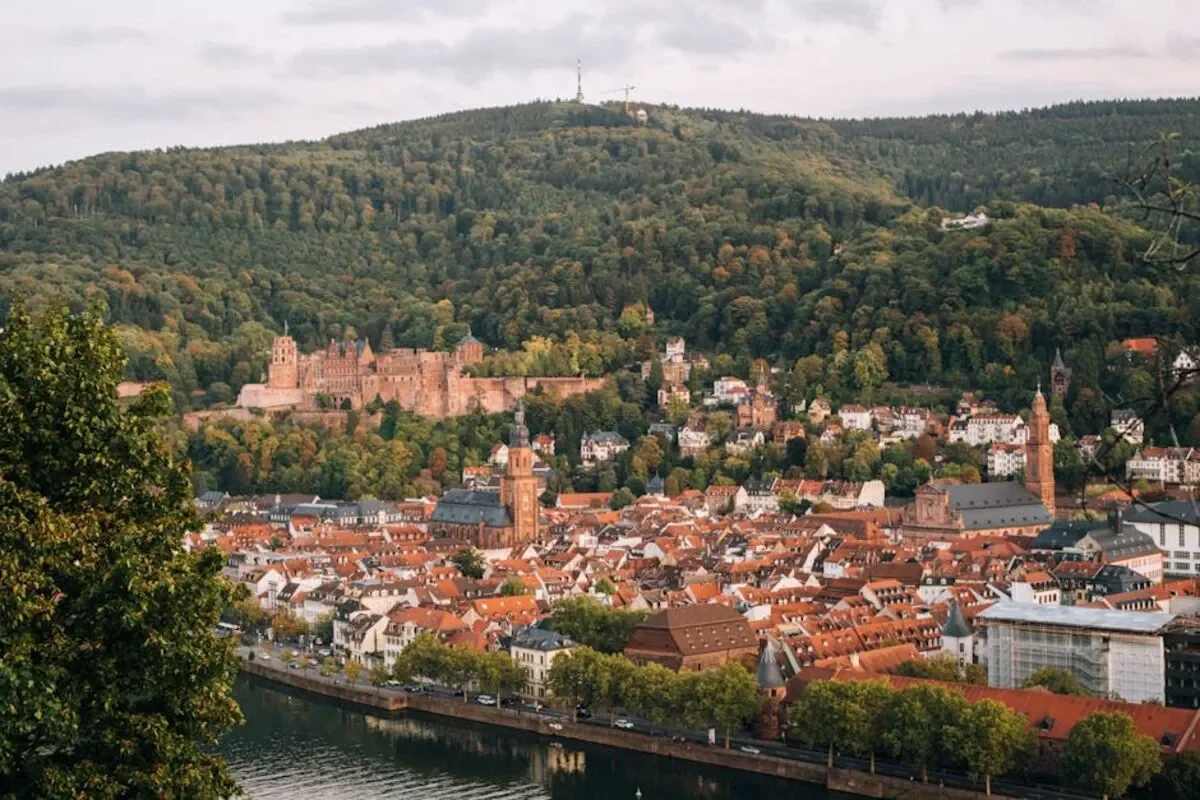
Heidelberg holds Germany’s oldest university, founded in 1386, and a red sandstone castle above the Neckar. Its Old Town fills with students and visitors year-round.
Mannheim uses a grid of numbered blocks instead of street names in its center, a layout dating to the 17th century. Karlsruhe fans out from its palace in a semicircle and hosts Germany’s Federal Constitutional Court.
Freiburg im Breisgau anchors the southern Black Forest with a Gothic minster and narrow water channels, called Bächle, running along its streets. It records some of Germany’s highest sunshine totals.
Baden-Baden built its reputation on thermal springs used since Roman times. Its casino, Festspielhaus concert hall, and Museum Frieder Burda serve a long-established spa clientele.
Tübingen keeps a medieval core along the Neckar, with punting boats and a university founded in 1477. Ulm’s minster carries the world’s tallest church steeple at 161.5 meters.
Heilbronn sits at the center of Württemberg wine country. Konstanz and Friedrichshafen face the Bodensee, with the latter known for Zeppelin history.
Pforzheim built its trade on jewelry and watches, while Reutlingen serves the Swabian Jura foothills. To the north, the Tauber valley leads toward the Romantic Road.
Automotive engineering drives Baden-Württemberg’s economy, supported by mechanical engineering, electrical engineering, and one of Europe’s densest research networks. Away from the factories, wine and food traditions shape daily life.
Mercedes-Benz traces its roots to Daimler’s work in Cannstatt and Carl Benz’s patent in Mannheim. Both museums in Stuttgart, the Mercedes-Benz Museum and the Porsche Museum, sit near the companies’ plants.
Robert Bosch GmbH, headquartered in Gerlingen near Stuttgart, supplies automotive and industrial components worldwide. SAP runs its global headquarters in Walldorf, north of Heidelberg.
Thousands of smaller suppliers form the backbone of this network, part of the wider Mittelstand business culture found across Germany.
Baden-Württemberg operates around 50 public universities and colleges. Heidelberg, Freiburg, Tübingen, Konstanz, and the Karlsruhe Institute of Technology carry the largest research budgets.
Research and development spending here ranks among the highest in the European Union as a share of economic output. Tübingen has built a biotechnology cluster around genomics and immunology work.
Vineyards cover slopes along the Neckar, the Tauber, the Kaiserstuhl, and the Upper Rhine. Baden grows mostly Spätburgunder (Pinot Noir) and Grauburgunder, while Württemberg favors Trollinger and Lemberger reds.
Swabian cooking centers on Spätzle (soft egg noodles), Maultaschen (filled pasta pockets), and Zwiebelrostbraten (roast beef with onions). Black Forest kitchens serve smoked ham and the layered Schwarzwälder Kirschtorte.
Tourism supports many of these traditions, from vineyard walks to village wine festivals held between August and October.
Baden-Württemberg has dense rail coverage, good autobahn links, and one international airport at Stuttgart. Most visitors reach the main cities by train and rent a car only for Black Forest villages or rural Jura routes.
Deutsche Bahn runs high-speed ICE services to Stuttgart, Mannheim, Karlsruhe, and Ulm. Regional trains connect smaller towns, though Black Forest branch lines run less frequently.
The Baden-Württemberg-Ticket covers one day of unlimited regional travel across the state for up to five people. The nationwide Deutschland-Ticket, a monthly subscription, covers all local and regional public transport.
Karlsruhe pioneered the tram-train model, where light rail vehicles run on both city tracks and mainline railways. That system now reaches deep into surrounding districts.
The A5, A8, and A81 autobahns form the main road spine. Scenic drives include the Schwarzwaldhochstraße (Black Forest High Road) and the southern extension of the German Wine Route.
Stuttgart Airport handles the state’s largest passenger volume. Frankfurt, Zürich, and Basel-Mulhouse airports offer alternatives, while Basel provides direct rail links into the southern Black Forest.
Crossing into France, Switzerland, or Austria is straightforward, though Switzerland lies outside the EU customs union and requires a vignette for motorway driving. Planning a trip to Germany around these crossings works best with a flexible rail pass.
May through September works well for hiking the Westweg and other long-distance Black Forest trails. German Wandern hiking culture supports a marked trail network, with huts and signposts throughout the region.
Lake Constance’s swimming season runs from June to early September, when water temperatures reach comfortable levels. Wine harvest festivals typically take place in September and October.
Winter brings cross-country skiing around the Feldberg and Christmas markets in Stuttgart, Heidelberg, and Ulm. Snow can close some higher Black Forest roads between December and March.
Baden-Württemberg occupies Germany’s southwest corner, bordered by France to the west and Switzerland to the south. Within Germany, it meets u003ca href=u0022https://www.everythingaboutgermany.de/regions/bavaria/u0022 target=u0022_blanku0022 rel=u0022noopeneru0022u003eBavariau003c/au003e to the east, Hesse to the north, and u003ca href=u0022https://www.everythingaboutgermany.de/regions/rhineland-palatinate/u0022 target=u0022_blanku0022 rel=u0022noopeneru0022u003eRhineland-Palatinateu003c/au003e to the northwest.
Stuttgart is the largest city and state capital, followed by Mannheim, Karlsruhe, Freiburg im Breisgau, and Heidelberg. Other major centers include Heilbronn, Ulm, Pforzheim, Reutlingen, Konstanz, and Tübingen.
Voters in Baden, Württemberg-Baden, and Württemberg-Hohenzollern approved a merger in a December 1951 referendum. The new state took effect on 25 April 1952. The goal was to replace occupation-zone borders with a single, workable state government for the southwest.
No. Baden-Württemberg and Bavaria are separate German states with different governments, laws, and cultural traditions. They share a long eastern border, and both sit near the Alps, which sometimes causes confusion abroad.
Deutsche Bahn regional trains connect every city named in this article. The Baden-Württemberg-Ticket covers a full day of travel for up to five people. Buses reach villages in the Black Forest and Swabian Jura, though service drops sharply on Sundays and public holidays.