Hohenzollern Castle
Local Insider Tips
- Photograph the castle from a distance first — the Zeller Horn or Raichberg viewpoints near Burg Hohenzollern deliver the classic misty-hilltop shot, particularly at dawn
- Weekday mornings see far fewer coach-tour crowds than weekends
- The on-site restaurant near the entrance gate serves solid Swabian fare, but better-value meals are found in Hechingen’s old town, a short drive away
- Bring a light jacket even in summer — wind on the exposed hilltop can be brisk
Nearby Excursions & Day Trips
Combine your visit with Hechingen’s understated old town and its former synagogue, one of the best-preserved in southern Germany. Bisingen offers access to the Zollernalb hiking trails and the Lochenstein viewpoint. History enthusiasts can extend the day toward Tübingen, a university town with a beautifully preserved medieval center just 30–40 minutes away, or the Sigmaringen Castle, another Hohenzollern seat perched above the Danube, roughly an hour’s drive south.
Best Time to Visit & Seasonal Events
Late spring through early autumn (May–September) offers the clearest views and full access to gardens and guided tours, though this is also peak crowd season — arrive before 10:30 AM to beat tour buses. Autumn brings dramatic fog rolling through the valley below, creating the castle’s famous “floating fortress” photographic effect, best captured from the Zeller Horn viewpoint at sunrise. Winter visits are quieter and atmospheric, especially around the Christmas markets held on select weekends in the castle courtyard, though some interior areas may have reduced hours.
Local Insider Tips
- Photograph the castle from a distance first — the Zeller Horn or Raichberg viewpoints near Burg Hohenzollern deliver the classic misty-hilltop shot, particularly at dawn
- Weekday mornings see far fewer coach-tour crowds than weekends
- The on-site restaurant near the entrance gate serves solid Swabian fare, but better-value meals are found in Hechingen’s old town, a short drive away
- Bring a light jacket even in summer — wind on the exposed hilltop can be brisk
Nearby Excursions & Day Trips
Combine your visit with Hechingen’s understated old town and its former synagogue, one of the best-preserved in southern Germany. Bisingen offers access to the Zollernalb hiking trails and the Lochenstein viewpoint. History enthusiasts can extend the day toward Tübingen, a university town with a beautifully preserved medieval center just 30–40 minutes away, or the Sigmaringen Castle, another Hohenzollern seat perched above the Danube, roughly an hour’s drive south.
How to Get There
The castle sits between the towns of Hechingen and Bisingen, roughly 50 km south of Stuttgart. By train, take a Deutsche Bahn regional service (RB) to Hechingen station, then continue by taxi (about 10 minutes) or on seasonal shuttle buses that run directly to the castle car park on weekends and holidays. Driving is the most flexible option: from Stuttgart, follow the B27 south toward Hechingen/Balingen, then follow signage for Burg Hohenzollern; the drive takes about 50–60 minutes. Ample parking is available at the base of the hill, from which visitors either walk uphill (roughly 20–25 minutes on a paved road) or take the shuttle bus to the upper gate.
Best Time to Visit & Seasonal Events
Late spring through early autumn (May–September) offers the clearest views and full access to gardens and guided tours, though this is also peak crowd season — arrive before 10:30 AM to beat tour buses. Autumn brings dramatic fog rolling through the valley below, creating the castle’s famous “floating fortress” photographic effect, best captured from the Zeller Horn viewpoint at sunrise. Winter visits are quieter and atmospheric, especially around the Christmas markets held on select weekends in the castle courtyard, though some interior areas may have reduced hours.
Local Insider Tips
- Photograph the castle from a distance first — the Zeller Horn or Raichberg viewpoints near Burg Hohenzollern deliver the classic misty-hilltop shot, particularly at dawn
- Weekday mornings see far fewer coach-tour crowds than weekends
- The on-site restaurant near the entrance gate serves solid Swabian fare, but better-value meals are found in Hechingen’s old town, a short drive away
- Bring a light jacket even in summer — wind on the exposed hilltop can be brisk
Nearby Excursions & Day Trips
Combine your visit with Hechingen’s understated old town and its former synagogue, one of the best-preserved in southern Germany. Bisingen offers access to the Zollernalb hiking trails and the Lochenstein viewpoint. History enthusiasts can extend the day toward Tübingen, a university town with a beautifully preserved medieval center just 30–40 minutes away, or the Sigmaringen Castle, another Hohenzollern seat perched above the Danube, roughly an hour’s drive south.
Practical Visitor Information
| Opening Hours | Daily, 10:00–17:30 (seasonal variations; shorter hours November–March, check official site for winter closures) |
| Entry Fee (Castle grounds + gardens) | Approx. €6–8 |
| Entry Fee (Grounds + Guided Interior Tour) | Approx. €12–16 |
| Parking | €6 per car at the base; shuttle bus (small fee) or 20-minute uphill walk to the castle |
| Website | burg-hohenzollern.com |
Interior visits are only possible via guided tour (available in German, with English tours running at set times, especially in peak season). Booking ahead online is strongly recommended in summer and around holidays, as tour slots fill quickly and walk-up visitors may face long waits. Comfortable shoes are essential — the walk from the car park to the castle entrance is steep.
How to Get There
The castle sits between the towns of Hechingen and Bisingen, roughly 50 km south of Stuttgart. By train, take a Deutsche Bahn regional service (RB) to Hechingen station, then continue by taxi (about 10 minutes) or on seasonal shuttle buses that run directly to the castle car park on weekends and holidays. Driving is the most flexible option: from Stuttgart, follow the B27 south toward Hechingen/Balingen, then follow signage for Burg Hohenzollern; the drive takes about 50–60 minutes. Ample parking is available at the base of the hill, from which visitors either walk uphill (roughly 20–25 minutes on a paved road) or take the shuttle bus to the upper gate.
Best Time to Visit & Seasonal Events
Late spring through early autumn (May–September) offers the clearest views and full access to gardens and guided tours, though this is also peak crowd season — arrive before 10:30 AM to beat tour buses. Autumn brings dramatic fog rolling through the valley below, creating the castle’s famous “floating fortress” photographic effect, best captured from the Zeller Horn viewpoint at sunrise. Winter visits are quieter and atmospheric, especially around the Christmas markets held on select weekends in the castle courtyard, though some interior areas may have reduced hours.
Local Insider Tips
- Photograph the castle from a distance first — the Zeller Horn or Raichberg viewpoints near Burg Hohenzollern deliver the classic misty-hilltop shot, particularly at dawn
- Weekday mornings see far fewer coach-tour crowds than weekends
- The on-site restaurant near the entrance gate serves solid Swabian fare, but better-value meals are found in Hechingen’s old town, a short drive away
- Bring a light jacket even in summer — wind on the exposed hilltop can be brisk
Nearby Excursions & Day Trips
Combine your visit with Hechingen’s understated old town and its former synagogue, one of the best-preserved in southern Germany. Bisingen offers access to the Zollernalb hiking trails and the Lochenstein viewpoint. History enthusiasts can extend the day toward Tübingen, a university town with a beautifully preserved medieval center just 30–40 minutes away, or the Sigmaringen Castle, another Hohenzollern seat perched above the Danube, roughly an hour’s drive south.
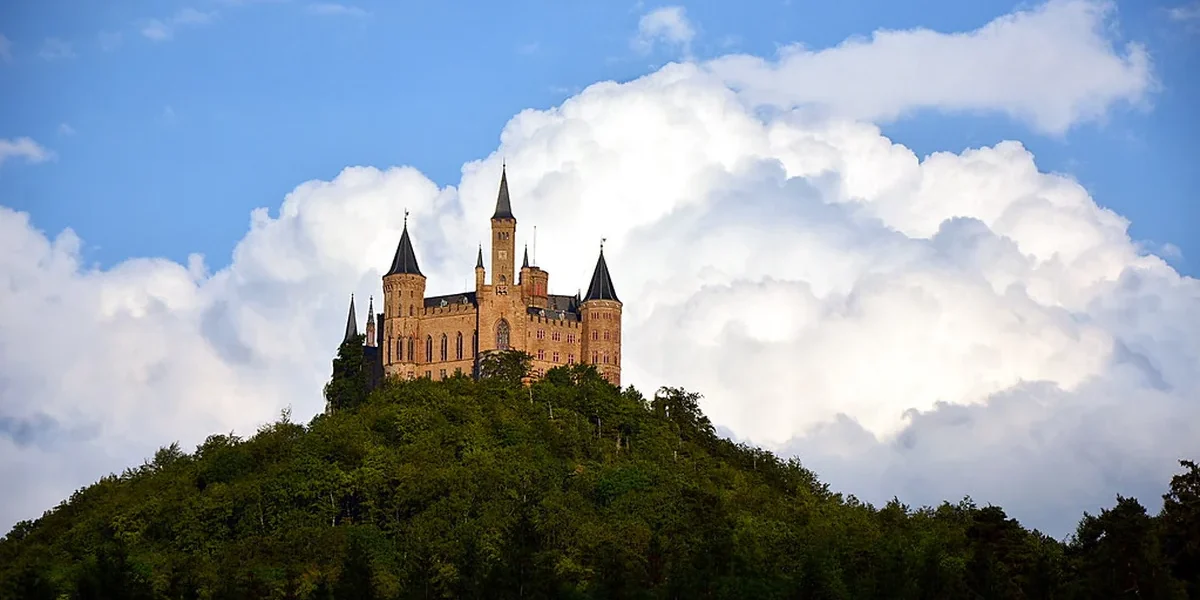
Few silhouettes in Europe are as instantly recognizable as Hohenzollern Castle, its turrets and spires piercing the mist above a solitary, conical hill on the edge of the Swabian Alps. This is not merely a picturesque fortress for postcards — it is the ancestral cradle of the House of Hohenzollern, the dynasty that produced Prussian kings and, ultimately, the German emperors who unified the nation in 1871. Perched roughly 855 meters above sea level near the town of Bisingen in Baden-Württemberg, the castle you see today is a 19th-century neo-Gothic reimagining, built atop the ruins of two earlier medieval strongholds dating back to the 11th century. Commissioned by Crown Prince Frederick William of Prussia (later King Frederick William IV) and completed in 1867, it was conceived as both a family monument and a romantic statement of dynastic continuity — a deliberate echo of Gothic Revival castles like Neuschwanstein, though older in symbolic weight.
The result is a fortress that feels equally at home in a fairy tale and a history lecture. Its commanding position, visible for miles across the rolling farmland of the Zollernalb, has made it one of Baden-Württemberg’s most photographed landmarks and a pilgrimage site for anyone tracing the roots of Prussian and German statehood.
Top Highlights & Architectural Wonders
The castle’s neo-Gothic exterior, with its spiked towers, crenellated walls, and steep bridge crossing a dramatic ravine, is only the beginning. Inside, the Treasure Chamber houses genuine royal regalia, including the Prussian Crown of 1889 and personal effects of Frederick the Great — a rare opportunity to see Prussian crown jewels up close, since most were dispersed or destroyed after 1918. The Family Tree Room traces eight centuries of Hohenzollern lineage in painted detail, while the Blue Salon and Count’s Hall showcase opulent period furnishings and portraiture that trace the family’s rise from medieval counts to German emperors.
- The Castle Church (Christuskirche), the burial site of several Hohenzollern family members
- The Eagle Gate and the winding approach road with panoramic viewpoints
- The Treasure Chamber’s Prussian Crown Jewels
- The Bastion Garden, offering sweeping views over the Swabian Alb
- The Chapel of St. Michael, incorporating remnants of the medieval original castle
Practical Visitor Information
| Opening Hours | Daily, 10:00–17:30 (seasonal variations; shorter hours November–March, check official site for winter closures) |
| Entry Fee (Castle grounds + gardens) | Approx. €6–8 |
| Entry Fee (Grounds + Guided Interior Tour) | Approx. €12–16 |
| Parking | €6 per car at the base; shuttle bus (small fee) or 20-minute uphill walk to the castle |
| Website | burg-hohenzollern.com |
Interior visits are only possible via guided tour (available in German, with English tours running at set times, especially in peak season). Booking ahead online is strongly recommended in summer and around holidays, as tour slots fill quickly and walk-up visitors may face long waits. Comfortable shoes are essential — the walk from the car park to the castle entrance is steep.
How to Get There
The castle sits between the towns of Hechingen and Bisingen, roughly 50 km south of Stuttgart. By train, take a Deutsche Bahn regional service (RB) to Hechingen station, then continue by taxi (about 10 minutes) or on seasonal shuttle buses that run directly to the castle car park on weekends and holidays. Driving is the most flexible option: from Stuttgart, follow the B27 south toward Hechingen/Balingen, then follow signage for Burg Hohenzollern; the drive takes about 50–60 minutes. Ample parking is available at the base of the hill, from which visitors either walk uphill (roughly 20–25 minutes on a paved road) or take the shuttle bus to the upper gate.
Best Time to Visit & Seasonal Events
Late spring through early autumn (May–September) offers the clearest views and full access to gardens and guided tours, though this is also peak crowd season — arrive before 10:30 AM to beat tour buses. Autumn brings dramatic fog rolling through the valley below, creating the castle’s famous “floating fortress” photographic effect, best captured from the Zeller Horn viewpoint at sunrise. Winter visits are quieter and atmospheric, especially around the Christmas markets held on select weekends in the castle courtyard, though some interior areas may have reduced hours.
Local Insider Tips
- Photograph the castle from a distance first — the Zeller Horn or Raichberg viewpoints near Burg Hohenzollern deliver the classic misty-hilltop shot, particularly at dawn
- Weekday mornings see far fewer coach-tour crowds than weekends
- The on-site restaurant near the entrance gate serves solid Swabian fare, but better-value meals are found in Hechingen’s old town, a short drive away
- Bring a light jacket even in summer — wind on the exposed hilltop can be brisk
Nearby Excursions & Day Trips
Combine your visit with Hechingen’s understated old town and its former synagogue, one of the best-preserved in southern Germany. Bisingen offers access to the Zollernalb hiking trails and the Lochenstein viewpoint. History enthusiasts can extend the day toward Tübingen, a university town with a beautifully preserved medieval center just 30–40 minutes away, or the Sigmaringen Castle, another Hohenzollern seat perched above the Danube, roughly an hour’s drive south.
💡 Visitor Tips & Best Experience
Book guided interior tours online in advance during summer; arrive before 10:30 AM to avoid tour groups; best photo views from Zeller Horn and Raichberg viewpoints at sunrise, especially in autumn fog.
🚆 How to Get There & Public Transit
DB regional train to Hechingen, then taxi or seasonal shuttle bus; by car via B27 south of Stuttgart (approx. 50–60 minutes), parking €6 at hill base
🎟️ Popular Tours & Tickets for Hohenzollern Castle
Compare tickets and guided experiences. Check available dates, what is included, and the provider's cancellation terms before booking.