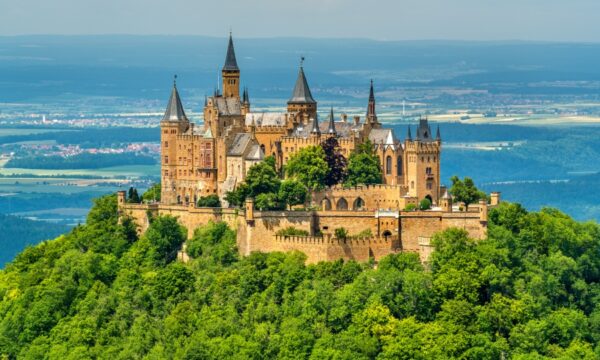
Hohenzollern Castle
Hohenzollern Castle is a powerful symbol of Prussian history and dynastic power. This commanding…
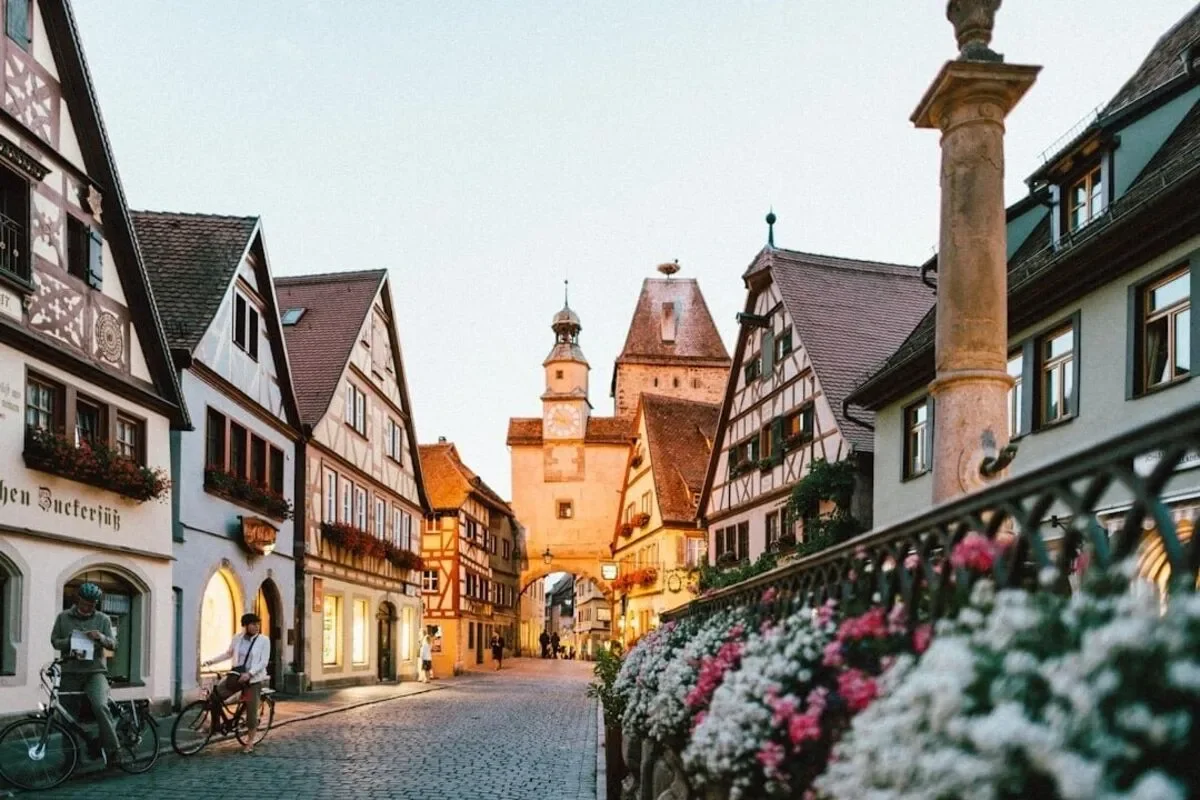
Stuttgart is the capital of Baden-Württemberg, a city of about 615,000 people built into a steep bowl of hills. Vineyards run down the slopes almost to the downtown streets. The city sits near the Neckar River, holds the Mercedes-Benz and Porsche museums, and anchors a metropolitan area of roughly 2.8 million known as Region Stuttgart.
Locals call that bowl the Stuttgarter Kessel, the “Stuttgart cauldron.” The name explains a lot about how a visit works here. The city center sits low, while parks, viewpoints, and old wine villages spread across the surrounding slopes, reached by stairways, cogwheel trains, and hillside funiculars.
A well-planned two days in Stuttgart covers the palace square, one of the two great car museums, a hilltop view, and a Swabian wine tavern. All of them sit within a compact transit network that rarely takes more than 20 minutes to cross.
Automotive history is the city’s global signature, and it earns that reputation. But the Staatsgalerie holds a first-rate art collection, the Weissenhof Estate changed how the world builds houses, and Bad Cannstatt sits on Europe’s second-largest mineral water reserves.
Start at Schlossplatz, the large open square at the center of Stuttgart-Mitte, because nearly every other central sight sits within a 15-minute walk. From there, the city fans out into shopping streets, two palaces, three major museums, and a hillside housing estate that reshaped modern architecture.
Schlossplatz is Stuttgart’s main civic space, framed on one side by the Neues Schloss (New Palace), an 18th-century Baroque building now used by the state government. The interior is closed to general visitors, so the draw is the facade and the lawns in front of it.
Königstraße runs north from the square toward Stuttgart Hauptbahnhof. At roughly 1.2 kilometers, it’s one of Germany’s longest pedestrian shopping streets, lined with department stores, cafés, and street performers.
The Altes Schloss (Old Castle) sits directly beside Schlossplatz and looks nothing like its neighbor. Its Renaissance courtyard, arcades, and moat date from the 16th century. It houses the Württemberg State Museum, which covers regional history from prehistory through the royal House of Württemberg.
A short walk southeast leads to the Bohnenviertel, the “bean quarter,” named for the beans grown by poorer residents who once lived here. The narrow streets now hold small wine bars, antique dealers, and workshops. The scale feels noticeably lower than the rest of Stuttgart-Mitte.
The Staatsgalerie Stuttgart is the city’s most significant art museum, strong in Swabian medieval painting, 19th-century German work, and 20th-century modernism. Its 1984 postmodern extension by James Stirling is a landmark in its own right, with bright green window frames and pink handrails that once startled critics.
Kunstmuseum Stuttgart takes a different approach: a glass cube on Schlossplatz holding contemporary art, with a rooftop restaurant that gives free views over the square. Its Otto Dix holdings are among the largest anywhere.
The Weissenhof Estate on the northern slopes is a 1927 experiment in modern housing, built for an exhibition by 17 architects, including Le Corbusier, Ludwig Mies van der Rohe, and Hans Scharoun. Eleven of the original buildings survive.
Two Le Corbusier houses are UNESCO World Heritage listed and now hold the Weissenhofmuseum. The museum explains what the architects were arguing about: flat roofs, open floor plans, and mass-produced housing.
Reach it by bus from Killesberg or by walking uphill from the city center. Admission is included with the StuttCard.
Stuttgart is where the automobile was invented twice over. Gottlieb Daimler, born in nearby Schorndorf in 1834, and Karl Benz both developed working petrol engines in this corner of Baden-Württemberg in the 1880s. Their companies later merged into Mercedes-Benz, while Porsche, Bosch, and hundreds of suppliers followed.
The Mercedes-Benz Museum in Neckarpark tells the story chronologically across nine levels. Visitors ride an elevator to the top, then spiral down through roughly 130 years of vehicles, starting with the 1886 Benz Patent-Motorwagen.
The building itself, a double-helix design opened in 2006, is part of the appeal. Plan two to three hours.
The Porsche Museum stands in Zuffenhausen, next to the factory where 911s are still built. Its collection is smaller and more focused than the Mercedes museum, with an emphasis on racing cars and the evolution of a single sports car line.
The sharp white concrete structure opened in 2009. Anyone curious about the engineer behind the marque can read more about Ferdinand Porsche and his role in early German motoring.
Beyond the two brand museums, Motorworld Region Stuttgart in Böblingen occupies a former airport building. It combines classic car dealers, workshops, and exhibition space.
Entry to the halls is free, which makes it a low-commitment stop for enthusiasts. Bosch, founded in Stuttgart in 1886, supplies the less visible half of the story: ignition systems, fuel injection, and sensors.
Readers interested in how this engineering culture shaped German driving habits will find context in the site’s autobahn culture coverage.
Stuttgart’s green spaces form a continuous Green U, a park corridor that curves for about eight kilometers from the city center to the Neckar. Add the hillside viewpoints and the mineral baths of Bad Cannstatt, and the outdoor side of a Stuttgart visit can fill a full day.
The Schlossgarten starts behind the Neues Schloss and runs northeast as a long strip of lawns, ponds, and old plane trees toward the Neckar. It connects to Rosensteinpark, an English-style landscape park around Schloss Rosenstein, which houses one of the two state natural history museums.
Killesberg Park sits on the northern heights, laid out for a 1939 garden show on a former quarry. The 42-meter Killesbergturm, a steel-cable observation tower opened in 2001, gives views across the basin. Climbing it is free.
The Fernsehturm Stuttgart in Degerloch was the world’s first television tower built from reinforced concrete. Completed in 1956, it rises 217 meters, putting the observation platform well above the surrounding ridges. Admission is charged and included with the StuttCard.
Free alternatives sit closer to the center. Karlshöhe is a small hill in Stuttgart-Süd with a beer garden and a wide view over the rooftops.
Connecting all of this are the Stäffele, the city’s public stairways. Around 400 of them, totaling roughly 20 kilometers, were built to serve the vineyard slopes. Today, they function as ordinary footpaths.
Wilhelma is a combined zoo and botanical garden on the site of a Moorish-revival royal bathhouse. It’s one of the few institutions in Europe to offer both functions on one ticket.
It sits at the northern end of the Green U in Bad Cannstatt. Nearby, 19 wells produce around 44 million litres of mineral water a day, the second-largest such reserves in Europe after Budapest.
Thirteen are state-recognized healing springs. Three municipal baths draw on them:
| Bath | Character |
|---|---|
| DAS LEUZE | Largest and most modern, indoor and outdoor pools |
| Mineralbad Berg | Nostalgic, minimal design, popular cold outdoor pool |
| SoleBad Cannstatt | Saltwater focus, quieter, beside the Kurpark |
For a wider look at German bathing traditions, the Baden-Baden thermal spas guide covers the state’s most famous spa town.
Stuttgart is one of very few large European cities with commercial vineyards within its boundaries. They mainly grow Trollinger (a light local red) and Riesling, on terraced slopes that rise directly above Bad Cannstatt, Untertürkheim, and Stuttgart-West.
Growers run seasonal taverns called Besenwirtschaften, literally “broom taverns.” The name comes from the broom hung outside to show that a tavern is open. They serve only their own wine and a short menu of cold Swabian food, usually for a few weeks at a time.
In Stuttgart-West, the Feuersee is a small lake with the neo-Gothic Johanneskirche on a spit of land at its center. Its tower has remained unrestored since bomb damage in 1944.
Stuttgart works well without a car. The VVS regional transit authority runs S-Bahn, U-Bahn, bus, and cogwheel services under one ticketing system. The airport connects to the main station by S-Bahn in about 27 minutes.
Stuttgart Airport (STR) sits on the plateau south of the city, next to the trade fair grounds. The S2 and S3 lines run from the terminal to Stuttgart Hauptbahnhof, the central station.
Long-distance trains connect Stuttgart with Munich, Frankfurt, and Paris. Travelers flying transatlantic often land at Frankfurt Airport instead and take a direct ICE train, which takes roughly 75 to 90 minutes.
Stuttgart’s U-Bahn is a Stadtbahn: light rail that runs underground downtown and on the surface in outer districts. The S-Bahn handles longer regional journeys to Ludwigsburg, Esslingen, and the airport.
The Zahnradbahn, nicknamed the Zacke, is a cogwheel railway that climbs from Marienplatz in Stuttgart-Süd to Degerloch. It runs on a normal VVS ticket and is the only cogwheel line in Germany integrated into an urban network.
A single-zone ticket covers most central journeys. Day tickets cover the whole city area and are worth buying if you plan to make three or more trips.
The StuttCard makes sense for visitors planning to see two or more paid museums in one day. It comes in 24-, 48-, and 72-hour versions, in a basic form and a StuttCard PLUS that includes unlimited VVS travel.
Covered sites include the Mercedes-Benz Museum, the Porsche Museum, Wilhelma, the Staatsgalerie, the Fernsehturm, and the Weissenhof Estate. Anyone visiting only one car museum and otherwise walking will spend less by buying tickets separately. Stuttgart-Marketing publishes the current prices.
The area around the Hauptbahnhof and Königstraße puts almost everything in this guide within easy reach.
| Hotel | Position |
|---|---|
| Steigenberger Graf Zeppelin | Directly opposite the Hauptbahnhof |
| Le Méridien Stuttgart | Beside the Schlossgarten, near the station |
| Motel One Stuttgart-Hauptbahnhof | Budget option, city center |
Marienplatz in Stuttgart-Süd suits visitors who want a residential feel, with the Zacke terminus and a lively square lined with cafés. For broader trip logistics, see the site’s guide to planning a trip to Germany.
Swabian cooking is flour-based, hearty, and distinct to this corner of Germany. It centers on handmade noodles and filled pasta. Stuttgart’s festival calendar revolves around two large fairground events, the spring Frühlingsfest and the autumn Cannstatter Wasen.
Maultaschen are large pasta pockets filled with minced meat, spinach, and breadcrumbs. Cooks serve them either in broth or pan-fried with onions. One local nickname is Herrgottsbscheißerle, “little God-cheaters,” based on a story about hiding meat inside dough during Lent.
Spätzle are irregular egg noodles, scraped by hand from a board into boiling water. Käsespätzle layers them with grated cheese and fried onions.
Zwiebelrostbraten is the classic main course: a pan-fried beef steak beneath a pile of crisp fried onions, with Spätzle and gravy alongside. Traditional houses such as Gasthaus zur Linde in Möhringen serve all three.
The Markthalle on Dorotheenstraße is an Art Nouveau hall from 1914. Around 40 stalls sell cheese, spices, produce, and prepared Swabian food, and a café operates inside. It closes on Sundays.
A Besenwirtschaft operates for limited weeks each year and posts its dates locally, so check before setting out. Table sharing is normal in traditional taverns, and a brief “Guten Appetit” to neighbors is standard practice. Wine comes by the quarter-litre glass, called a Viertele.
The Cannstatter Wasen takes place on the Wasen meadow in Bad Cannstatt in late September and early October. It is Germany’s second-largest beer festival after Oktoberfest, with large tents and a fruit-column centerpiece. Details on dates and tents appear in the Cannstatter Volksfest guide.
Frühlingsfest uses the same grounds in April and May, but on a smaller scale. In August, the Stuttgart Summer Festival takes over Schlossplatz and the Eckensee area with open-air music and food stands, and entry is free. Christmas markets fill Schlossplatz and the Markt through Advent; the German Christmas market guide explains what to expect.
Stuttgart Ballet, based at the Staatsoper Stuttgart, has an international reputation dating back to the John Cranko era. Tickets for the opera and ballet often sell out well in advance.
Nightlife centers on Theodor-Heuss-Straße, a strip of bars and clubs in the center that fills on weekend evenings. The Wagenhallen, a converted railway depot in the north of the city, hosts concerts, art studios, and events with a rougher industrial feel. For the outdoor drinking culture that carries over from Bavaria, see the notes on beer gardens.
Ludwigsburg and Esslingen are the two strongest half-day options, both reachable by S-Bahn in 15 to 25 minutes. Tübingen, the Black Forest, and the Schwäbische Alb need a full day.
Ludwigsburg Palace is one of the largest Baroque palaces in Europe to survive unaltered, with 452 rooms across 18 buildings. The surrounding Blühendes Barock gardens include a fairytale garden aimed at children.
Trains run from Stuttgart Hauptbahnhof to Ludwigsburg in about 12 minutes on the S4 and S5 lines. Closer to the city, Solitude Palace is a smaller rococo hunting lodge on a ridge west of Stuttgart. A 13-kilometer straight avenue links it to Ludwigsburg.
Esslingen am Neckar is a 15-minute S-Bahn ride away and has a well-preserved medieval core, with half-timbered houses, a hilltop castle wall, and one of Germany’s oldest sparkling wine cellars. Its medieval Christmas market is among the largest of its kind.
Tübingen sits about an hour south by regional train. The university town rises above the Neckar, with punt boats on the river and steep lanes around the Stiftskirche.
The Schwäbische Alb is a limestone plateau southeast of Stuttgart, known for caves, hilltop castles, and the Blautopf spring. Lichtenstein Castle sits about an hour away by car.
The northern Black Forest begins roughly 90 minutes west. Day-trip anchors include the Triberg waterfalls and the walking trails inside Black Forest National Park. Public transport works for the main towns, but the smaller valleys need a car.
Heidelberg is about 40 minutes from Stuttgart by ICE, making Heidelberg Castle an easy day out. Regional trains take longer but cost less.
Frankfurt is 75 to 90 minutes away by ICE. Stuttgart also has direct or near-direct services toward Strasbourg in France and Zurich in Switzerland, both under four hours. That makes the Stuttgart region a workable base for a wider southwest itinerary. Book ICE tickets in advance through Deutsche Bahn for lower Sparpreis fares.
Stuttgart is worth visiting for travelers interested in automotive history, modern architecture, art, or German wine culture. It draws fewer international tourists than Munich or Berlin, so central sights feel less crowded. Visitors looking mainly for a medieval old town will find more of that in nearby Esslingen or Tübingen.
Two full days cover the city center, one car museum, a hilltop viewpoint, and a wine tavern. A third day lets you visit both car museums or take a day trip to Ludwigsburg.
Travelers using Stuttgart as a base for Baden-Württemberg can easily justify four or five nights.
Stuttgart’s city center is highly walkable, with Schlossplatz, both palaces, the Staatsgalerie, and Königstraße all within a compact area. The surrounding hills are steep, though, and reaching Killesberg, Degerloch, or the vineyard slopes involves long stairways or public transit.
The Stäffele stairways make good walking routes if you’re comfortable with sustained climbs.
Stuttgart is best known as the home of Mercedes-Benz and Porsche. Both companies were founded here and operate museums in the city.
Stuttgart is also the capital of Baden-Württemberg, a wine-growing city with vineyards within its limits, and home to the Stuttgart Ballet and the Cannstatter Wasen festival.
Schlossplatz, the Schlossgarten, Killesberg Park, and the Killesbergturm observation tower are all free to visit. So are the Motorworld Region Stuttgart halls, the Karlshöhe viewpoint, and all 400 or so Stäffele stairways. In August, you can also enter the Stuttgart Summer Festival on Schlossplatz for free.
Explore the historic Old Town (Altstadt) on foot and use the local S-Bahn/U-Bahn network.
Purchase a 24-hour transit day pass (Tageskarte) for unlimited city travel.
Discover curated walking tours, museum passes, and authentic experiences in Stuttgart with instant confirmation.