Triberg Waterfalls

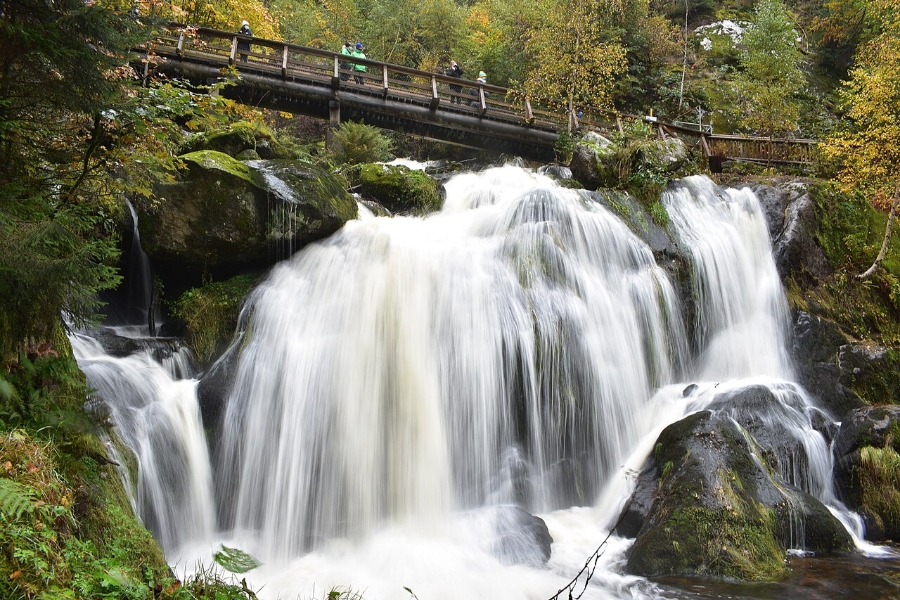
The Triberg Waterfalls (Triberger Wasserfälle) are the tallest waterfalls in Germany, sending the Gutach River tumbling 163 meters down a granite staircase carved into the heart of the Black Forest. Spread across seven distinct cascades, the falls drop through a dense canopy of spruce and beech, filling the surrounding gorge with a constant cool mist and a roar that’s audible well before you reach the entrance gate. For more than a century, this has been one of the most-visited natural attractions in southwestern Germany, and it remains the anchor of any Black Forest itinerary.
Triberg itself grew up around this natural spectacle and the cuckoo-clock trade that made the region famous. The town sits in the Gutach valley, roughly midway between Freiburg and Villingen-Schwenningen, and the waterfalls lie just a short walk from the town center, threaded through a network of well-graded forest paths that Romantic-era travelers were already praising in the 19th century. Goethe is said to have visited; the falls were officially opened to organized tourism in 1830, making this one of Germany’s oldest managed nature attractions.
Highlights of the Falls

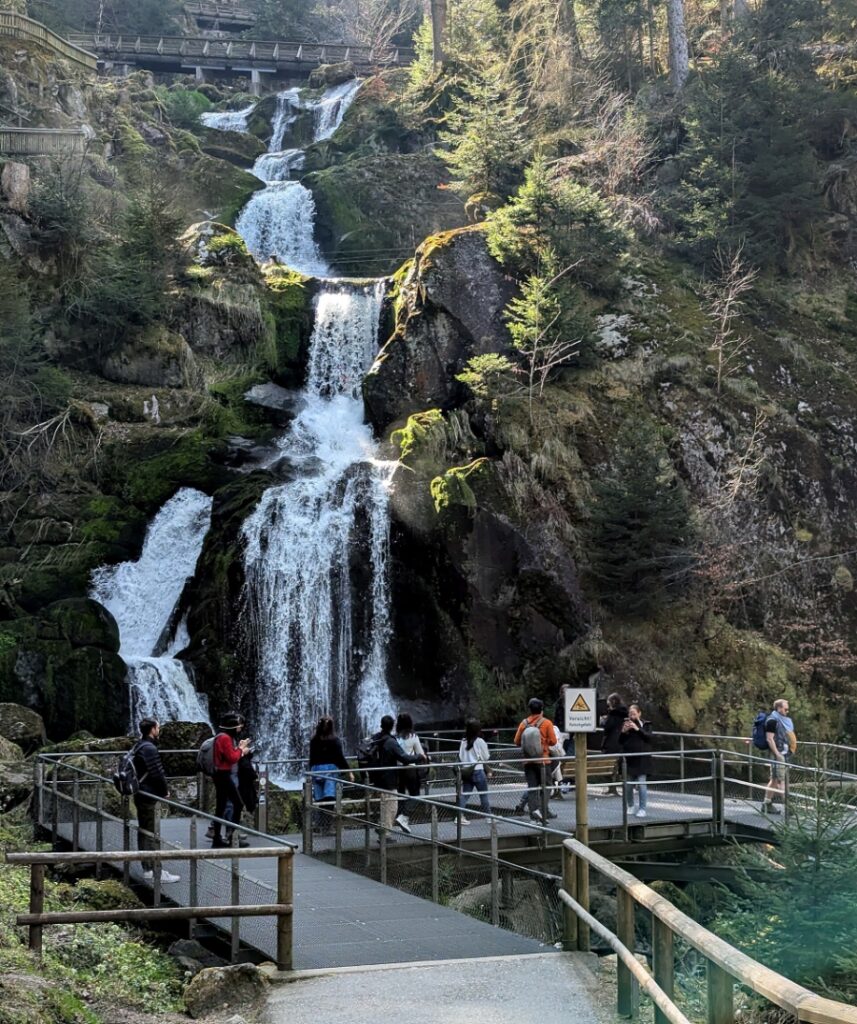
The main trail climbs alongside the cascades via stone steps, wooden bridges, and viewing platforms, giving you constantly changing perspectives on the water as it splits, pools, and drops again. Several highlights stand out:
- The lower viewing bridge, where you get the classic postcard shot of the falls framed by fir trees
- The middle cascades, the steepest and most dramatic section, especially powerful after snowmelt in spring
- The upper plateau near the top entrance, a quieter spot with fewer crowds and good picnic benches
- Resident red squirrels along the lower path, famously bold and used to visitors offering nuts — a favorite with kids
- Illuminated evening visits in summer, when spotlights are trained on the cascades after dusk (seasonal, check current schedule)
Practical Visitor Information
The falls have two main entrances — one near the town center (Hauptstraße) and one higher up near the Wallfahrtskirche pilgrimage church — so you can walk up one side and down the other for a varied loop of about 1.5 to 2 hours at an easy pace.
| Category | Details |
|---|---|
| Opening Hours | Daily, 9:00 AM – 7:00 PM (shorter hours Nov–Mar, weather dependent) |
| Entry Fee | Adults €6; reduced rates for children, students, and families; free for children under 6 |
| Address | Hauptstraße 85, 78098 Triberg, Germany |
| Duration | 1–2 hours for the full loop trail |
| Website | triberg.de |
Tickets are sold at machines and small kiosks at both entrances — no advance booking is required or available, and the modest entry fee goes toward maintaining the paths and safety railings. Sturdy shoes are worth packing since the stone steps get slippery with constant spray, especially in the cooler months.
How to Get There

Triberg sits directly on the Schwarzwaldbahn (Black Forest Railway), one of Germany’s most scenic rail lines, connecting Karlsruhe/Offenburg to Villingen-Schwenningen and Konstanz via DB Regio trains. Triberg’s station is a level, well-signed 10-minute walk from the lower waterfall entrance.
- By train: Direct regional trains from Offenburg (about 1 hour) or Villingen-Schwenningen (about 30 minutes); Offenburg connects to the ICE network from Frankfurt, Basel, and Karlsruhe
- By car: Via the B33, roughly 50 minutes from Freiburg and about 1.5 hours from Stuttgart; several paid parking lots (€3–5/day) are located near both entrances
- By bus: Regional buses link Triberg with surrounding Black Forest villages, useful if you’re basing yourself in Titisee or Furtwangen
Best Time to Visit

Late spring (May–June) brings the most dramatic water volume from snowmelt, while autumn (late September–October) pairs the cascades with vivid foliage color — arguably the most photogenic combination. Midsummer weekends draw the heaviest coach-tour crowds, so aim for a weekday morning before 10 AM if you want the paths to yourself. Winter visits are possible and atmospheric, with partially frozen cascades, though icy steps demand caution and some upper sections may close after heavy snow.
Insider Tips
- Enter from the upper (church-side) entrance and walk downhill — it’s easier on the knees and lets you finish near the town’s cafés
- Visit right at opening time to beat the tour buses that typically arrive from 10:30 AM onward
- Combine your visit with Triberg’s Black Forest Museum or one of the town’s cuckoo-clock workshops, both a short stroll from the falls
- Try a slice of authentic Black Forest cake (Schwarzwälder Kirschtorte) at a café near Hauptstraße — Triberg claims to be its birthplace
- Bring a light rain jacket even on sunny days; spray from the middle cascades reaches the path
Nearby Excursions

Triberg makes an excellent base for exploring the central Black Forest. The Schwarzwälder Freilichtmuseum Vogtsbauernhof, an open-air museum of historic farmhouses, is about 20 minutes away by car. Furtwangen’s German Clock Museum offers deeper context on the region’s clockmaking heritage. For more nature, the Gutach valley trail network extends toward Schonach, and Lake Titisee is roughly 45 minutes south for a classic Black Forest lake day trip.
💡 Visitor Tips & Best Experience
Visit at opening time to avoid tour buses, enter from the upper church-side gate and walk downhill, and pair the visit with Black Forest cake near Hauptstraße
🚆 How to Get There & Public Transit
Reachable via DB Regio trains on the Schwarzwaldbahn line (Offenburg–Villingen-Schwenningen–Konstanz), a 10-minute walk from Triberg station; by car via the B33; paid parking near both entrances
🎟️ Popular Tours & Tickets for Triberg Waterfalls
Compare tickets and guided experiences. Check available dates, what is included, and the provider's cancellation terms before booking.