Heidelberg Castle
Heidelberg Castle is one of the most important Renaissance structures north of the Alps.…
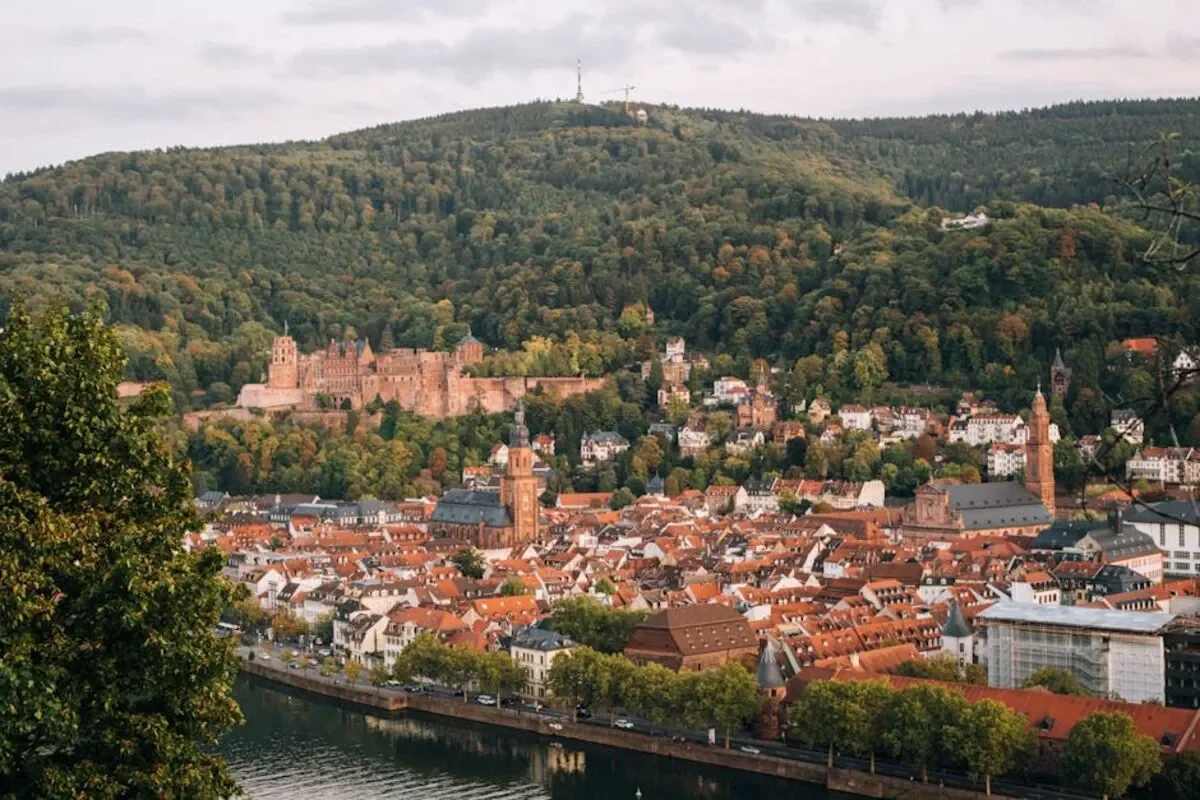
Heidelberg sits on the Neckar River in Baden-Württemberg, in southwest Germany. A red sandstone castle ruin looks down on the compact Altstadt (old town) and a university founded in 1386.
That university, Germany’s oldest, still sets the city’s rhythm. Roughly one in five residents is a student, and lecture halls, laboratories, and student pubs share the narrow streets with tour groups.
Most travelers can see the essentials in one full day, while two days allow time for the castle, Old Bridge, Philosophenweg, and a river cruise without rushing. The city is small enough to cross on foot in about 30 minutes, so the main planning question is the route’s order, not the distance.
Heidelberg also rewards a little historical context. The castle was wrecked in the 17th century and never rebuilt. That ruined state drew German Romantic poets and painters, along with Mark Twain, who devoted a long stretch of A Tramp Abroad to the town in 1878.
A single day works if you go uphill first and downhill later: Heidelberg Castle in the morning, the Altstadt at midday, and the Alte Brücke (Old Bridge) in the afternoon. A second day adds the Philosophenweg on the north bank, a Neckar River cruise, and slower visits to the museums and squares.
Start at Heidelberg Castle before 10:00, before the tour buses begin arriving. Take the Bergbahn funicular from Kornmarkt or walk up Burgweg, a steep 10 to 15 minute climb.
Allow 90 minutes to two hours inside the grounds, including time on the terrace for the view over the rooftops.
Come down to Kornmarkt, then walk two minutes to Marktplatz for lunch. Spend the early afternoon on Hauptstraße, one of Europe’s longer pedestrian shopping streets, and inside the Church of the Holy Spirit.
Finish on the Old Bridge in the late afternoon, when the light hits the castle face. Cross to the north bank for the classic view back toward the Altstadt.
Day one follows the route above at a slower pace. Add time for the German Pharmacy Museum inside the castle and a stop at the Kurpfälzisches Museum on Hauptstraße.
Day two belongs to the river and the hills:
Light direction decides which view works best. The castle faces roughly north over the river, so it photographs well from the Old Bridge and the Philosophenweg in the afternoon and at sunset.
Morning suits the reverse view. From the castle terrace, the Altstadt and Neckar Valley sit in clear light, with fewer visitors on the ramparts.
Weekday mornings outside July and August are the quietest hours at the castle. Summer weekends and Christmas market weeks bring the heaviest crowds to Marktplatz and Hauptstraße.
Four sites carry most of Heidelberg’s history: the castle ruins above the town, the Old Bridge across the Neckar, the Altstadt squares with the Church of the Holy Spirit, and the museums holding the region’s Palatinate collections. Each records a different chapter, from Renaissance court life to the wars that destroyed it.
Heidelberger Schloss began as a fortress in the 13th century and grew into a Renaissance palace for the Electors Palatine. French troops burned it during the Nine Years’ War in 1689 and 1693, and a lightning strike in 1764 ended plans to rebuild it.
The ruin has stood open to the weather ever since. Two things inside deserve the time:
The Bergbahn funicular links Kornmarkt to the castle and continues to Molkenkur and Königstuhl. Ticket prices and running times change seasonally, so check the current schedule before setting out.
The Karl Theodor Bridge, known to everyone as the Alte Brücke, dates from 1788 and replaced a series of wooden and stone crossings washed out by floods. German troops blew up two arches in March 1945, and the town rebuilt them by 1947.
At the Altstadt end stands a bronze monkey holding a mirror. Installed in 1979 after a medieval original, it warned travelers crossing the bridge to look back and remember that no one is above anyone else.
Local custom holds that touching the mirror brings wealth, while touching the outstretched fingers brings a return to Heidelberg. The bronze is polished smooth from decades of hands.
Marktplatz is the civic center, framed by the 18th-century town hall and the Heiliggeistkirche (Church of the Holy Spirit), begun in 1398. The church once housed the Bibliotheca Palatina, a celebrated manuscript library seized in 1622 and largely moved to the Vatican.
Across the square stands Hotel zum Ritter, built in 1592. It’s the only Renaissance house in the Altstadt to survive the French destruction.
Kornmarkt, one block south, holds a baroque Madonna column from 1718 and the lower funicular station. Hauptstraße runs about 1.6 kilometers through the old town and links both squares to Bismarckplatz.
The Kurpfälzisches Museum, in an 18th-century palace on Hauptstraße, holds Palatinate art and archaeology, including a cast of the Homo heidelbergensis jawbone.
Heidelberg University has operated since 1386, and its buildings, customs, and scholars are woven into the Altstadt rather than set apart on a separate campus. The result is a city where a 16th-century lecture hall, a 19th-century student jail, and a modern research quarter all belong to the same institution.
Ruprecht Karl University of Heidelberg, or Universität Heidelberg, was founded by Elector Ruprecht I in 1386. That makes it the oldest university in modern Germany and the third founded in the Holy Roman Empire.
The Old University building on Universitätsplatz dates from 1712 to 1735. It now holds the University Museum and the Alte Aula, a ceremonial hall redecorated for the 1886 anniversary.
The university’s medical and science faculties sit northwest of the Altstadt in Neuenheimer Feld, while administration and social sciences spread through Bergheim. Roughly 30,000 students attend, and about one in five comes from outside Germany.
Universitätsplatz is the open square between the Old and New University buildings, built over the site of an Augustinian monastery where Martin Luther defended his theses in 1518.
Behind the Old University sits the Studentenkarzer, the student prison used from 1778 to 1914. The university had its own jurisdiction over students, and offenses such as dueling, drunkenness, or insulting a professor earned sentences from a few days to four weeks.
Prisoners carved names, silhouettes, and complaints into the wooden walls and doors. Those inscriptions survive and remain visible on visits, entered through the same courtyard as the University Museum.
The ruined castle turned Heidelberg into a center of German Romanticism after 1800, when writers such as Clemens Brentano and Achim von Arnim collected folk poetry in the town. Goethe visited repeatedly and drew the castle grounds.
Mark Twain stayed three months in 1878 and gave Heidelberg several chapters of A Tramp Abroad, describing the castle, the student dueling clubs, and a raft trip down the Neckar. His account fixed the city in the American imagination.
Heidelberg came through World War II with almost no bomb damage, which is why the Altstadt street plan and its Baroque houses remain intact. The Old Bridge arches were the notable loss.
The north bank of the Neckar holds the views because the castle and Altstadt face that direction. The Philosophenweg gives the panorama, the Heiligenberg above it holds Celtic and Nazi-era remains, and Königstuhl on the south side looks out over the whole Neckar Valley.
The Philosophenweg (Philosopher’s Walk) runs along the south slope of the Heiligenberg, opposite the castle. University professors once walked it, and the name has stuck since the 19th century.
The standard approach is the Schlangenweg (Snake Path), a stepped lane that climbs from the north end of the Old Bridge. It rises about 100 meters in roughly 15 minutes of steady steps.
The path is paved and lined with a small terraced garden where figs, lemons, and Japanese cherries grow in the warm microclimate. Allow 60 to 90 minutes for the full loop up, along, and back down.
Above the Philosophenweg, the Heiligenberg carries the remains of a Celtic hill fort ringed by earthworks, plus the ruins of two medieval monasteries, St. Michael and St. Stephen.
The Thingstätte is an open-air amphitheater built between 1934 and 1935 as a Nazi propaganda venue, seating around 8,000. It sits on the wooded plateau and is open to walk through, with signs explaining its origins.
Reaching the summit adds about 45 minutes of forest walking from the Philosophenweg. The Odenwald forest continues north from here.
Königstuhl rises 568 meters on the south side of the river and is the upper terminus of the Bergbahn funicular. The summit holds a viewing platform, a fairy-tale park for children, and marked trails back down to the castle.
From the top, the view runs west across the Rhine plain toward Mannheim and east up the Neckar Valley into the Odenwald.
Neckar cruises head upstream past Neckargemünd toward Neckarsteinach, a small town with four castle ruins. Boats also cross the Neuenheim waterfront, where the Neckarwiese lawn fills with residents on warm evenings.
Heidelberg has no airport of its own, so most visitors arrive by train from Frankfurt or Mannheim, then walk or take a tram from Heidelberg Hauptbahnhof. The Altstadt is compact, well served by RNV trams and buses, and easiest to explore on foot.
Fares, admission prices, and hours change, so confirm them with the operators before travel.
| Route | Typical journey time | Notes |
|---|---|---|
| Frankfurt Airport (FRA) | About 55 to 70 minutes | Direct Deutsche Bahn regional trains, or ICE with one change at Mannheim |
| Frankfurt Hauptbahnhof | About 50 to 60 minutes | Regional and ICE services |
| Stuttgart Hauptbahnhof | About 40 minutes by ICE | Some services require a change at Mannheim |
| Mannheim Hauptbahnhof | 12 to 15 minutes | The main regional interchange, trains every few minutes |
| By car from Frankfurt | About 1 hour | A5 and A656; Altstadt parking is limited and metered |
Heidelberg Hauptbahnhof sits about 2 kilometers west of the Altstadt. Trams 5, 21, 22, 24, and 26 leave from the station forecourt and reach Bismarckplatz in under 10 minutes.
Rhein-Neckar-Verkehr (RNV) operates Heidelberg’s trams and buses. Bismarckplatz serves as the main hub at the west end of Hauptstraße.
Cobblestones cover most of the Altstadt, while the castle grounds include uneven paths and steps.
The Altstadt places the castle, Marktplatz, and Old Bridge within a few minutes’ walk. It also has the highest concentration of small hotels and guesthouses.
Street noise from the student pubs can continue late around Untere Straße. Weststadt, between the station and Bismarckplatz, offers 19th-century apartment buildings, quieter streets, and a 15 to 20 minute walk into the old town.
Neuenheim, on the north bank, suits travelers who want the river and Philosophenweg close by. Business hotels cluster near the Hauptbahnhof and in Bergheim.
Rooms sell out during university graduation weeks, the autumn Heidelberger Herbst festival, and the Christmas market.
Late April through June and September through mid-October bring mild weather and open-air seating without the peak summer crowds. Heidelberg’s sheltered valley keeps it warmer than much of Germany, which helps figs and almonds grow on the hillsides.
July and August are the busiest and warmest months, with river cruises and terrace restaurants running at full capacity. Three Schlossbeleuchtung evenings, when fireworks light up the castle and Old Bridge, take place in June, July, and September.
Winter stays quiet apart from the Christmas market weeks. Bare trees open views from Philosophenweg that summer foliage hides. For a wider look at seasonal travel, see the best time to visit Germany.
Baden and Palatinate cooking dominate local menus. Look for Maultaschen (large filled pasta pockets, served in broth or pan-fried), Flammkuchen (thin dough with crème fraîche, onion, and bacon), and Spätburgunder, the German name for Pinot Noir, from Baden vineyards.
Heidelberg’s Christmas market spreads across six Altstadt squares from late November until shortly before Christmas. Karlsplatz, below the castle, also has an ice rink. Anyone comparing markets around the country will find more context in the ultimate German Christmas market guide.
Day trips by train:
Heidelberg also works as a stop on a longer route. The Rhine Valley and Middle Rhine castles sit about an hour northwest by train.
Heidelberg brings together a Renaissance castle ruin, Germany’s oldest university, and an Altstadt that escaped World War II bombing, all within a 30 minute walk. Travelers who want architecture, river scenery, and academic history in one compact place will find the trip worthwhile.
Those mainly looking for nightlife or major city museums may find more to do in Frankfurt or Munich.
One full day covers the castle, Altstadt, and Old Bridge at a brisk pace. Two days give you time for Philosopher’s Walk, a Neckar cruise, and the museums without rushing.
Three days suit travelers using Heidelberg as a base for Speyer, Mannheim, or the Odenwald.
Direct Deutsche Bahn regional trains run from Frankfurt Airport‘s long-distance station to Heidelberg Hauptbahnhof in about 55 to 70 minutes. ICE trains via Mannheim can be faster on the main leg, but you’ll need to change trains.
Check current schedules and fares with Deutsche Bahn, since both change seasonally.
Courtyard and terrace tickets are sold at the gate and rarely sell out, so independent visitors don’t usually need to book ahead. Guided interior tours of the state rooms run on a fixed schedule and fill up in summer, which makes advance booking sensible then.
The castle administration publishes current prices and tour times.
May, June, September, and early October offer mild weather and manageable crowds. The three Schlossbeleuchtung illumination evenings in June, July, and September draw plenty of visitors, as does the Christmas market from late November.
January and February are the quietest months. You’ll also get clear views of the hills through the bare trees.
Explore the historic Old Town (Altstadt) on foot and use the local S-Bahn/U-Bahn network.
Purchase a 24-hour transit day pass (Tageskarte) for unlimited city travel.
Discover curated walking tours, museum passes, and authentic experiences in Heidelberg with instant confirmation.