Burg Eltz
Burg Eltz is an extraordinary medieval castle nestled in a lush forest valley near…
Trier, in the German state of Rhineland-Palatinate, was founded by the Romans around 16 BC as Augusta Treverorum, making it Germany’s oldest city. Its Roman monuments, cathedral, and Church of Our Lady form a single UNESCO World Heritage listing. The Mosel (Moselle) River runs past vineyards at the edge of the old town.
That combination is unusual. A visitor can stand inside a fourth-century imperial hall in the morning, walk fifteen minutes to a Gothic church, and reach a working vineyard slope before dinner.
Two days is enough to see Trier’s Roman core, its religious buildings, and a stretch of the Moselle wine region, because nearly everything in the historic center sits within a 20-minute walk.
Trier also sits close to national borders. Luxembourg City lies roughly 30 miles southwest, and France is a short drive beyond. That location shaped the city’s role as a crossing point long before modern borders existed.
Trier matters because it was a Roman provincial capital and, for a time, an imperial residence, a status no other German city holds. That history left an archaeological complex that survived largely because later builders reused it rather than demolishing it.
The Romans founded the settlement around 16 BC under Emperor Augustus, naming it Augusta Treverorum after the local Treveri tribe. The Moselle crossing made it a useful supply point for the wider Roman Empire.
By the late third and fourth centuries, the Roman town had become one of the empire’s western capitals. Emperors, including Constantine, resided here, and the city’s public buildings grew to an imperial scale.
That period explains the size of the surviving Roman monuments. They were built for an administrative capital, not a provincial market town.
UNESCO inscribed Trier’s Roman monuments, cathedral, and Church of Our Lady as a single World Heritage site in 1986. The listing covers several separate locations rather than one enclosed area.
Grouping them together reflects how the city developed. The Christian buildings rose on Roman foundations, so the ancient and medieval layers are physically stacked in places.
Similar layering appears elsewhere in the country. Everything About Germany’s wider destinations coverage helps place Trier alongside other heritage landscapes such as the Rhine Valley.
The University of Trier gives the city a student population that keeps its cafés, bookshops, and bars busy outside peak tourist season. This is a working university town, not only a monument site.
Its position in western Germany, close to Luxembourg and France, has shaped its economy and language for centuries. Rheinland-Pfalz border regions still see daily cross-border commuting, and many Trier residents work in Luxembourg.
Start with the Porta Nigra, then work south through the Imperial Baths and the Constantine Basilica. This route follows the ancient city’s north-south axis and covers the four largest Roman structures in about half a day of walking.
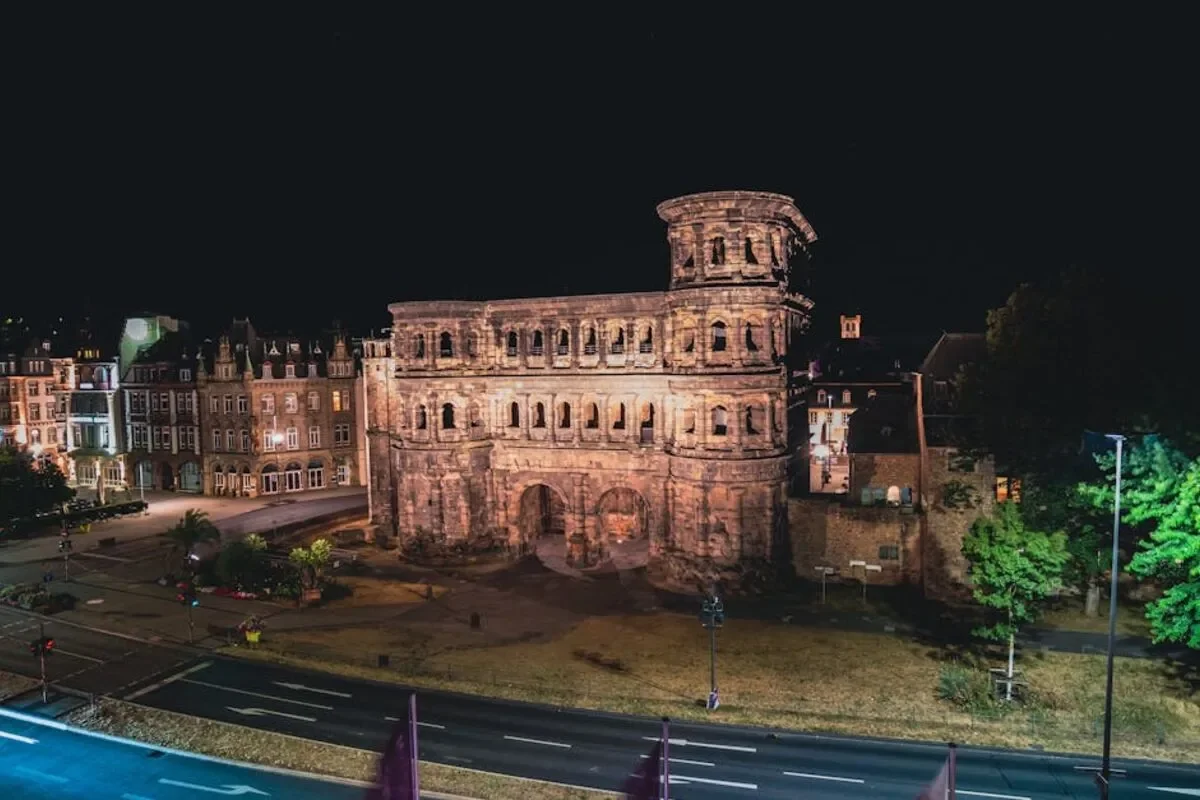
The Porta Nigra (“Black Gate”) is a Roman city gate built around AD 170 from sandstone blocks that darkened over centuries. It is the best-preserved Roman gate north of the Alps.
It survived because builders converted it into a church. In the 11th century, a Greek monk named Simeon lived walled inside the structure. After his death, the gate became the Church of St. Simeon.
Napoleon ordered the church stripped away in the early 1800s, returning the gate to its Roman form. The medieval apse on the east side is the one visible remnant of that thousand-year detour.
The Kaiserthermen (Imperial Baths) began in the fourth century as one of the largest bath complexes in the Roman world. Visitors can walk through the heating channels and service tunnels beneath the floors. They show the plumbing engineering more clearly than the walls above.
The Barbarathermen (Barbara Baths) are older, dating to the second century, and were once the second-largest Roman baths anywhere. Less survives above ground, but an elevated walkway lets visitors read the floor plan from above.
Both sites drew water from the Ruwer valley through aqueducts.
The Basilica of Constantine was the throne hall of the imperial palace, completed around AD 310. Its interior is 220 feet long and 108 feet high, with no columns breaking the space. It now functions as a Protestant church.
The Roman amphitheatre, cut into the Petrisberg hillside, held roughly 18,000 spectators. Visitors can access its underground cellars, which once housed animals and stage machinery.
The Römerbrücke (Roman Bridge) still carries traffic across the Moselle on Roman stone piers laid in the second century. It is the oldest bridge in Germany still in use.
The Rheinisches Landesmuseum Trier holds the finds that the monuments themselves cannot show: mosaics, grave monuments, coins, and a hoard of more than 2,500 Roman gold coins. Visiting it before or after the ruins turns empty stone shells into readable buildings.
The museum’s model of fourth-century Trier offers the clearest single explanation of how the scattered sites once connected. Check the museum’s published hours and ticket options before visiting, as these change seasonally.
Trier’s medieval and early modern core sits directly on top of the Roman grid, so the cathedral, market square, and palace gardens are all within a few minutes’ walk of each other. The religious buildings and the Karl Marx House give the city two very different intellectual histories.
The Trierer Dom (Trier Cathedral) is Germany’s oldest episcopal church, with Roman masonry from the fourth century still visible in its north wall. Its layers of Romanesque, Gothic, and Baroque work remain exposed rather than hidden.
The cathedral holds the Holy Robe, a garment tradition identifies as the tunic of Christ. It is displayed rarely, with pilgrimages held only a handful of times per century.
Attached to the cathedral’s south side, the Liebfrauenkirche (Church of Our Lady) is one of the earliest Gothic churches in Germany. Builders used a rose-shaped floor plan in the 13th century.
The Hauptmarkt has been Trier’s central market square since the 10th century. The Market Cross of 958 and the Petrusbrunnen fountain of 1595 mark the space, while cafés and produce stalls still fill it on weekday mornings.
A low archway off the square leads into the Judengasse, the narrow lane of Trier’s medieval Jewish quarter. Brass Stolpersteine (stumbling stones) set into pavements across the city record residents deported during the Nazi period. The Stolpersteine walking guide explains how to read them.
Karl Marx was born at Brückenstraße 10 in 1818, and the Baroque townhouse is now a museum covering his life, writing, and global influence. The exhibition treats his ideas critically and adds context on how people applied his work after his death.
The house is a ten-minute walk from the Hauptmarkt. Marx attended the Friedrich Wilhelm Gymnasium in Trier before studying in Bonn and Berlin.
The Electoral Palace, a rococo building in pink and white, adjoins the Constantine Basilica, and its formal gardens are free to enter. The contrast between the fourth-century brick hall and the 18th-century wing is one of the sharpest in the city.
For a view over the whole valley, walk up to the Petrisberg above the amphitheatre. Along the water, the Zurlaubener Ufer is lined with fishermen’s houses turned into restaurants, and Nells Park offers shaded riverside paths. The old customs crane on the quay dates from 1413.
The Moselle wine region starts inside Trier’s city limits, with vineyards on the slopes above the river. Riesling dominates, and tastings, marked vineyard trails, and boat trips downstream are all available without leaving the city for long.
Riesling is the signature grape of the Mosel Valley, grown on steep slate slopes that hold heat and drain quickly. The wines are known for high acidity and low alcohol.
Elbling is the older variety here, planted by the Romans along the upper Moselle near the Luxembourg border. It produces dry, sharp white wines and is used for sparkling Sekt.
Winemaking in this valley has continued since Roman times. That’s why the region’s wine and drinking traditions differ noticeably from beer-focused parts of Germany such as Bavaria.
Trier’s Weinkulturpfad (Wine Culture Trail) is a marked walking route through the vineyards on the city’s edge, with information panels on grape growing and slate soils. It links several estates and takes a few hours at an easy pace.
Weinstuben (wine taverns) in the old town pour local bottles by the glass alongside regional food. Flammkuchen, a thin flatbread with cream, onion, and bacon, is the standard partner for a dry Riesling.
The Trier Wine Festival runs in early August each year with free entry. Confirm dates with the city’s tourist information before planning around it.
Bernkastel-Kues, about 30 miles downstream, has a half-timbered market square and a ruined castle above the vineyards. Cochem, further along, is dominated by its hilltop Reichsburg castle.
The Moselle joins the Rhine at Koblenz, roughly 120 miles from Trier by river. Boats, trains, and the Moselle cycle path all follow the valley.
Closer in, the Ruwer and Saar rivers feed smaller wine areas, and the Sauer marks part of the Luxembourg border. The Hunsrück and Eifel uplands rise on either side of the valley.
Two full days covers Trier’s main sites at a reasonable pace, with a third day for the Moselle Valley. The compact old town means most visitors walk everywhere and use trains for arrivals and day trips.
One day covers the Porta Nigra, cathedral, Constantine Basilica, and Imperial Baths if you start early. It’ll feel rushed, though.
Two days let you add the amphitheatre, the Rheinisches Landesmuseum, and the Karl Marx House without skipping meals. With three days, you can fit in a vineyard walk or a boat trip.
Most things to do in Trier are within the old town, so travel between sites takes little time. That makes short stays practical.
| From | Approx. distance | Notes |
|---|---|---|
| Luxembourg City | 30 mi | Direct regional train, about 50 min |
| Luxembourg Airport | 35 mi | Bus or train via Luxembourg City |
| Frankfurt Airport | 130 mi | Train via Koblenz or Mainz, 3 hr+ |
| Frankfurt-Hahn (HHN) | 60 mi | Bus connections, limited schedule |
| Saarbrücken | 55 mi | Regional train, about 1 hr 20 min |
| Cologne | 120 mi | Train via Koblenz, about 3 hr |
| Mannheim | 130 mi | Train, about 3 hr |
| Kaiserslautern | 85 mi | Regional train, about 2 hr |
Schedules change, so check current timetables before booking. Everything About Germany’s planning a trip to Germany resource explains rail passes and regional tickets in more detail.
Hotels near the Porta Nigra and Hauptmarkt put nearly every sight within a 15-minute walk. Accommodation in Trier-Süd, near the Imperial Baths, is quieter and still easy to reach on foot.
City buses run from the main station, but few visitors need them inside the old town. Parking garages sit around the edge of the pedestrian zone.
Mobile coverage in the city is reliable on major German networks, including Vodafone and O2. Signal can drop to a slower Edge connection at the edge of the valley and in vineyard areas.
May through September brings the warmest weather, wine festivals, and open-air concerts at the amphitheatre. December adds the Christmas market on Hauptmarkt, beneath the cathedral’s west front.
April and October are quieter, with lower hotel rates and comfortable walking weather. Winter outside December is cold and grey, although the museums remain open.
For Trier in 2026, check the city’s official tourist information for current event dates, guided tour schedules, and monument opening hours. Broader seasonal guidance appears in Everything About Germany’s best time to visit Germany overview.
Trier is worth visiting if you’re interested in Roman history. It holds the largest concentration of Roman remains in Germany, protected as a UNESCO World Heritage site.
Its cathedral, medieval market square, and Moselle vineyards add layers beyond the Roman period. The compact center also makes it manageable as a day trip.
The main attractions are the Porta Nigra, Trier Cathedral, the Constantine Basilica, the Imperial Baths, the Roman amphitheatre, and the Roman Bridge. The Rheinisches Landesmuseum Trier and the Karl Marx House cover the city’s archaeology and intellectual history.
All of them sit within walking distance of each other.
In one day, start at the Porta Nigra, then walk south to Hauptmarkt and the cathedral. Continue to the Constantine Basilica, Electoral Palace gardens, and Imperial Baths.
That route covers the core UNESCO sites in roughly six hours with stops. If time allows, add the Roman Bridge or a glass of Riesling at a riverside tavern.
Two days gives you a comfortable amount of time for Trier’s Roman monuments, churches, and museums without rushing. A third day allows a vineyard walk on the Weinkulturpfad or a Moselle boat trip to Bernkastel-Kues.
One day works for the headline sights only.
May through September usually brings the best weather, along with the August wine festival and outdoor events at the amphitheatre. April and October see fewer visitors and lower prices, while the weather stays pleasant enough for walking. December is ideal for travelers who want to visit the Christmas market on the Hauptmarkt.
Explore the historic Old Town (Altstadt) on foot and use the local S-Bahn/U-Bahn network.
Purchase a 24-hour transit day pass (Tageskarte) for unlimited city travel.
Discover curated walking tours, museum passes, and authentic experiences in Trier with instant confirmation.