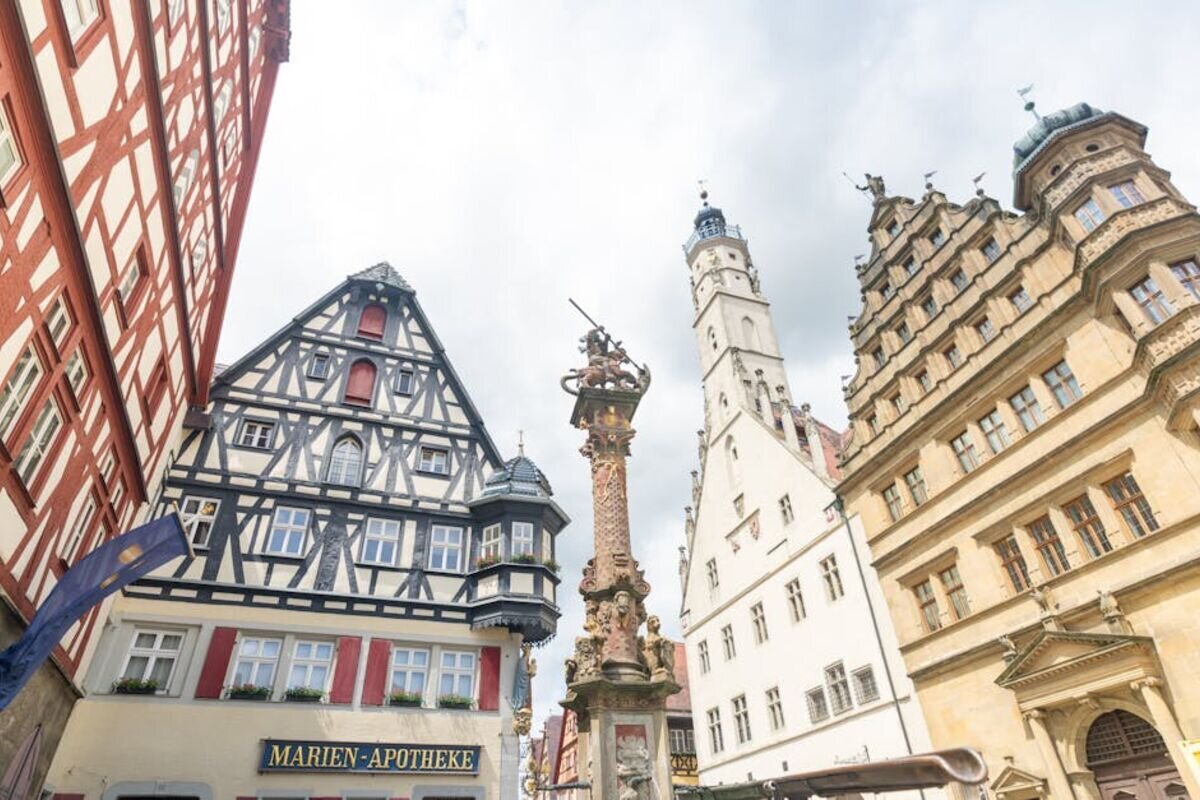
Rothenburg ob der Tauber
Perfectly preserved medieval walled city on the Romantic Road, featuring the famous Plönlein and…
Bavaria (Bayern in German) is the largest of Germany’s 16 federal states by area, covering the country’s entire southeastern corner. Its official name is the Free State of Bavaria, or Freistaat Bayern, and its capital is Munich.
That size explains a lot. A state stretching from vineyards along the Main River to glaciers on the Zugspitze holds several distinct cultures within one set of borders.
Franconians in the north, Swabians in the west, and Old Bavarians in the south speak differently, cook differently, and celebrate different saints’ days.
Treating Bavaria as one uniform place is the fastest way to miss most of it, so this piece maps the state’s four broad regions, its 1,500-year history, and the cities and customs that make each corner distinct.
The Free State of Bavaria is one of Germany’s 16 constituent states. It has its own constitution, parliament, and Minister-President, all operating within the Federal Republic of Germany.
It is landlocked, mountainous in the south, and Germany’s largest state by land area.
Bavaria occupies the southeastern block of Germany. Its neighbors give a quick sense of scale.
| Border | Neighbor |
|---|---|
| West | Baden-Württemberg |
| Northwest | Hesse |
| North | Thuringia and Saxony |
| East | Czech Republic |
| South and southeast | Austria (and a short stretch facing Switzerland) |
The Danube crosses the state from west to east. The Alps form the southern edge, topped by the Zugspitze at 2,962 meters on the Germany-Austria border.
“Freistaat” translates roughly as “republic.” Bavaria adopted the title in 1918, when the monarchy ended and the state declared itself a republic instead of a kingdom.
The label carries no extra legal powers today. Saxony and Thuringia use it too.
In Bavaria, it acts as a statement of self-image, reinforced by a constitution and a parliamentary tradition that Bavarians trace back centuries.
Bavaria’s politics have a permanent regional flavor. The Christian Social Union (CSU) exists only in Bavaria and has led the state government for most of the postwar period, partnering nationally with the CDU.
Local identity runs deep. Many residents describe themselves as Bavarian first and German second, and the Bavarian dialect (Bairisch) remains widely spoken in the south and east.
That said, Bavarian culture isn’t one thing. A Franconian in Bamberg and a farmer near Berchtesgaden share a state, not a dialect. Readers comparing this to other states can browse the wider German regions coverage on Everything About Germany.
Bavaria splits into seven administrative districts, which group into four broad cultural areas: Upper Bavaria and the Alpine foothills, Franconia in the north, Bavarian Swabia and the Allgäu in the southwest, and eastern Bavaria along the Danube. Each has its own dialect, cuisine, and drinking culture.
Upper Bavaria (Oberbayern) holds Munich, the big lakes, and the Bavarian Alps. Lake Starnberg and Lake Chiemsee sit within an hour of the capital by train.
South of them, the ground rises fast. Garmisch-Partenkirchen sits below the Zugspitze, while Berchtesgaden occupies a mountain pocket that juts into Austrian territory.
The Inn River drains much of this country toward the Danube.
Franconia (Franken) covers the north and thinks of itself as separate. Its language is Franconian, not Bavarian, and its wine matters more than its beer in some districts.
The Main River loops through Würzburg and the Franconian wine region, where producers bottle dry Silvaner in the flat, round Bocksbeutel.
Bamberg brews smoked beer. The Rhön uplands mark the northwestern boundary with Hesse and Thuringia.
Bavarian Swabia (Bayerisch-Schwaben) lies west of Munich, centered on Augsburg. Swabian dialect and Swabian noodles cross the state line here from Baden-Württemberg.
South of Augsburg, the Allgäu begins: dairy country of green hills, hard mountain cheese, and cross-country trails. Lindau sits on an island in Lake Constance, at Bavaria’s far southwestern tip.
ℹ️ Located in Günzburg, Bavaria; check seasonal opening calendar before booking.
We may earn a commission when you book through these links, at no extra cost to you.Eastern Bavaria follows the Danube through Regensburg and Passau toward Austria. The Regen River joins it at Regensburg, giving the city its name.
The Bavarian Forest (Bayerischer Wald) runs along the Czech border. It’s a low, densely wooded range with Germany’s first national park and long-standing glassmaking villages.
Bavaria’s history covers roughly 2,000 years, from Roman frontier provinces to a stem duchy, an electorate, a sovereign kingdom, and finally a state of the Federal Republic.
The Wittelsbach family ruled it continuously from 1180 until 1918.
Celtic peoples lived here first, including the Raeti in the Alps and the Vindelici to their north. Under Augustus, the Roman Empire pushed its border to the Danube and absorbed everything south of it.
That territory became the province of Raetia, with Noricum to the east in what is now Austria. Augusta Vindelicorum (Augsburg) served as the main Roman city.
Regensburg and Passau began as fortified Danube outposts. The Bavarian name appears in Frankish records by around 520 AD.
Saint Boniface arrived around 734 and organized the church, founding or restoring bishoprics at Salzburg, Freising, Regensburg, and Passau.
The Duchy of Bavaria formed in the 6th century under the Agilolfing dukes, who governed for the Frankish kings. Charlemagne deposed the last of them, Tassilo III, in 788.
Henry the Lion, duke in the 12th century, founded Munich in 1158. His fall handed Bavaria to the Wittelsbachs in 1180.
The duchy fought on the Catholic side in the Thirty Years’ War and became the Electorate of Bavaria in 1623. This gave its ruler a vote in choosing the Holy Roman Emperor.
Napoleon’s reorganization of Germany made Bavaria a kingdom in 1806 and brought it into the Confederation of the Rhine. The Kingdom of Bavaria absorbed Franconia and Bavarian Swabia, which is why those regions still feel distinct.
Bavaria joined the German Empire in 1871 while keeping unusual privileges, including its own army in peacetime, postal service, and railways.
Defeat in World War I ended the monarchy. Kurt Eisner declared a republic in November 1918, King Ludwig III left the throne, and the short-lived Bavarian Soviet Republic was crushed by spring 1919.
The Weimar Republic years brought instability, including Hitler’s failed Beer Hall Putsch in Munich in 1923. Bavaria later became a center of Nazi power.
World War II left Nuremberg, Munich, and Würzburg heavily bombed. Under American occupation, Bavaria became part of West Germany.
Its Bamberg Constitution, adopted in December 1946, remains the state’s founding document.
Bavaria’s headline destination is Munich, but four other cities carry UNESCO listings or major museums of their own: Nuremberg, Bamberg, Würzburg, and Regensburg.
Add the Alpine resorts and the Wittelsbach palaces, and a two-week route fills easily.
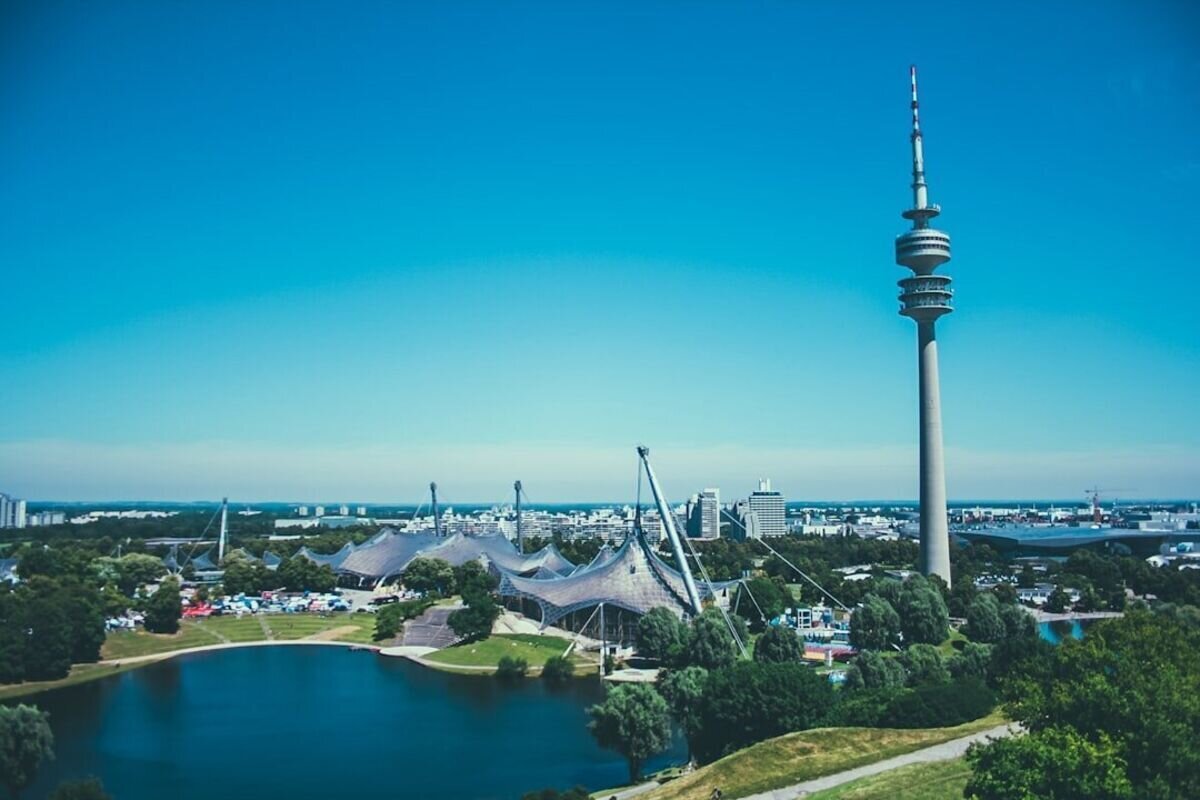
Munich (München) has about 1.5 million residents and is Germany’s third-largest city. Its draws run well past the beer tents on Theresienwiese, the 42-hectare Oktoberfest grounds.
Satellite towns each hold something: Dachau’s concentration camp memorial, Freising’s cathedral hill, Erding’s thermal baths, and Rosenheim’s Inn valley setting.
Full details sit in the Munich city guide.
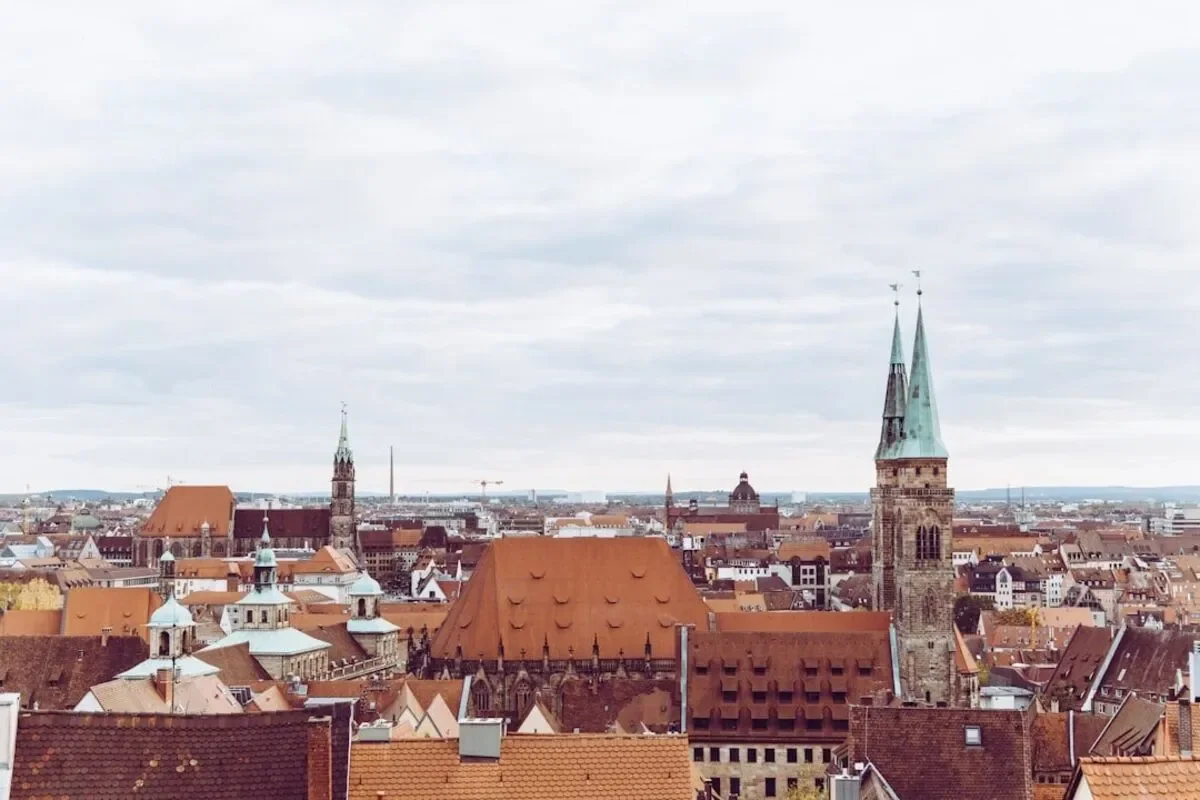
Nuremberg (Nürnberg) is Franconia’s largest city, with an imperial castle, the Germanisches Nationalmuseum, the Nazi Party Rally Grounds documentation center, and the Christkindlesmarkt, one of Germany’s oldest Christmas markets.
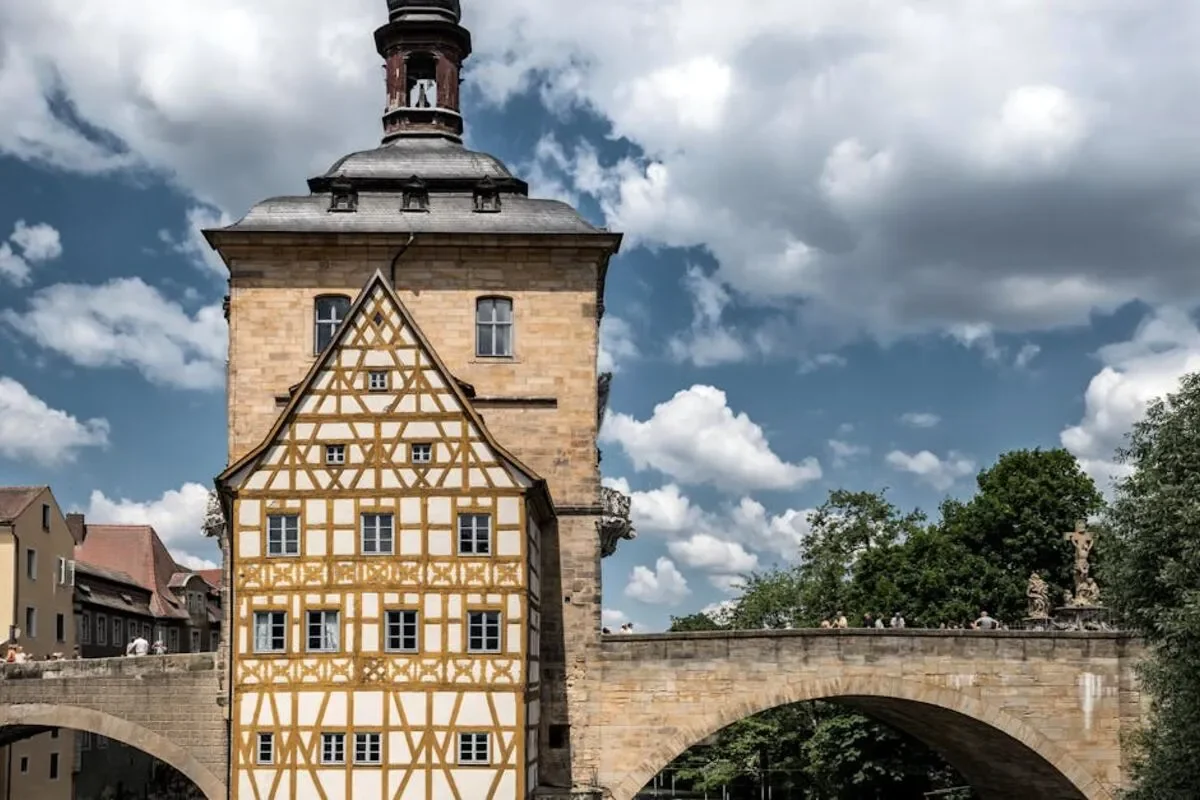
Fürth and Erlangen sit next door in the same metro area. Bamberg escaped wartime destruction almost intact and holds UNESCO World Heritage status for its old town.
Nine breweries still operate there, several producing Rauchbier (smoked beer).
Würzburg anchors the Franconian wine region and the northern end of the Romantic Road. Its Residenz palace, with a Tiepolo ceiling fresco over the staircase, is also UNESCO-listed.
Bayreuth hosts the annual Wagner Festival. Schweinfurt, Aschaffenburg, and Hof round out Franconia’s regional centers.
Augsburg was founded by the Romans in 15 BC, making it one of Germany’s oldest cities. Its Fuggerei, built in 1521, still houses low-income residents for a nominal annual rent.
Regensburg’s medieval center is UNESCO-listed, with a 12th-century Stone Bridge over the Danube and a Gothic cathedral. Passau sits where the Danube, Inn, and Ilz meet.
St. Stephen’s Cathedral there holds one of the world’s largest church organs. Ingolstadt, Landshut, Straubing, Kelheim, Amberg, and Cham serve as smaller regional hubs along the Danube corridor.
King Ludwig II built the palaces that put Bavaria on postcards: Neuschwanstein above Hohenschwangau, Linderhof in the Graswang valley, and Herrenchiemsee on an island in the Chiemsee.
Mountain access is fairly straightforward. A cog railway and cable car both reach the Zugspitze summit, which operates from 8:15 to 16:30 daily, although weather closures do happen.
Berchtesgaden provides access to the Königssee and the road to the Eagle’s Nest. In the west, Memmingen, Kempten, Lindau, Starnberg, and Roth make useful bases.
Ticket prices and seasonal hours change, so confirm details with each operator before traveling.
Bavarian culture rests on Catholic tradition, a strong brewing heritage, and folk customs that vary sharply between Franconia, Swabia, and Old Bavaria. At the same time, the state hosts BMW, Audi, Siemens, MAN, and Adidas.
Bavaria has roughly 600 breweries, more than any other German region, with the highest concentration around Bamberg and Upper Franconia. The 1516 Reinheitsgebot, or purity law, originated here.
Beer garden custom includes one rule visitors should know: at tables without cloths, you can bring your own food and buy only the drinks. The Biergarten culture guide covers seating conventions and typical opening seasons.
At Oktoberfest, wait for the “O’zapft is!” tapping before drinking. Make eye contact when you clink glasses for a Prost, and never smash the glasses together. Table reservations for the tents open months ahead.
Tracht is the umbrella term for traditional dress: Lederhosen, or leather breeches, for men and Dirndl for women. Cut, color, and apron details signal the region, while Franconians historically wore entirely different styles.
Village customs still mark the calendar. Maypoles go up on May 1 in blue and white, Fasching, or carnival, runs through winter, and Corpus Christi processions fill the streets in June.
Brass bands and zither music remain living traditions, not museum pieces.
Bavarian cooking is pork-forward, wheat-heavy, and generously portioned. Some staples include:
Franconia adds Schäufele, or pork shoulder, and Nürnberger Rostbratwürste, while the Allgäu supplies Bergkäse, or mountain cheese.
Bavaria has Germany’s second-largest population and one of its strongest economies. BMW is headquartered in Munich, Audi in Ingolstadt, and Siemens in Munich.
MAN has offices in Munich and Nuremberg, while Adidas is based in Herzogenaurach near Erlangen. Daily life combines that modern economy with strict Sunday closing, Catholic public holidays that other states don’t observe, and Feierabend, the sharp line between work and evening free time.
Bavaria is part of Germany, one of its 16 federal states. Its formal name, Free State of Bavaria, reflects its 1918 shift from kingdom to republic and its own constitution, but it has no independent status.
Bavaria is best known for Munich, Oktoberfest, Neuschwanstein Castle, the Bavarian Alps, and its brewing tradition. It is also home to BMW, Audi, and Siemens, and holds several UNESCO World Heritage sites, including the old towns of Bamberg and Regensburg.
Bavaria is German. It borders Austria to the south and southeast, and the two share dialect features and Alpine culture, which explains the confusion. The border has stood in roughly its current form since the 19th century.
Standard German is the official language and is spoken everywhere. Regional dialects run alongside it: Bavarian in the south and east, Franconian in the north, and Swabian in the west. English is widely spoken in Munich and major tourist areas.
Yes. Nuremberg, Bamberg, Würzburg, Regensburg, and Augsburg all have major historical sites. The Allgäu, Bavarian Forest, and Berchtesgaden offer hiking and lake country with far fewer crowds. A week outside Munich lets you see most of them by regional train.