Rothenburg ob der Tauber
Rothenburg ob der Tauber is one of the most beautiful and well-preserved medieval towns…
Rothenburg ob der Tauber is a walled medieval town in Franconia, northern Bavaria, sitting on a plateau above the Tauber River. Its defensive circuit still stands: roughly four kilometers of wall with 42 gates and towers, most of which visitors can walk.
The town held the status of Free Imperial City from 1274 until 1803. It governed itself under the emperor rather than a regional prince. That independence funded the civic buildings, patrician houses, and fortifications that define the Altstadt (old town) today.
A first-time visitor can cover Rothenburg’s essential sights in a single well-planned day, but staying overnight gives access to the quiet early mornings and evenings when the tour buses have gone.
Roughly 45 percent of the old town was destroyed by bombing in March 1945. International donors helped fund the careful postwar reconstruction by “adopting” sections of wall, which is why the streets still read as a coherent medieval whole.
Start in the southern old town at Plönlein, then work north through Marktplatz to St. Jakobskirche and end west at the Burggarten, where the plateau drops away toward the Tauber. That route covers the town’s four defining spaces (a street junction, a civic square, a parish church, and a castle terrace) in about two hours of unhurried walking.
Every stop below sits within the walls, and the total distance is under two kilometers.
Plönlein means “small square” in the local dialect. It marks the point where Schmiedgasse splits into two lanes at different heights. A narrow half-timbered house with a yellow façade stands at the fork.
Behind it rise two gate towers. The Siebersturm (Sieber Tower) guards the upper lane and dates to around 1385. The Kobolzeller Tor (Kobolzell Gate) sits below and opens onto the steep road down to the valley.
Walk through both gates rather than only photographing them from the junction. The view back uphill from the Kobolzeller Tor shows how the town used its slope for defense.
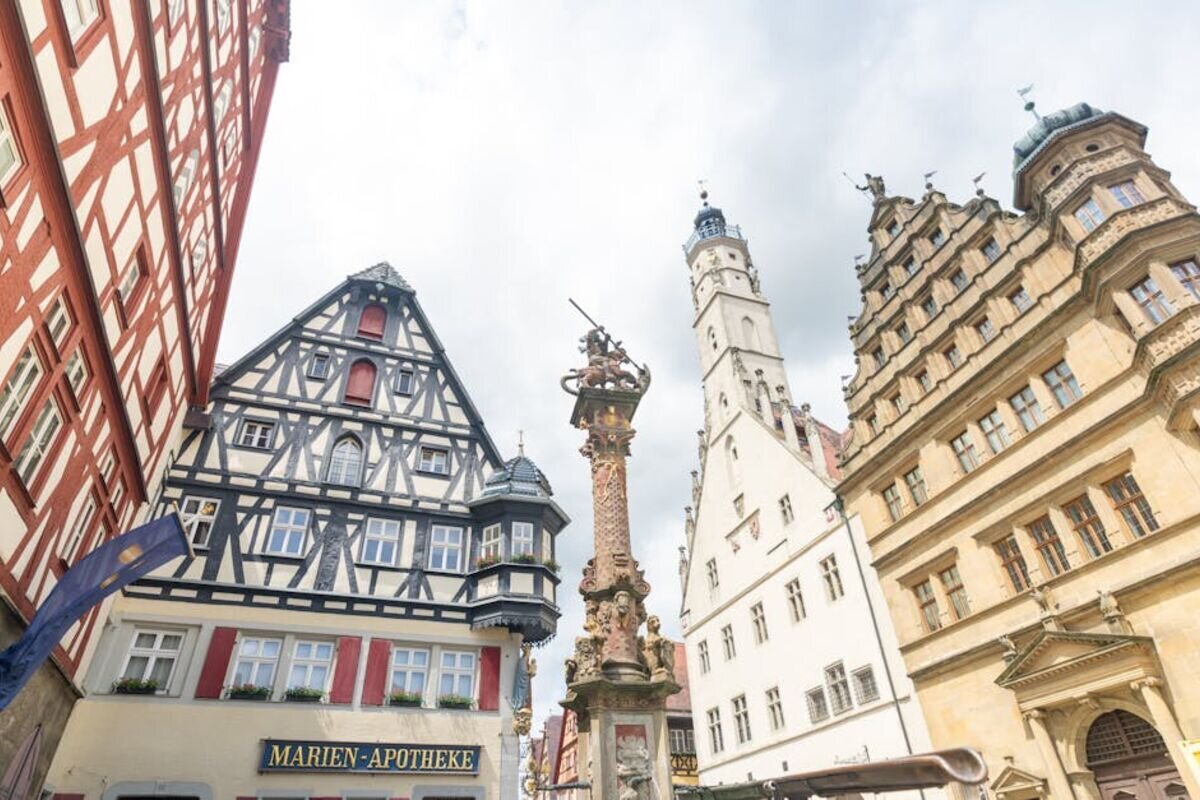
The Marktplatz (market square) is the civic center, framed by the town hall and merchant houses. The Georgsbrunnen fountain has stood here since 1446, above a well eight meters deep.
The Rathaus (town hall) has two halves: a Gothic section from the 14th century and a Renaissance front completed in 1578. Visitors can climb its tower, tackling 220 steep steps and narrow final ladders to reach the highest viewpoint in town.
Beside it stands the Ratstrinkstube, the former councillors’ tavern. Its clock gables open several times daily to show two figures reenacting the Meistertrunk legend.
St. Jakobskirche (St. James’ Church) is Rothenburg’s Lutheran parish church, begun in 1311 and consecrated in 1484. It once served as a stop on the pilgrim route to Santiago de Compostela.
The reason to pay admission is the Holy Blood Altarpiece in the west gallery, carved by Tilman Riemenschneider between 1500 and 1505. The central panel shows the Last Supper as Christ identifies his betrayer, with Judas at the front of the composition.
Riemenschneider left the limewood unpainted and relied on light from the window behind. Visit in the morning if possible, when that backlighting works best.
The Burggarten (castle garden) occupies the spur where Rothenburg Castle stood until an earthquake destroyed it in 1356. Only the chapel and the Burgtor gateway survive.
From the western terrace, the ground falls sharply into the Taubertal (Tauber Valley). Vineyards, orchards, and the village of Detwang spread out below.
This is public parkland with free entry and no closing gate. Sunset here is the classic view of the town from outside its own walls.
The Doppelbrücke (double bridge) crosses the Tauber below town on two tiers of stone arches. The original dates to 1330, while the present structure is a postwar rebuild after the retreating army destroyed it in 1945.
A short walk upstream stands Topplerschlösschen (Toppler Castle), a fortified tower house built in 1388 for Mayor Heinrich Toppler. It is tall and narrow, with living quarters stacked above a moat-ringed base.
The descent from the Burggarten takes about 20 minutes on foot. The climb back is steep, so allow more time for the return.
Two more houses are worth noting inside the walls: the Baumeisterhaus on Obere Schmiedgasse, a 1596 patrician house with carved figures of the seven virtues and seven vices, and Zur Höll, one of the oldest surviving buildings in town.
The wall walk is the single best way to grasp how Rothenburg was built, and it costs nothing. Add two or three museums and an evening tour, and a full day fills easily.
The circuit runs roughly four kilometers and takes about 2.5 hours at a steady pace. You can also explore the covered walkway in shorter sections.
The Stadtmauer (city wall) dates largely to the 13th and 14th centuries, with an earlier inner ring from the 12th. Much of it carries a roofed wooden walkway that stays dry in rain and shaded in summer.
The Rothenburg Tower Trail (Turmweg) is the signposted route around the wall, with 42 gates and towers along the way. Information boards explain each section.
Access points are frequent, so start anywhere. The stretch between the Rödertor and the Spitaltor offers the widest walkway and the clearest views over the red roofs.
Look for the small stone plaques set into the parapet. Each records a donor who paid for a meter of postwar reconstruction, with names from across the world.
Six main gates pierce the wall. Each has a different character:
| Gate or tower | Where | Why go |
|---|---|---|
| Spitaltor | South | Largest complex, a double bastion shaped like a figure eight, built 1586 |
| Rödertor | East | Climbable tower with a small exhibit on the 1945 bombing |
| Klingentor | North | Doubles as a water tower, attached to St. Wolfgang’s fortified church |
| Burgtor | West | Tallest gate, leads to the Burggarten, with a “needle eye” pedestrian door |
| Galgentor | Northeast | The old Gallows Gate, quiet and rarely crowded |
| Markusturm | Central | 12th-century tower from the earliest wall ring, with the Röderbogen arch |
The Markusturm stands inside the current walls because the town outgrew its first fortification. Spotting it explains the town’s expansion at a glance.
The Mittelalterliches Kriminalmuseum (Medieval Crime and Justice Museum) covers a thousand years of European legal history across four floors. It holds one of the largest collections of its kind in Europe.
Exhibits cover court procedure, trial documents, punishment devices, and shame masks used for public humiliation. Displays explain the legal reasoning behind each practice, with English labels throughout.
Allow 90 minutes. The museum sits on Burggasse, a short walk from Marktplatz.
The RothenburgMuseum, housed in a former Dominican convent, covers the town’s own story instead. Highlights include the original 13th-century convent kitchen, weapons, and the tankard tied to the Meistertrunk story.
Käthe Wohlfahrt operates a year-round Christmas Village on Herrngasse, opened in 1977 and now the anchor of Rothenburg’s reputation as a Christmas destination. Rooms of nutcrackers, pyramids, glass ornaments, and cuckoo clocks sit beneath a large decorated tree.
Upstairs, the Deutsches Weihnachtsmuseum (German Christmas Museum) charges separate admission and takes a documentary approach. It traces how German Christmas customs developed, including the history of the tree, the Advent calendar, and changing depictions of the gift-bringer.
The shop is free to enter and busy at midday. Go early or late if crowds bother you.
The Nachtwächter (night watchman) tour leaves from Marktplatz each evening, with an English departure at 8 p.m. from roughly April to December and a German tour following. The guide carries a halberd, lantern, and horn.
The hour-long walk covers medieval civic duties, fire risk, sanitation, and the realities of a watchman’s night shift. The guide delivers it with dry humor, and you pay at the end.
Even without the tour, the old town after 7 p.m. is a different place. Streetlights are low, the day buses have left, and lanes such as Schmiedgasse and Klingengasse empty out.
One full day covers the wall walk, Marktplatz, St. Jakobskirche, the Burggarten, and one museum. Two days add the Tauber Valley on foot, a second museum, and the night watchman tour without rushing.
Rothenburg is compact enough that walking distances rarely exceed 15 minutes. The real constraint is opening hours, not geography.
A workable order for a day trip:
That leaves the last daylight hour free. Wandering the lanes east of Marktplatz reveals quiet corners the main route skips.
An overnight stay unlocks the two hours day-trippers never see: before 10 a.m. and after 6 p.m.
Add the night watchman tour at 8 p.m. and dinner in a traditional tavern. Then return to Plönlein early the next morning, when the lane is empty.
On the second day, walk down to the Doppelbrücke and Topplerschlösschen, then continue to Detwang to see the second Riemenschneider altarpiece in St. Peter and Paul’s church. Budget two to three hours round trip, including the climb back up.
May, June, and September offer long daylight, open museums, and moderate crowds. July and August bring the heaviest visitor numbers, though the town handles them better than its reputation suggests.
Late November and December bring the Christmas market and short, cold days. January through March is the quietest stretch, with some restaurants and smaller attractions closed for winter breaks.
For broader seasonal planning across the country, Everything About Germany’s guide to the best time to visit Germany covers regional weather patterns and festival calendars.
The Reiterlesmarkt is Rothenburg’s Christmas market, running on Marktplatz and neighboring squares through Advent. Its name comes from the Reiterle, a pre-Christian rider figure from Franconian folklore that later became part of Christmas tradition.
The Meistertrunk (Master Draught) festival takes place over the Whitsun weekend, with a costumed reenactment, historical camp, and shepherd’s dance.
The legend holds that in 1631, during the Thirty Years’ War, Count Tilly offered to spare the captured town if a councillor could drink a three-and-a-quarter-liter tankard of wine in one go, and that former Mayor Nusch did it.
Historical records show that negotiation and payment spared the town. Adam Hörber turned the drinking story into a stage play in 1881, and performers have presented it ever since. Both the play and the documented history are worth knowing before watching the clock figures on Marktplatz.
Coach tours concentrate between 11 a.m. and 4 p.m., mainly on Herrngasse, Marktplatz, and the Plönlein junction.
Three practical moves help: visit those spots before 10 a.m., save the wall walk for midday when it stays comparatively empty, and use the north end of town, including Klingentor and St. Wolfgang’s, during the busiest hours.
Staying inside the walls overnight solves the problem outright.
Rothenburg is reachable by rail with one or two changes, or directly by car via the A7 motorway. The old town is closed to most through traffic, so drivers park outside the walls and walk in.
Journey times range from about 70 minutes from Nuremberg to roughly three hours from Munich.
Trains don’t run directly to Rothenburg from major cities. Travelers change at Steinach bei Rothenburg onto a branch line that covers the final 14 minutes.
The branch train meets arriving regional services, and the platform connection is short. Rothenburg’s station sits about a 10-minute walk east of the Rödertor.
Timetables change seasonally, and Sunday service is thinner. Check Deutsche Bahn before traveling, especially for the last evening connection out of Steinach.
The A7 motorway runs north to south past Rothenburg, with exits at Rothenburg ob der Tauber and Bad Windsheim feeding onto the B25.
Numbered parking lots (P1 through P5) sit just outside the walls. P1 near the Spitaltor and P5 by the Schrannenplatz are the most useful. All charge a daily fee and sit within a 10-minute walk of Marktplatz.
Vehicle access inside the walls is restricted for non-residents during the day. Hotel guests can usually drive in to unload, but they should arrange it with the hotel in advance.
Rothenburg is a standard stop on the Romantische Straße (Romantic Road), and Everything About Germany’s Romantic Road overview places it in the wider route between Würzburg and Füssen.
| From | By car | By train (with changes) |
|---|---|---|
| Nuremberg | ~1 hr 10 min | ~1 hr 15 min via Ansbach and Steinach |
| Würzburg | ~1 hr | ~1 hr 10 min via Steinach |
| Frankfurt / Frankfurt Airport | ~2 hr 30 min | ~3 hr via Würzburg and Steinach |
| Stuttgart | ~2 hr | ~2 hr 30 min via Ansbach or Crailsheim |
| Munich | ~2 hr 45 min | ~3 hr via Ansbach and Steinach |
Frankfurt Airport has its own long-distance rail station, so arriving passengers can board a train toward Würzburg without transferring into the city.
Munich makes a long day trip at roughly six hours of round-trip travel. Nuremberg and Würzburg are much more comfortable bases.
Staying inside the walls is the main advantage Rothenburg offers over a day visit. Most hotels occupy historic buildings, many with fewer than 25 rooms.
Herrngasse and the streets around Marktplatz put everything within a five-minute walk. The quieter southern end near Plönlein and the Spitaltor trades a little distance for less foot traffic.
Hotel BurgGartenpalais on Herrngasse sits in an 18th-century building with its own garden near the Burgtor. It’s one example of the historic-property accommodation the old town is known for. Guesthouses outside the walls cost less and remain walkable.
Book several months ahead for December weekends and the Whitsun Meistertrunk festival.
The Taubertal cycle path (Liebliches Taubertal) follows the river roughly 100 kilometers from Rothenburg to Wertheim on the Main. The first stretch toward Bad Mergentheim is gently downhill and well surfaced.
By car or bus, Dinkelsbühl (45 minutes south) and Nördlingen (75 minutes) continue the Romantic Road with their own intact wall circuits. Nördlingen’s wall is fully walkable, and the town sits inside a meteorite crater.
Bamberg, about 90 minutes northeast, offers a UNESCO-listed old town and a distinct Franconian beer culture. For walking routes elsewhere in Germany, the site’s feature on wandern hiking culture explains marked-trail conventions and etiquette.
Franconian food in Rothenburg centers on pork, dumplings, and dry white wine, with the Schneeball as the town’s signature pastry. Practical details, such as admission, hours, and cobblestones, shape a visit more than menu choices do.
Most restaurants serve lunch from 11:30 to 14:00 and dinner from 17:30, with a closed afternoon in between.
Schneeballen (“snowballs”) are strips of shortcrust pastry rolled into a loose ball, deep-fried, and coated. Traditional versions use powdered sugar, while modern shops offer chocolate, nut, and marzipan coatings.
They’re hard, dense, and better shared. Bakers sell them in sizes ranging from a fist to a grapefruit.
Savory Franconian dishes to look for:
Afternoon coffee and cake is a fixed habit here. The Kaffee und Kuchen tradition explains why cafés fill up around 15:00.
Franconian wine is mostly dry white, led by Silvaner and Müller-Thurgau grown along the Main and Tauber. Bottles from the region come in the Bocksbeutel, a flat, rounded flask protected by law for Franconian wines.
Local beer leans toward Kellerbier and unfiltered Zwickel from small Franconian breweries. Rothenburg sits between wine country to the west and beer country to the east, so both show up on the same menus.
Traditional taverns cluster on Herrngasse, Klingengasse, and around Marktplatz. Reserve for dinner in high season, since small dining rooms can fill by 19:00.
Rothenburg’s old town is a public space open 24/7, with no entry fee and no gates closed at night. You only pay admission at individual sites.
Approximate costs and hours:
Several attractions cut their hours or close entirely in January and February. Check official websites before traveling, since published hours can change with little notice.
Rothenburg’s streets are laid with rough cobbles, and the ground slopes in most directions. Sturdy flat shoes are worth packing; wheeled luggage handles badly here.
The wall walkway has steps at nearly every access point, so it isn’t wheelchair accessible. The Burggarten, Marktplatz, and Herrngasse are largely level, and tourist information can advise on step-free routes.
Plönlein and Herrngasse are lined with private homes and working businesses. Stay out of doorways, avoid blocking the narrow lane at the Plönlein fork, and skip tripods during peak hours.
Drone flights over the old town are restricted. Check current German aviation rules before flying anywhere near the walls.
One full day covers the wall walk, Marktplatz, St. Jakobskirche, the Burggarten, and one museum. Two days allow the Tauber Valley walk to the Doppelbrücke and Topplerschlösschen, the night watchman tour, and quiet early mornings before day-trippers arrive.
Yes, though it means roughly six hours of round-trip travel by train via Ansbach and Steinach. Nuremberg, about 1 hour 15 minutes each way, and Würzburg, about 1 hour 10 minutes, make far easier day-trip bases.
The Stadtmauer wall walk, the Burggarten terrace overlooking the Tauber Valley, and the Käthe Wohlfahrt Christmas Village shop all cost nothing to enter. Wandering the lanes and viewing Plönlein, the Rathaus exterior, and the Ratstrinkstube clock figures is also free.
December brings the Reiterlesmarkt Christmas market on Marktplatz through Advent, along with early darkness and cold weather. Weekends draw large crowds, and hotels book out months ahead, so weekday visits and advance reservations work better.
Travel to Steinach bei Rothenburg, then change to the branch line for the final 14-minute ride into town. Trains run from Würzburg, Ansbach, and Nuremberg, and the branch service usually meets arriving trains. Check Deutsche Bahn for the last evening departure.
Explore the historic Old Town (Altstadt) on foot and use the local S-Bahn/U-Bahn network.
Purchase a 24-hour transit day pass (Tageskarte) for unlimited city travel.

Discover curated walking tours, museum passes, and authentic experiences in Rothenburg ob der Tauber with instant confirmation.