Kaffee und Kuchen
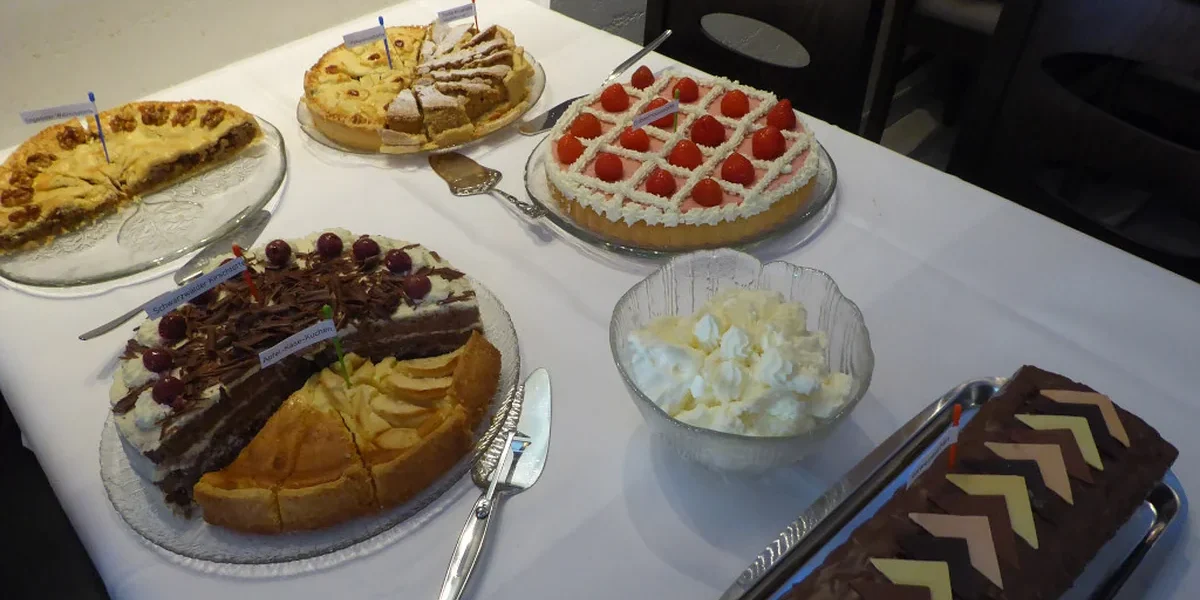
Kaffee und Kuchen (“coffee and cake”) is Germany’s afternoon social ritual, usually held between 3 and 5 p.m. People pause the day to share brewed coffee and a slice of cake at home, in a bakery, or at a café.
The custom traces back to the coffeehouses of the 17th and 18th centuries, then moved into private living rooms during the 19th century. Today, it works as a light third meal between lunch and dinner. It’s also the most common way German households invite guests over without hosting a full dinner party.
Anyone who learns the timing, the invitation etiquette, and the difference between a Bäckerei and a Konditorei can join this ritual comfortably almost anywhere in Germany, from a Berlin corner café to a Black Forest pastry shop.
The cakes themselves change by region and season: fruit sheet cakes in summer, Stollen and Lebkuchen in December, and cream tortes for birthdays and family celebrations.
Key Takeaways
- Kaffee und Kuchen is a shared afternoon break, most associated with Sundays and family visits.
- Guests are expected to arrive on time and rarely turn up empty-handed.
- Cake choices, coffee styles, and seasonal specialties vary widely between German regions.
What Does Kaffee und Kuchen Mean in German Daily Life?
Kaffee und Kuchen is a scheduled social pause, not a snack grabbed on the run. It gives friends, relatives, and colleagues a fixed reason to sit down together for an hour or two, and it carries much of the same weight in German social life that a shared meal does elsewhere.
From Afternoon Coffee to a Shared Social Ritual
The older word for the gathering is Kaffeeklatsch, roughly “coffee gossip,” a term for afternoon coffee and cake accompanied by conversation. It grew out of 19th-century middle-class households where women hosted one another in the afternoon.
The modern version is more mixed and more casual. What stayed constant is the pace: the coffee is poured slowly, second slices are offered, and nobody stands up to leave after twenty minutes.
That unhurried mood is what Germans call Gemütlichkeit, a sense of warmth and ease. For newcomers, an invitation to coffee and cake is one of the most reliable routes to making friends in Germany, because it happens in someone’s home rather than a bar.
Why Sunday Afternoons Are Closely Associated With the Tradition
Sunday is the classic day because most German shops are closed by law, so the afternoon is free by default. Families often bake in the morning or pick up a cake from the bakery on Saturday.
Many households pair it with a walk. People eat lunch, take a long Spaziergang (stroll) through a park or forest, then return home for coffee around 3:30 p.m.
How It Differs From British Afternoon Tea
British afternoon tea is a served, tiered affair with sandwiches, scones, and pots of tea, often booked at a hotel. German coffee and cake is simpler: one pot of coffee, one or two cakes, with whipped cream on the side.
| Kaffee und Kuchen | British afternoon tea | |
|---|---|---|
| Usual time | 3–5 p.m. | 3–5 p.m. |
| Main drink | Filter coffee | Tea |
| Savory course | Rarely | Sandwiches standard |
| Typical setting | Home, bakery, café | Hotel, tea room |
| Formality | Everyday | Occasion-based |
The German version belongs to ordinary weeks as much as to celebrations, and that everyday frequency is a real part of German heritage.
How Do Hosts and Guests Take Part in the Ritual?
Hosts set the table properly, guests arrive close to the stated time, and everyone waits for a shared “Guten Appetit” before the first bite. The rest is flexible, and customs shift by household, generation, and region.
At Home, in the Workplace, and After a Sunday Walk
At home, the table usually has a cloth, cake plates, cake forks, and a coffee service. Many families keep porcelain reserved for exactly this purpose.
Workplaces have a shorter version. A colleague brings a cake for a birthday or a farewell, and the team gathers in the kitchen for a Kaffeepause, the German coffee break, before returning to work.
The Sunday version after a walk is the longest. Coffee and cake follow a couple of hours outdoors, and the conversation can easily run until dinner gets skipped entirely.
Invitation Etiquette and the Value of Punctuality
An invitation is a genuine social step, and it’s worth treating it as one. Arriving five minutes after the agreed time is fine; arriving half an hour late is not, since punctuality matters in German social life.
Guests rarely arrive with nothing. Flowers or good chocolate are the standard gifts, and this small gesture is a familiar part of German Gastfreundschaft, or hospitality.
Offering to bring a cake is welcome, but ask first. Hosts often have their own baking planned.
Useful Table Customs and German Phrases
A few words go a long way at the table:
- Guten Appetit – said before eating; reply “danke, gleichfalls” (thanks, same to you).
- Sahne / Schlagsahne – cream and whipped cream, usually fresh and unsweetened, served in a bowl on the side.
- Ein Kännchen Kaffee – a small pot of coffee, roughly two cups, common in traditional cafés.
- Möchtest du noch ein Stück? – “Would you like another piece?” Saying yes is a compliment to the baker.
Where Can You Experience Coffee and Cake in Germany?
Almost every German town has somewhere to sit down for coffee and cake. The choice comes down to three types of place: the neighborhood Bäckerei, the specialist Konditorei, and the modern specialty coffee shop.
Bäckerei vs. Konditorei: What Is the Difference?
A Bäckerei is a bakery focused on bread and rolls. Most sell Brötchen (bread rolls), several varieties of loaf, and a modest selection of simple cakes. Many also have a few tables for coffee.
German bread culture and the daily bakery run are closely tied, and a traditional German bakery is where most people buy their sheet cake for the week.
A Konditorei is a pastry shop run by a Konditor, a confectioner whose title is a protected trade qualification earned through a formal apprenticeship. Konditoreien specialize in layered cream tortes, decorated pastries, and elaborate desserts.
| Bäckerei | Konditorei | |
|---|---|---|
| Core product | Bread, Brötchen | Tortes, fine pastry |
| Cake style | Sheet cakes, simple bakes | Cream and layer cakes |
| Seating | Sometimes | Usually, with table service |
| Price for cake and coffee | Lower | Higher |
Traditional German Cafés and Modern Specialty Coffee Shops
Traditional cafés serve filter coffee by the pot, display cakes in a glass case, and expect you to point out your slice before sitting down. The pace is slow, and the clientele includes several generations.
Specialty coffee shops in Berlin, Hamburg, Munich, and Leipzig work differently. They roast their own beans, pour filter coffee by hand, and stock oat milk. The food case leans toward cheesecake, banana bread, or cinnamon buns.
What to Expect When Ordering at a Café
Order the cake at the counter, then take a seat; in table-service cafés, wait to be seated. Coffee arrives either by the cup or as a Kännchen.
Whipped cream is a separate question, and staff will ask “mit Sahne?“. Payment is often at the table at the end, and rounding up the bill by 5 to 10 percent is normal.
Which Cakes and Coffee Drinks Belong on the Table?
The table divides into two categories: Kuchen (everyday cakes, often baked in a sheet pan) and Torten (layered cream cakes for celebrations). Coffee ranges from strong filter brew to espresso-based drinks, depending on the venue.
Everyday Cakes, Sheet Cakes, and Fruit-Topped Bakes
Blechkuchen is sheet cake baked on a large tray and cut into squares. It’s the standard format for feeding a family or group, and it’s what most households bake at home.
Common versions include:
- Apfelkuchen – apple cake, sometimes with a crumb top; Apfelstrudel (apple strudel) is its rolled, Austrian-influenced cousin.
- Streuselkuchen – yeast dough under thick butter-sugar-flour Streusel crumbs.
- Käsekuchen – German cheesecake made with Quark, a fresh soft cheese. It gives the cake a lighter, tangier result than cream cheese versions.
- Bienenstich – “bee sting cake,” made with yeast dough, a caramelized almond topping, and vanilla cream filling.
- Erdbeerkuchen, Rhabarberkuchen, Pflaumenkuchen – strawberry, rhubarb, and plum cakes, sold during the weeks when their fruit is in season. In Bavaria and Franconia, people call plum cake Zwetschgenkuchen.
- Marmorkuchen and Gugelhupf – marble cake and ring-mold cake, both plain enough for a weekday.
- Mohnkuchen – poppy seed cake, heavier and especially popular in the east.
Cream Tortes and Celebration Cakes
Torten appear at birthdays, baptisms, and Sunday visits with guests. The best-known is Schwarzwälder Kirschtorte, the Black Forest cake made with chocolate sponge, sour cherries, whipped cream, and Kirschwasser (cherry brandy).
Donauwelle, “Danube wave,” combines vanilla and chocolate batter with sour cherries, buttercream, and a chocolate glaze that ripples across the top. Frankfurter Kranz is a ring cake filled with buttercream and coated in Krokant, a crunchy caramelized nut brittle.
People often serve fresh whipped Sahne alongside these cakes, in a bowl rather than piped on.
Traditional Filter Coffee and Contemporary Café Choices
Filterkaffee remains the standard afternoon drink at home. People brew it strong and serve it black or with cream and sugar.
| Drink | What it is |
|---|---|
| Filterkaffee | Drip filter coffee, the classic afternoon choice |
| Kännchen Kaffee | A small pot, roughly two cups |
| Milchkaffee | Half filter coffee, half hot milk, in a large cup |
| Cappuccino | Espresso with steamed milk and foam |
| Latte Macchiato | Layered milk and espresso in a tall glass |
| Espresso | Single or double, common after cake |
| Eiskaffee | Cold coffee with vanilla ice cream and cream |
How Do Regional and Seasonal Traditions Change the Experience?
What lands on the cake plate depends heavily on where you are and what month it is. The Black Forest, Bavaria, Saxony, and the northern coast each have their own signature bakes and coffee habits.
Black Forest, Bavaria, and the South
The Black Forest gave its name to Schwarzwälder Kirschtorte. Local bakers use Kirschwasser distilled from regional sour cherries, and bakeries sell the cake by the slice all week, not just on Sundays.
Bavaria leans toward yeast doughs and fruit: Zwetschgendatschi (plum sheet cake) in late summer, Apfelstrudel, and Gugelhupf. Coffee culture there sits alongside Biergarten culture as two different ways to spend an afternoon outdoors.
Everything About Germany covers these regional food traditions alongside the destinations they come from, from Munich to the Rhine Valley, for readers planning travel around Germany’s regions.
Saxony and Eastern Germany’s Sheet-Cake Traditions
Saxony has a strong sheet-cake culture. Eierschecke is the local specialty, a three-layer Dresden cake made with yeast dough, quark filling, and set egg-and-cream custard on top.
Dresden is also the home of Christstollen, a dense fruit bread with a protected regional name. Poppy seed cake and Streuselkuchen remain staples across Saxony and Thuringia.
In Berlin, the Berliner (a jam-filled doughnut, called Pfannkuchen locally) shares counter space with cheesecake and imported café styles.
Spring Fruit Cakes and Winter Holiday Baking
The baking year follows the harvest. Rhubarb arrives in April and May, strawberries in June, cherries in July, plums from August into October, and apples through autumn.
December changes the table completely. Stollen, Lebkuchen (spiced gingerbread), and Spekulatius (thin spiced biscuits) appear from late November. Christmas markets sell them alongside hot drinks.
On the North Sea and Baltic coasts, cold afternoons bring the Pharisäer: coffee with rum and a thick cap of whipped cream, created to hide the alcohol from a disapproving pastor.
Frequently Asked Questions
What is the German tradition of Kaffee und Kuchen?
It is an afternoon gathering where people drink coffee and eat cake together, usually for an hour or two. It works as a light meal between lunch and dinner and remains the standard way to host visitors at home in German coffee culture.
What time is Kaffee und Kuchen usually served in Germany?
Between 3 and 5 p.m., with 3:30 p.m. a common starting time for invitations. Sunday is the most traditional day, though workplaces and cafés keep the same afternoon window on weekdays.
What does Kaffee und Kuchen mean in English?
It translates directly as “coffee and cake.” The phrase names both the food and the social occasion, so a German invitation to Kaffee und Kuchen means a sit-down visit, not just a drink.
What cakes are commonly served with Kaffee und Kuchen?
Sheet cakes such as Streuselkuchen, Apfelkuchen, and seasonal plum or rhubarb cake are everyday choices. Cream tortes like Schwarzwälder Kirschtorte, Donauwelle, and Frankfurter Kranz appear for birthdays and guests.
Is it polite to bring something when invited for Kaffee und Kuchen?
Yes, most guests bring flowers or chocolates for the host. You can also offer to bring a cake, but check first. The host has probably already baked or ordered one.