Schwarzwälder Kirschtorte
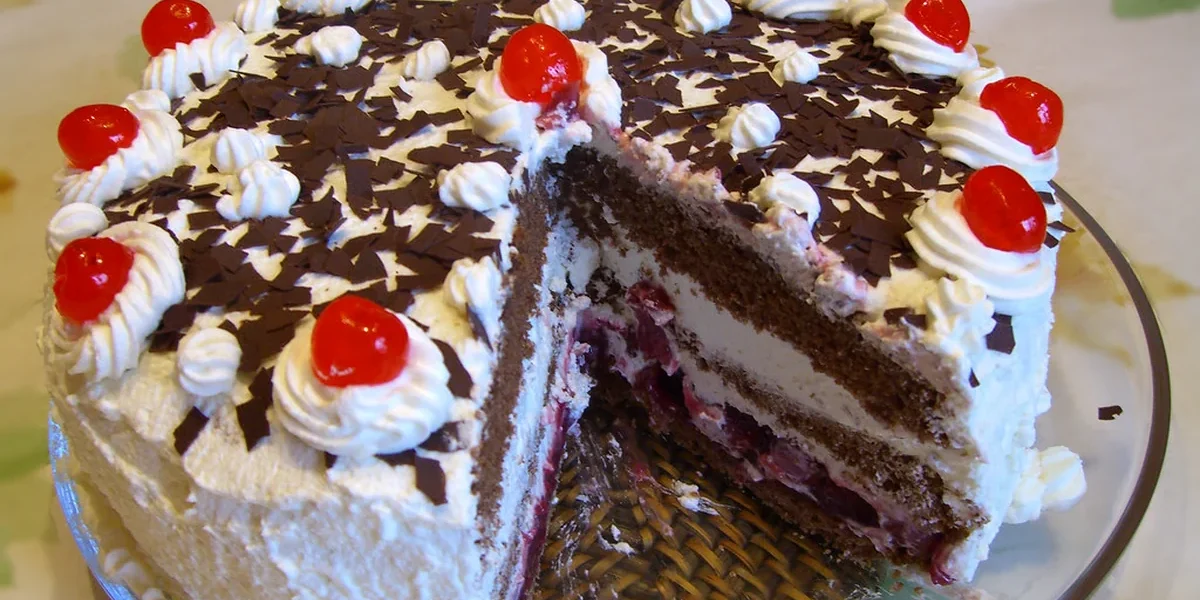
Schwarzwälder Kirschtorte is a German layer cake made with chocolate sponge, sour cherries, whipped cream, and Kirschwasser, a clear cherry brandy distilled in the Black Forest (Schwarzwald) region of southwestern Germany. German food law treats that brandy as a defining component, so a cherry-and-chocolate cake without it is technically a different dessert.
The name translates as “Black Forest cherry torte.” It spread across Germany from the 1930s onward and became the country’s best-known cake, served in hilltop cafés in Baden-Württemberg and bakeries far beyond Europe.
A traditional version needs five things: a light cocoa sponge, tart sour cherries, a Kirschwasser soak, lightly sweetened whipped cream, and dark chocolate shavings on top. Everything else comes down to regional preference.
Key Takeaways
- The cherry brandy soak, sour cherries, and cocoa sponge set the traditional cake apart from generic chocolate-cherry layer cakes.
- Assembly happens in stages: bake and cool the sponge, cook the cherry filling, soak the layers, then fill and coat the cake with stabilized cream.
- Cherry juice can replace the brandy in alcohol-free versions, and the finished cake keeps for two to three days in the refrigerator.
What Defines the Traditional Cake?
A klassische Schwarzwälder Kirschtorte brings together five components: a cocoa sponge (Biskuitboden), a sour cherry filling (Kirschfüllung), a Kirschwasser soak, a cream filling (Sahnefüllung) made with whipped cream (Schlagsahne), and chocolate shavings (Schokoladenspäne). Remove the cherry brandy, and the cake loses the flavor that gives it its name.
Why Is It Called Black Forest Cake?
The name points to Schwarzwälder Kirsch, the cherry brandy distilled from sour cherries grown in the Black Forest. It doesn’t claim that someone invented the cake in a particular village there. Kirschwasser is a protected regional product, and its sharp, dry cherry aroma is what inspired the cake’s name.
German food writers often repeat a second explanation: the black, white, and red of the traditional Black Forest women’s costume, with its dark dress, white blouse, and red pom-pom hat, match the cake’s chocolate, cream, and cherries. It’s a charming story, though no one has verified it.
Which Elements Are Considered Essential?
German food standards describe the cake as containing cream filling and Kirschwasser, along with cherries and a cocoa-based sponge. In practice, bakers treat these as the fixed parts:
- Biskuit with cocoa — a fat-light sponge, not a dense butter cake
- Sour cherries — Schattenmorellen or similar tart varieties
- Kirschwasser — 38 to 45 percent alcohol, clear, unsweetened
- Whipped cream — lightly sweetened, used for both filling and coating
- Chocolate shavings — dark and coarse, covering the sides and top
Some bakers add a base layer of shortcrust pastry (Mürbeteig) beneath the sponge. That’s a regional convention accepted in many Baden bakeries, and leaving it out doesn’t make the cake untraditional.
How Does It Differ From German Chocolate Cake?
German chocolate cake is American. It takes its name from Baker’s German’s Sweet Chocolate, a product named after Samuel German, and it comes filled with a cooked coconut-pecan frosting.
Schwarzwälder Kirschtorte contains no coconut, pecans, or caramel-style frosting. The two cakes share only the word “German” and a dark cake layer.
| Schwarzwälder Kirschtorte | German Chocolate Cake | |
|---|---|---|
| Origin | Germany (Baden-Württemberg) | United States |
| Cake base | Light cocoa sponge | Butter-based chocolate layers |
| Filling | Sour cherries, whipped cream | Coconut-pecan frosting |
| Alcohol | Kirschwasser | None |
| Topping | Chocolate shavings, cherries | Coconut-pecan frosting |
Which Ingredients Create Its Characteristic Layers?
The ingredient list falls into three groups: sponge, made with eggs, sugar, flour, cornstarch, cocoa, and butter; filling, made with sour cherries, cherry juice, cornstarch, and Kirschwasser; and cream, made with heavy cream, sugar, and stabilizer. The quantities below make one 26 cm (10-inch) cake for 12 to 14 people.
Yield: 1 cake, 12–14 slices
Prep time: 50 minutes
Bake time: 30–35 minutes
Chill time: 4 hours minimum
For the chocolate sponge (Schoko-Biskuit):
- 6 eggs (Eier), room temperature, separated
- 150 g (¾ cup) sugar (Zucker)
- 1 packet vanilla sugar (Vanillezucker), about 8 g
- 1 pinch salt (Salz)
- 100 g (¾ cup + 1 tbsp) wheat flour (Weizenmehl), type 405 or all-purpose
- 50 g (⅓ cup) cornstarch (Speisestärke)
- 30 g (¼ cup) baking cocoa (Backkakao), unsweetened
- 1 tsp baking powder (Backpulver)
- 60 g (4 tbsp) melted butter, cooled
For the cherry filling (Kirschmasse):
- 2 jars sour cherries (Sauerkirschen/Schattenmorellen), about 700 g drained weight
- 400 ml (1⅔ cups) cherry juice (Kirschsaft) from the jars
- 40 g (⅓ cup) cornstarch
- 50 g (¼ cup) sugar
- 4 tbsp Kirschwasser
For the cream and finish:
- 1 liter (4¼ cups) heavy cream (Sahne), at least 30% fat
- 3 packets cream stabilizer (Sahnesteif)
- 2 packets vanilla sugar
- 40 g (⅓ cup) powdered sugar
- 3 tbsp Kirschwasser for soaking the layers
- 150 g (5 oz) dark chocolate shavings (Raspelschokolade)
- 12–14 whole cherries for decoration
Choosing Cherries and Cherry Juice
Sour cherries are the right fruit for this cake. Schattenmorellen is the German variety name most often printed on jars, and it refers to a dark, tart Morello-type cherry.
Jarred cherries work better than fresh ones because their packing liquid becomes the Kirschsaft used to thicken the filling. Sweet cherries make the cake taste flat. The tartness balances the cream and cocoa.
The Role of Kirschwasser
Kirschwasser is a clear, dry fruit brandy distilled from whole sour cherries, including the pits, which add a faint almond note. It contains no added sugar, so it sharpens the cake rather than sweetening it.
About 4 tablespoons go into the cherry filling, and 3 go into the sponge soak. A cheap “cherry liqueur” behaves differently. It’s sweet and syrupy, which can make the layers cloying.
What Makes a Light Chocolate Sponge?
Beaten eggs provide the volume, not chemical leavening or creamed butter. Bakers whip the whites (Eiweiß) with sugar to firm peaks, then fold in the yolk mixture and dry ingredients by hand. That keeps the crumb open enough to absorb the soak.
The cornstarch matters here. Replacing a third of the flour with Speisestärke softens the protein structure and gives the cake a more tender slice. Sift the cocoa with the flour so it doesn’t clump.
How Is the Cream Kept Stable?
A cake this tall needs cream that can hold its shape for hours. Sahnesteif, a starch-based whipping cream stabilizer sold in small packets across Germany, is the standard solution. Add it as the cream begins to thicken.
Without it, use cream with at least 36 percent fat, and chill the bowl and beaters first. Stop whipping at firm peaks. Over-whipped cream turns grainy and can’t be rescued.
How Is the Cake Baked and Assembled?
Assembly follows a set order: bake the sponge, cool it completely, cook the cherry filling, split and soak the layers, then build the cake with cream and chill it. Don’t rush the cooling stage. That’s the most common reason a cake slumps.
Baking the Chocolate Sponge in a Springform
- Heat the oven (Backofen) to 180°C (350°F) conventional heat. Line the base of a 26 cm springform pan (Springform) with parchment. Leave the sides ungreased so the batter can climb.
- Beat the egg whites with the salt until soft peaks form. Add the sugar and vanilla sugar in a steady stream, then beat until the peaks look firm and glossy.
- Beat in the yolks one at a time on low speed. The whole process should take about 20 seconds.
- Sift the flour, cornstarch, cocoa, and baking powder over the eggs. Fold them in with a spatula using wide strokes until no dry streaks remain.
- Fold in the cooled melted butter last.
- Pour the batter into the pan and level the surface. Bake for 30 to 35 minutes, until a skewer comes out clean.
- Cool the sponge in the pan for 10 minutes. Run a knife around the edge, then transfer it to a rack and cool completely for at least 2 hours. A warm sponge tears when you split it.
Cooking the Cherry Filling
- Drain the cherries, catching the juice. Measure out 400 ml of Kirschsaft and set aside 100 ml.
- Bring the remaining 300 ml of juice and the sugar to a boil in a saucepan.
- Whisk the cornstarch into the reserved cold juice. Pour it into the pan while stirring, then simmer for 1 minute, until the mixture turns thick and glossy.
- Remove the pan from the heat. Stir in the drained cherries and 4 tablespoons of Kirschwasser, then cool the filling to room temperature. Reserve 12 to 14 cherries for the top.
Soaking and Layering the Tortenboden
- Slice the cooled sponge horizontally into three even layers (Tortenböden) with a long serrated knife or cake wire.
- Brush each cut surface with 1 tablespoon of Kirschwasser. Let it soak in for 5 minutes.
- Whip the cream with the stabilizer, powdered sugar, and vanilla sugar until firm peaks form.
- Place the bottom layer on a cake plate inside a cake ring. Spread a thin band of cream around the rim to hold the filling in place, then spoon in half the cherry mixture. Cover it with cream.
- Add the second layer and press gently. Repeat with the remaining cherries and more cream.
- Set the third layer on top, cut side down. Chill the cake for 1 hour before coating it.
Finishing With Cream, Cherries, and Chocolate
- Remove the ring. Coat the top and sides with a smooth layer of cream, reserving about a quarter for piping.
- Press chocolate shavings (Schokoraspel) against the sides with a palette knife or your hand.
- Pipe 12 to 14 cream rosettes (Sahnetupfen) around the top edge. Set one reserved cherry on each rosette.
- Scatter more shavings across the center. Chill for at least 3 more hours before slicing, so the layers can set.
What Is Known About Its Black Forest Origins?
The cake’s documented history begins in the early twentieth century. Its regional identity rests on Kirschwasser, not on a single confirmed inventor. Cherries and cream had been paired in the Black Forest long before the cake itself appeared.
How Did Kirschwasser Shape the Regional Identity?
The Black Forest has thousands of small licensed distilleries, many attached to farms. They produce fruit brandies from local orchards, and sour cherries were among the crops that could be preserved this way through winter.
That distilling culture explains why the region’s name became attached to a cake made elsewhere in Germany. Travelers exploring the Black Forest and towns such as Triberg im Schwarzwald still find Kirschwasser in cafés and farm shops.
What Do the Main Origin Stories Claim?
Three accounts circulate, and none has been settled:
- Josef Keller, 1915. A confectioner in Bad Godesberg, near Bonn and not in the Black Forest, gets credit in one account for combining cherries, cream, and Kirschwasser on a chocolate base. His written recipe remains the most frequently cited documentary claim.
- Erwin Hildenbrand, 1930. Some German accounts name a pastry chef at Café Agner in Tübingen as the creator of the modern form.
- The costume theory. This folk explanation links the cake’s colors to regional dress, but no documented recipe supports it.
What is certain is that the cake spread widely in Germany during the 1930s and appeared in a printed German cookbook by 1934.
How Did the Cake Become an International German Classic?
Post-war prosperity and the rise of Kaffee und Kuchen, Germany’s afternoon coffee-and-cake custom, put the cake in nearly every café display case by the 1950s. German emigrants and British and American visitors carried it abroad, where it became known as “Black Forest gateau.”
By 1949 it ranked among Germany’s most ordered cakes. Abroad, it now sits alongside schnitzel and sauerbraten as shorthand for German cooking.
How Should It Be Adapted, Served, and Stored?
The cake handles two changes well: replacing the brandy with cherry juice and splitting the work across two days. Whipped topping and canned pie filling, though, don’t work nearly as well.
How Can You Make an Alcohol-Free Version?
Replace the 3 tablespoons of soaking Kirschwasser with 6 tablespoons of cherry juice (Kirschsaft). Replace the 4 tablespoons in the filling with the same volume of juice. The extra liquid makes up for its thinner consistency.
For a closer flavor match, simmer 100 ml of cherry juice with 1 teaspoon of lemon juice until reduced by half. Cool it, then use it as the soak. A drop of almond extract mimics the pit note in the brandy.
Can the Components Be Prepared a Day Ahead?
Yes, and the sponge actually improves with the extra time. Bake the Biskuitboden one day early, cool it, wrap it in plastic, and keep it at room temperature or in the refrigerator (Kühlschrank) for up to three days.
The cherry filling also keeps for a day when covered and chilled. Whip the cream and assemble the cake on serving day, since whipped cream loses volume after roughly 24 hours, even when stabilized.
A fully assembled cake benefits from at least 4 hours in the refrigerator before serving. Many German bakers assemble it the evening before.
How Long Does It Keep in the Refrigerator?
It keeps for two to three days when covered and stored at 4°C (39°F) or below. The cream limits its shelf life, and the cake tastes best within 48 hours.
Store it under a cake dome or loosely tented with foil so the cream doesn’t absorb refrigerator odors. Slices can be frozen for up to a month, although the cream turns slightly rougher when thawed.
Which Shortcuts Change the Traditional Result?
Some substitutions go unnoticed; others completely rewrite the cake:
| Shortcut | Effect on the result |
|---|---|
| Boxed cake mix | Denser crumb, absorbs less soak |
| Canned cherry pie filling | Sweeter, gel texture, no tartness |
| Non-dairy whipped topping | Holds shape well, flat flavor |
| Sweet cherry liqueur for Kirschwasser | Cloying; loses the dry cherry note |
| Milk chocolate shavings | Softens quickly, less contrast |
Buying a block of dark chocolate and shaving it with a vegetable peeler takes five minutes. It makes more visual difference than almost any other single step. More on regional German food traditions sits in the wider culture coverage from Everything About Germany.
Frequently Asked Questions
What is Schwarzwälder Kirschtorte called in English?
It is called Black Forest cake in American English and Black Forest gateau in British English. The German name translates literally as “Black Forest cherry torte,” preserving the cherry element that the English names leave out.
Which ingredient belongs in an authentic Schwarzwälder Kirschtorte?
Kirschwasser, the clear cherry brandy from the Black Forest, defines the cake under German food standards. Sour cherries, a cocoa sponge, whipped cream, and dark chocolate shavings complete the traditional build.
Can Schwarzwälder Kirschtorte be made the day before?
Yes. Assembling the cake the evening before serving lets the Kirschwasser and cherry juice settle into the sponge. The layers also slice more cleanly after a night in the Kühlschrank. Keep the cake covered and serve it within 48 hours of assembly.
Can Black Forest Cake be made without alcohol?
Yes. Substitute cherry juice (Kirschsaft) for the Kirschwasser in both the soak and the filling. Use about double the volume of juice, since it is thinner and less aromatic than the brandy.
Are Morello cherries the same as the cherries used in Schwarzwälder Kirschtorte?
Essentially, yes. Schattenmorellen, the variety named on most German jars, is a Morello-type sour cherry that’s dark red and tart. Jarred Morello cherries sold in American stores work directly in the recipe, and their packing juice serves as the Kirschsaft.