Quedlinburg
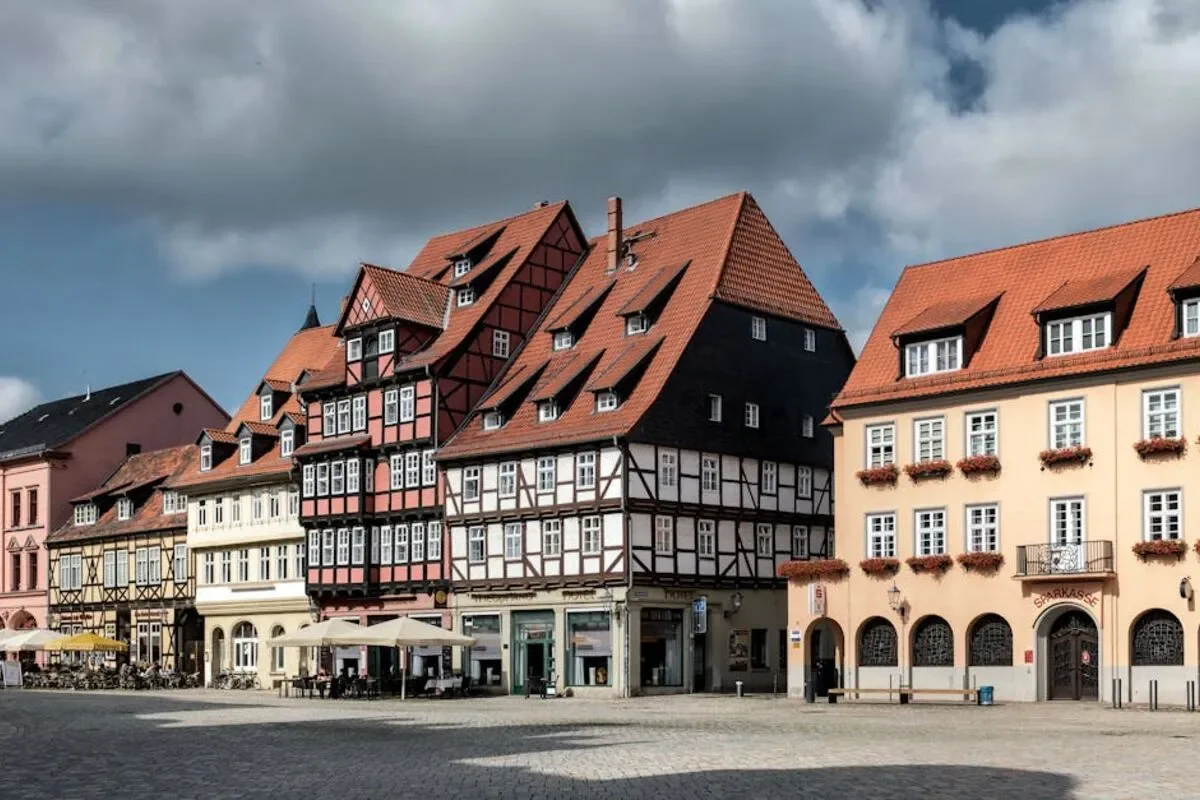
Quedlinburg is a medieval town in Saxony-Anhalt, on the northeastern edge of the Harz Mountains. Its Collegiate Church, Castle, and Old Town joined the UNESCO World Heritage List in 1994. Around 2,000 half-timbered houses from eight centuries stand across a protected area of about 93 hectares.
That scale separates the town from a single restored street or rebuilt market square. The street plan, its buildings, and the royal complex above the rooftops survived largely intact, which led UNESCO to treat the whole ensemble as one monument.
This Quedlinburg travel guide gives readers what they need to plan a visit: the sights worth prioritizing, a realistic one to three day route, rail connections from Berlin and Magdeburg, and the Harz day trips that pair naturally with a short stay.
Quedlinburg also carries unusual political weight in German history. Henry I, the first Saxon king of the East Frankish realm, was buried here in 936, and his widow Mathilde founded the women’s abbey that shaped the town for the next eight centuries.
Key Takeaways
- Quedlinburg’s UNESCO listing covers three linked areas: the Old Town, the Schlossberg with the Collegiate Church, and the Münzenberg.
- One full day covers the castle hill, the cathedral treasury, and the main half-timbered streets. Two or three days allow Harz trips by narrow gauge steam railway.
- Regional trains connect the town with Magdeburg, Halle, and Berlin, and the station sits about a 10 minute walk from the market square.
What Makes Quedlinburg a UNESCO World Heritage City?
Quedlinburg earned World Heritage status because an entire medieval town plan survived, along with the royal and religious complex that created it. The town served as a seat of power for the Ottonian dynasty and later became a prosperous trading center with links to the Hanseatic League.
The 1994 UNESCO Inscription and Its Three Components
UNESCO inscribed “Collegiate Church, Castle and Old Town of Quedlinburg” on the World Heritage List in 1994. The listing names three connected areas rather than one building.
- Historic center (Altstadt): the medieval street grid and its half-timbered housing stock
- Schlossberg (castle hill): the Collegiate Church of St. Servatius and the castle buildings
- Münzenberg: a second hill west of the Old Town with the remains of a former monastery
The protected zone covers roughly 93 hectares, making Quedlinburg one of Germany’s largest area monuments. The value lies in the whole townscape, including modest houses that would rarely make the list on their own.
From King Henry I to the Ottonian Dynasty
Quedlinburg first appears in written records in 922, in a document issued by Henry I. He died in 936 and was buried on the castle hill, and his tomb remains in the crypt of St. Servatius.
His widow Mathilde founded a women’s collegiate foundation on the hill that same year. Under Otto I and his successors, the site served as a royal residence and assembly place. That history helps explain why historians connect Quedlinburg with the formation of the early German kingdom.
How the Abbey Shaped a Medieval Town
An abbess who answered to the emperor ruled the abbey. It held land, market rights, and legal authority over the settlement below, and that arrangement lasted until 1802.
Trade brought a second layer of wealth. Quedlinburg traded in cloth and later in seeds and plants, while its merchant houses paid for the tall timber-framed buildings that fill the center today. For readers comparing German medieval towns, the mix of imperial abbey and merchant trade sets Quedlinburg apart from a purely commercial center like Rothenburg ob der Tauber.
What Are the Essential Sights in Quedlinburg?
The core sights sit in two clusters: the Schlossberg with its church, treasury, and museum, and the Marktplatz area at the heart of the Old Town. A third stop, the Münzenberg, takes about 15 minutes to reach on foot from the market square.
Schlossberg, Quedlinburg Castle, and the Castle Museum
The Schlossberg is a sandstone rock about 25 meters above the Old Town. It holds the former abbey buildings and the Renaissance palace known as Quedlinburg Castle. The complex replaced earlier medieval structures between the 16th and 17th centuries.
Inside, the Schlossmuseum (Castle Museum) covers the abbey’s history, the Ottonian period, and the site’s misuse during the Nazi years, when the church became a political shrine. The terraced castle gardens on the slope offer the clearest view over the town’s roofs. Check the museum’s published admission fees and seasonal opening hours before visiting.
The Collegiate Church of St. Servatius and Cathedral Treasury
St. Servatius, often called the Stiftskirche, is a Romanesque church consecrated in 1129 and one of Germany’s most important examples of Romanesque architecture. Its nave uses the Saxon alternation of columns and pillars.
The crypt holds the graves of Henry I and Mathilde. The Domschatz (cathedral treasury) is displayed in the church and includes medieval manuscripts, reliquaries, and textiles. Thieves stole several pieces at the end of the Second World War, and they returned from the United States in the 1990s.
Marktplatz, Rathaus, and the Roland Statue
The Marktplatz (market square) forms the civic center of the Old Town. It is framed by the Renaissance Rathaus (town hall), whose portal dates from 1616 to 1619. The festival hall inside was completed in 1901 and appears on guided tours arranged through the Quedlinburg Information office.
A stone Roland statue stands beside the town hall. German towns placed Roland figures as symbols of market rights and civic freedom, and Quedlinburg’s dates from the 15th century.
Münzenberg and Its Monastic Remains
The Münzenberg is the hill facing the Schlossberg across the small Bode valley. A convent of St. Mary stood here from the 10th century until the Peasants’ War destroyed it in 1525.
Residents later built small houses directly into the ruins, and those walls remain visible in the lanes. Local volunteers run the Münzenbergmuseum, which explains the site’s history in a former musician’s house.
How Should You Explore the Old Town?
Walking is the only practical way to see the Old Town, and most of its 2,000 half-timbered houses stand within a 20 minute radius of the Marktplatz. The oldest examples, museums, and artisan workshops sit along a handful of connected lanes.
Half-Timbered Architecture and Timber Framing
Quedlinburg’s timber framing spans eight centuries, making the town a working record of how the technique changed. Early builders used the Ständerbau method, with long vertical posts running from the ground to the roof.
The Fachwerkmuseum im Ständerbau (Half-Timbered Museum) occupies a house on Wordgasse dated to about 1310, one of Germany’s oldest surviving timber-framed dwellings. Later houses show carved beams, overhanging upper floors, and painted decoration from the Renaissance and Baroque periods. Anyone tracing this building tradition across the country can follow the wider German Half-Timbered Route itinerary, which links Quedlinburg with towns in Lower Saxony, Hesse, and Thuringia.
A Walking Route Through Wordgasse and Steinweg
A compact route starts at the Marktplatz, runs through the district called the Word, and continues along Wordgasse to the half-timbered museum. From there, the climb to the Schlossberg takes about five minutes.
Coming back down, Steinweg leads east toward the Bode, with a long line of merchant houses along the way. The cobblestone streets are uneven, so flat shoes are worth packing. You can book guided walking tours in English through the tourist information office.
Museums, Artisan Shops, and Local Culture
Three museums cover the town’s cultural history beyond architecture:
- Klopstockhaus: birthplace of the poet Friedrich Gottlieb Klopstock (1724 to 1803), author of the epic Der Messias
- Lyonel Feininger Gallery: works by the Bauhaus painter and printmaker Lyonel Feininger
- Stadtmuseum: town history in the medieval Ständerbau on the Schlossberg
Small workshops in the center sell ceramics, printed textiles, and woodwork, and several operate as combined studios and shops.
How Do You Plan a Quedlinburg Itinerary?
One full day covers the UNESCO ensemble at a reasonable pace, while two or three days allow museum visits plus Harz excursions. Late spring and early autumn bring mild weather and lighter crowds, while Advent is the busiest period of the year.
A One-Day Route for First-Time Visitors
A single day works well in this order:
- Morning: Marktplatz, Rathaus, and the Roland statue, then the Word district and the Fachwerkmuseum
- Midday: climb to the Schlossberg for St. Servatius and the Domschatz
- Afternoon: Schlossmuseum and the terraced garden, then descend to the Münzenberg
- Late afternoon: Steinweg and a stop in one of the wine bars near the market
Buying tickets on arrival at each site is straightforward, though the church closes for services and the treasury has restricted hours in winter.
How to Spend Two or Three Days in Town and the Harz
A second day gives you room for the Klopstockhaus, the Lyonel Feininger Gallery, and a walk in Brühl Park. This landscaped green space lies southwest of the center, where the Romantik Hotel am Brühl sits.
Day three suits a Harz trip by rail. Wernigerode takes about 30 minutes by regional train, and the Bode Gorge near Thale is reachable in under an hour. Readers building a longer route can slot the town into a wider plan for a trip through Germany alongside Magdeburg or Leipzig.
Best Time to Visit Quedlinburg
May, June, and September offer the most comfortable walking weather and full museum hours. Weekly markets on the Marktplatz run through the warmer months, usually on Wednesday and Saturday mornings.
Winter is cold and daylight is short, though the Old Town grows quieter outside Advent weekends. Local menus lean toward Harzer Käse (a strong sour-milk cheese), regional beer, and wines served in the small bars around the center.
Christmas Market and Advent in den Höfen
Quedlinburg’s Christmas market runs on the Marktplatz through Advent, with wooden stalls beneath the town hall. The town’s distinctive event is Advent in den Höfen (“Advent in the Courtyards”), when residents open around 20 private half-timbered courtyards to visitors on selected weekends in December.
The courtyard weekends draw large numbers of day visitors, so accommodation books out months ahead and trains from Magdeburg run full. The town publishes exact dates each autumn.
How Do You Reach Quedlinburg and Explore the Harz?
Quedlinburg has no airport or direct long-distance ICE service. Most visitors arrive by regional train via Magdeburg or Halle, or by car. The station sits on the eastern edge of the Old Town and also serves as the northern terminus of the Harz narrow gauge network.
Regional Trains From Berlin, Magdeburg, Halle, Leipzig, and Hannover
Deutsche Bahn regional trains reach Quedlinburg from several hubs. Typical journey times include:
| From | Route | Approximate time |
|---|---|---|
| Magdeburg | Direct regional train | 1 hour 15 minutes |
| Halle (Saale) | Via Aschersleben | 1 hour 30 minutes |
| Berlin | Via Magdeburg | 3 hours |
| Leipzig | Via Halle or Magdeburg | 2 hours 30 minutes |
| Hannover | Via Magdeburg or Halberstadt | 3 hours |
Timetables change with each schedule period, so confirm connections on the Deutsche Bahn site before traveling. FlixBus serves nearby Halberstadt and Wernigerode rather than Quedlinburg itself.
Arrival at Quedlinburg Station and Getting Around Locally
Quedlinburg station sits about a 10 minute walk from the Marktplatz along Bahnhofstraße. You won’t need a vehicle once you’re in the center, and much of the Old Town is closed or restricted to cars.
Local buses connect the station with outer districts, Thale, and Halberstadt. Drivers should use the marked car parks around the edge of the historic zone because the cobbled lanes are narrow and mostly one-way.
Harz Narrow Gauge Railways and Steam Train Routes
The Harzer Schmalspurbahnen (Harz Narrow Gauge Railways) run a 140 kilometer meter-gauge network with regular steam-hauled services. Quedlinburg marks the eastern end of the Selketalbahn line toward Gernrode, Alexisbad, and Hasselfelde.
To reach the Brocken, Germany’s highest peak outside the Alps at 1,141 meters, travelers coming from Wernigerode change to the Brockenbahn at Drei Annen Hohne. The Brocken summit train gets busy, and seats can sell out in summer and around holidays.
Day Trips to Brocken, Wernigerode, and the Bode Valley
Three trips fit especially well with a Quedlinburg base:
- Wernigerode: half-timbered center and a hillside castle, 30 minutes by regional train
- Thale and the Bode Gorge: a marked hiking path through the Bode valley between Thale and Treseburg, roughly 10 kilometers
- Teufelsmauer (Devil’s Wall): a sandstone rock ridge north of Thale and Blankenburg, reachable on foot or by local bus
Goslar, another UNESCO-listed town on the western side of the Harz, takes about two hours by train. It works better as an overnight trip than a same-day return. Everything About Germany’s regional coverage explains how these Harz sites connect with the wider network of German UNESCO heritage landscapes.
Frequently Asked Questions
Is Quedlinburg worth visiting?
Quedlinburg is worth visiting if you’re interested in German architecture or medieval history. Around 2,000 half-timbered houses and the Ottonian royal complex survive in one protected area. The compact center packs a lot into a day, though travelers seeking nightlife or major art collections may find the options limited.
What is Quedlinburg known for?
Quedlinburg is known for half-timbered houses spanning eight centuries and for its role as an Ottonian royal seat. King Henry I was buried here in 936, and his tomb lies in the crypt of the Collegiate Church of St. Servatius.
The Collegiate Church, Castle, and Old Town joined the UNESCO World Heritage List in 1994.
How do I get from Berlin to Quedlinburg by train?
The standard route runs from Berlin to Magdeburg on a fast train, followed by a regional train to Quedlinburg. The full journey takes about three hours. Some connections go via Halberstadt instead, and Deutsche Bahn provides current bookings and timetables.
How many days do you need in Quedlinburg?
One full day covers the Schlossberg, the cathedral treasury, and the main Old Town streets. Two days let you add the Klopstockhaus, the Feininger Gallery, and the Münzenberg without rushing. A third day works best for a Harz trip to Wernigerode, the Brocken, or the Bode Gorge.
When is the best time to visit Quedlinburg?
May, June, and September offer mild weather, long daylight hours, and full museum schedules. December brings the biggest crowds, thanks to the Christmas market and the Advent in den Höfen courtyard weekends. Rooms often book out well in advance.
January and February are quiet and cold, but they’re also the cheapest months for a stay.
💡 Essential Travel Tips
Explore the historic Old Town (Altstadt) on foot and use the local S-Bahn/U-Bahn network.
🥨 Local Insights & Food Culture
Purchase a 24-hour transit day pass (Tageskarte) for unlimited city travel.
🎟️ Top Activities & Experiences in Quedlinburg
Discover curated walking tours, museum passes, and authentic experiences in Quedlinburg with instant confirmation.