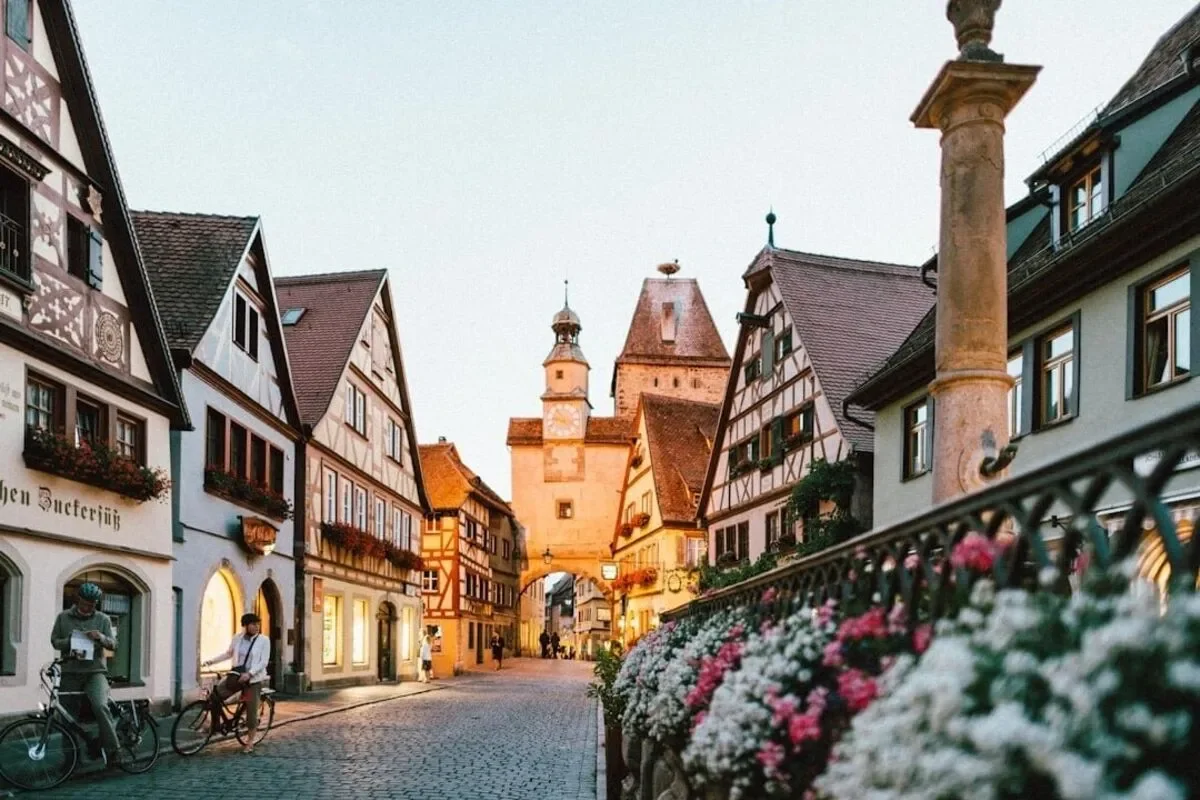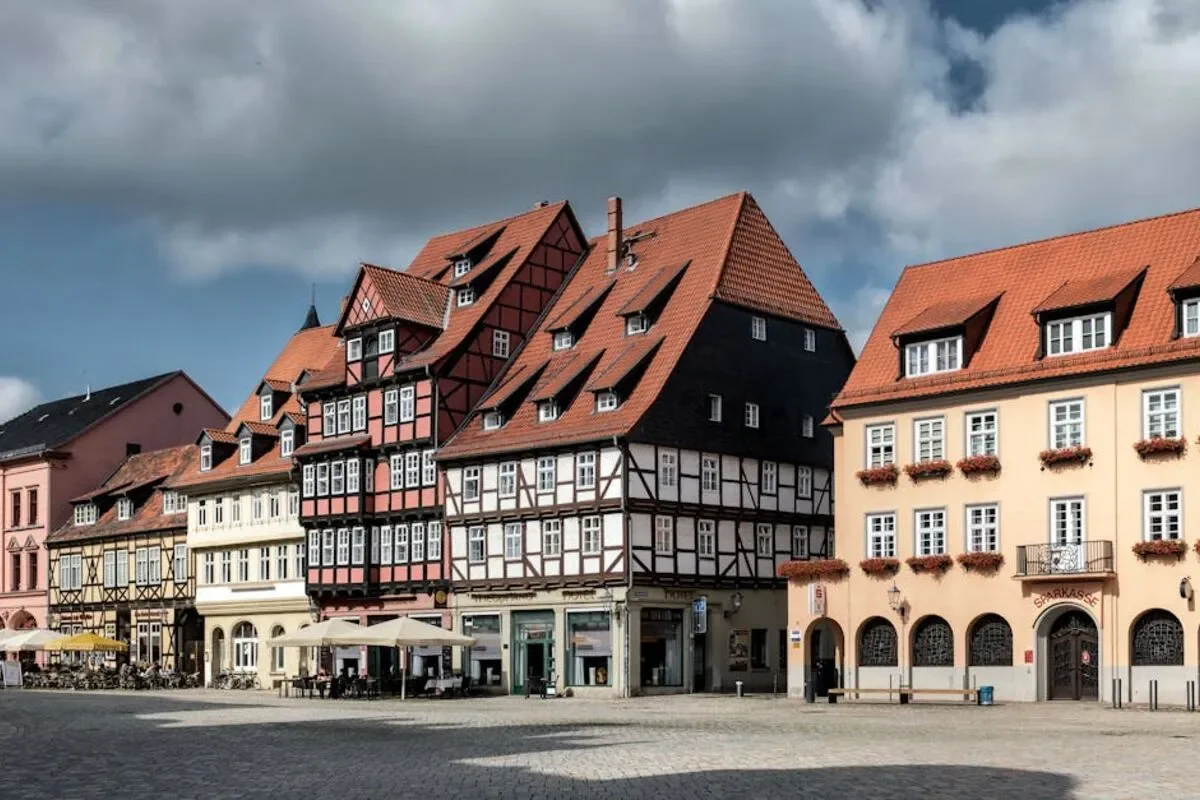
Quedlinburg
UNESCO World Heritage town with over 2,000 half-timbered houses spanning six centuries, birthplace of…
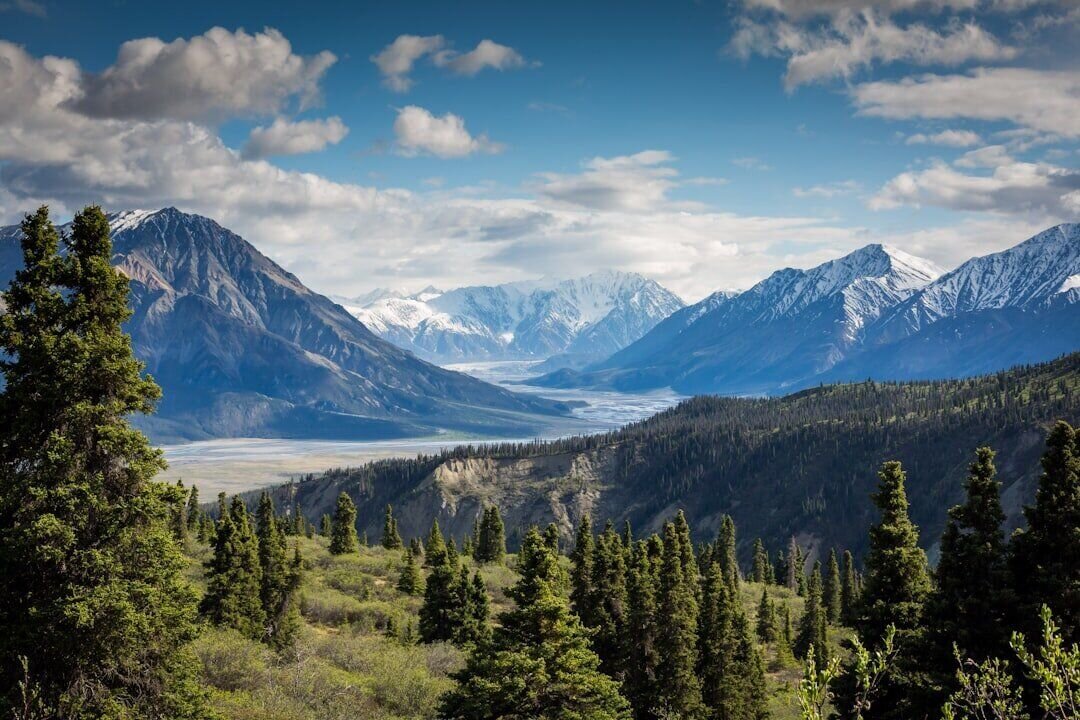
Saxony-Anhalt (Sachsen-Anhalt) sits in central Germany, between Berlin and the Harz Mountains. It holds one of the country’s densest concentrations of UNESCO World Heritage: Luther’s Reformation sites, the Bauhaus buildings in Dessau, the medieval town of Quedlinburg, Naumburg Cathedral, the Dessau-Wörlitz Garden Realm, and the Middle Elbe Biosphere Reserve.
Travelers who plan around four anchors, the Luther towns, Dessau’s Bauhaus, the Harz, and the Saale-Unstrut wine valley, can see the state’s core in four to seven days using regional trains and short drives.
That density makes the region practical to visit. Wittenberg to Dessau takes about half an hour by rail, while Quedlinburg and Wernigerode sit less than 20 minutes apart. In a single day, you can move from a Bronze Age sky map in Halle to a Gothic cathedral in Naumburg.
Saxony-Anhalt covers 20,452 square kilometers in central Germany and has roughly 2.14 million residents. It borders Brandenburg, Saxony, Thuringia, and Lower Saxony.
Its identity comes from three things: the Elbe and Saale river systems, the Harz uplands in the west, and a layered history running from the Holy Roman Empire through Prussia to East Germany.
Saxony-Anhalt and Saxony are two separate federal states with different capitals, dialects, and histories. Saxony holds Dresden and Leipzig; Saxony-Anhalt holds Magdeburg and Halle.
The confusion is understandable. Both names come from the historic Saxon lands, but modern borders took shape after World War II, not in the Middle Ages.
To the west lies Lower Saxony, which shares the Harz range. Thuringia borders the southwest and shares the Saale valley. Brandenburg wraps around the northeast, putting Berlin within easy reach.
The modern state combines the former Duchy of Anhalt around Dessau and Köthen with Prussian Saxony, the province Prussia carved out after 1815. The current borders date to 1990, when Germany reunified and re-formed the state.
Between 1949 and 1990, this was East Germany’s most industrialized area, centered on chemical plants around Halle, Bitterfeld, and Wolfen. Many of those plants closed after 1990, leaving a landscape of restored old towns, industrial museums, and quiet countryside.
Geography sorts the state into workable travel zones:
Each zone works as a two- or three-day base. Crossing between them takes one to two hours by car or train.
Start with Lutherstadt Wittenberg, Dessau, Quedlinburg, and Halle if time is short. Together, they cover the Reformation, Bauhaus, medieval townscape, and archaeology.
Add Naumburg and Freyburg for cathedral Gothic and wine, and the Altmark for a slower, less-visited north.
Lutherstadt Wittenberg is where Martin Luther published his 95 Theses against the sale of indulgences in 1517. The Schlosskirche (Castle Church) holds his tomb and has bronze doors inscribed with the theses.
The Lutherhaus, his family home in a former monastery, is now the world’s largest museum of Reformation history. Both sites, together with the Melanchthonhaus, joined the UNESCO list in 1996.
Lutherstadt Eisleben, about 90 minutes west by rail, preserves Luther’s birth house and death house. It works well as a half-day trip from Halle.
The Bauhaus Dessau building, designed by Walter Gropius and opened in 1926, is the defining structure of the Bauhaus movement and a founding work of the International Style. Nearby, the Masters’ Houses held Kandinsky, Klee, and Feininger.
The school marks its Dessau centenary through 2026 with exhibitions in the main building and elsewhere in the city.
Twenty minutes east, the Dessau-Wörlitz Garden Realm (Gartenreich Dessau-Wörlitz) spreads English-style landscape parks across 142 square kilometers of Elbe floodplain. Schloss Wörlitz, built in the 1770s, was among Germany’s first neoclassical buildings.
Magdeburg, the state capital, grew around Otto I of the Ottonian dynasty, who lies buried in Magdeburg Cathedral. Begun in 1209, it is the oldest Gothic cathedral on German soil.
The city also honors Otto von Guericke, the 17th-century mayor and physicist who demonstrated vacuum pressure with the Magdeburg hemispheres. Friedensreich Hundertwasser’s last building, the Grüne Zitadelle, stands near the cathedral.
Halle (Saale) is the state’s largest city and the birthplace of George Frideric Handel. The Handel Festival (Händel-Festspiele) runs each June, while the State Museum of Prehistory holds the Nebra Sky Disk.
Quedlinburg holds roughly 1,300 timber-framed houses built across six centuries, earning the entire old town a UNESCO listing in 1994. The Stiftsberg above town carries St. Servatius Collegiate Church and its cathedral treasury, which is reopening in phases through 2026.
Wernigerode, 20 minutes northwest, is known for colorful half-timbered houses and a hilltop castle rebuilt in 19th-century historicist style.
Thale sits at the mouth of the Bode Gorge, the deepest rock valley north of the Alps. A cable car runs to the Hexentanzplatz plateau, and the nearby Rappbode dam carries one of Europe’s longest pedestrian suspension bridges.
Naumburg Cathedral gained UNESCO status in 2018, largely because of the twelve donor statues carved around 1250 by the anonymous Naumburg Master. The figure of Uta von Ballenstedt is among Europe’s best-known medieval sculptures.
Saale-Unstrut is one of Germany’s northernmost wine regions, planted mostly with Müller-Thurgau, Silvaner, and Weißburgunder. Freyburg holds Schloss Neuenburg and the Rotkäppchen sparkling wine cellars, whose vaulted rooms include a 120,000-liter carved wooden cask.
The Altmark in the far north is thinly populated farmland with Hanseatic brick towns. Tangermünde keeps a walled old town above the Elbe, while Stendal has a Gothic cathedral and Uenglinger Gate. Salzwedel is known for Baumkuchen, the layered spit cake.
Arendsee, a glacial lake, is the region’s main swimming and boating spot.
South and central Anhalt hold quieter stops: Bernburg with its Saale-side castle, Köthen where Johann Sebastian Bach worked from 1717 to 1723, Zerbst, and Mansfeld, where Luther grew up. Broader planning context for these routes appears across Everything About Germany’s regional guides.
Four movements shaped Saxony-Anhalt’s heritage sites, each leaving physical traces you can visit in a single trip: Bronze Age astronomy, Ottonian imperial power, the Protestant Reformation, and Bauhaus modernism. The sites sit close enough to form one continuous story.
The Nebra Sky Disk, found in 1999 near Nebra, is a bronze plate about 32 centimeters across, inlaid with gold sun, moon, and star symbols. Dated to around 1600 BCE, it is the oldest known concrete depiction of the night sky.
The disk is displayed in Halle, while the Arche Nebra visitor center stands near the find site.
The Goseck Circle, a reconstructed Neolithic enclosure from about 4900 BCE, aligns with the winter solstice sunrise. Both sites lie on the Himmelswege (Sky Paths) route, a signed driving trail linking four archaeological locations.
Otto I was crowned in 936 and made Magdeburg his imperial seat, founding the archbishopric that carried Christianity east. His first wife, Editha, is buried in the cathedral, and the Ottonian dynasty ruled the Holy Roman Empire until 1024.
The Straße der Romanik (Romanesque Road) is a 1,180-kilometer signed route through 88 buildings across the state. Most are churches, monasteries, and castles from the 10th to 13th centuries, and the figure-eight loop centers on Magdeburg.
Luther’s break with Rome began in Wittenberg and spread through printed pamphlets within months. His colleague at the university, Philipp Melanchthon, drafted the Augsburg Confession, which remains a doctrinal foundation for Lutheran churches.
The Luther Memorials in Wittenberg and Eisleben mark 30 years on the UNESCO list in 2026, with tours and programming from June through September. For context on other figures from this period, Everything About Germany’s history pages cover the wider cast.
The Bauhaus school moved from Weimar to Dessau in 1925 and stayed until 1932, its most productive period. The Dessau buildings introduced the glass curtain wall, flat roofs, and asymmetric plans that later became standard in modernist architecture worldwide.
UNESCO listed the Bauhaus Buildings in Weimar, Dessau, and Bernau in 1996. Dessau also holds the Törten housing estate, an early experiment in prefabricated worker housing.
The Harz National Park, the Elbe Cycle Route, and the Saale valley give Saxony-Anhalt a full outdoor season. You can hike and ride steam railways in the mountains, cycle flat long-distance routes along the rivers, or take a boat through floodplain forest. Most of it works without a car.
The Brocken rises 1,141 meters, making it the highest point in northern Germany. It sits inside Harz National Park, and its bare, windswept summit is reachable on foot from Schierke in about two and a half hours.
The Harz Narrow Gauge Railways (Harzer Schmalspurbahnen) run 140 kilometers of meter-gauge track with daily steam trains. The Brocken Railway climbs from Wernigerode to the summit in about 100 minutes.
Winter brings cross-country skiing around Schierke and Braunlage, along with modest downhill runs. Snow cover varies from year to year.
The Harzer Wandernadel hiking badge system covers 222 stamped checkpoints across the range. It gives anyone following German Wandern hiking culture a useful structure.
The Elberadweg (Elbe Cycle Route) crosses the state for roughly 300 kilometers. The route stays flat and largely traffic-free, passing Wittenberg, Dessau, Magdeburg, and Tangermünde.
The Saale Cycle Route runs 427 kilometers in total. It enters from Thuringia and follows the river through Naumburg, Halle, and Bernburg to the Elbe at Barby.
The Unstrut route links vineyards between Naumburg and Freyburg along a short 30-kilometer stretch. Regional trains carry bicycles for a supplementary ticket, so one-way rides are practical.
Elbe cruise ships stop at Magdeburg, Dessau-Roßlau, and Wittenberg on Hamburg-to-Prague itineraries. Shorter sightseeing boats operate from Magdeburg in summer.
Canoe rentals on the Saale between Halle and Bernburg suit beginners. The current moves slowly, and staff operate the locks.
In Wörlitz, gondola-style boats cross the lake to garden islands. The Garden Realm sits about 80 kilometers east of Goslar, making a Harz-and-gardens combination workable in one week.
Fly into Leipzig/Halle Airport or take a direct train from Berlin. Then base yourself in Halle, Dessau, or Quedlinburg and travel by regional rail.
Four days covers the UNESCO core; a week adds the Harz and the Altmark.
May through September brings the most reliable weather, with July averages around 24°C (75°F). Winter in the Harz brings snow above 600 meters.
Dated highlights worth planning around:
Christmas markets run from late November to December 23 in Magdeburg, Halle, Quedlinburg, and Wernigerode. Quedlinburg’s Advent in den Höfen opens private courtyards across the old town on two weekends.
Comparisons with other regions appear in the ultimate German Christmas market guide.
Leipzig/Halle Airport is the closest hub, 25 minutes by S-Bahn from Halle Hauptbahnhof. Berlin Brandenburg Airport is about two hours from Magdeburg.
Approximate rail times on Deutsche Bahn:
| From | To | Time | Notes |
|---|---|---|---|
| Berlin Hbf | Lutherstadt Wittenberg | 40 min | ICE, direct |
| Berlin Hbf | Magdeburg | 1 hr 40 min | IC/RE |
| Leipzig Hbf | Halle (Saale) | 30 min | S-Bahn or RE |
| Hannover Hbf | Magdeburg | 1 hr 30 min | IC |
| Frankfurt Hbf | Halle (Saale) | 3 hr 30 min | ICE |
FlixBus serves Magdeburg, Halle, and Wittenberg from Berlin at lower fares and slower speeds. Check current schedules and prices before booking.
Regional trains connect all major towns. The Sachsen-Anhalt-Ticket covers unlimited regional travel for one day for up to five people.
The Deutschland-Ticket works on every regional and local service in the state. A car helps with the Altmark, the Himmelswege archaeological route, and the smaller Harz villages, where bus service thins outside peak hours.
Useful rail pairings:
Halle and Magdeburg have the widest range of hotels and hostels. Quedlinburg and Wernigerode offer timber-framed guesthouses, but they book out on summer weekends and during Advent.
Regional dishes to look for:
Freyburg’s Rotkäppchen cellars run daily tours with tastings.
Two days (Reformation and Bauhaus): Visit Wittenberg for the Schlosskirche and Lutherhaus, then stay overnight. Continue to Dessau for the Bauhaus building and Wörlitz gardens.
Four days: Add Halle for the Nebra Sky Disk and Handel’s birthplace. On day four, visit Naumburg Cathedral and enjoy a Freyburg tasting.
One week: Follow the four-day plan, then move to Quedlinburg for two nights. Cover Wernigerode, the Brocken Railway, and the Bode Gorge at Thale.
Close with Magdeburg for the cathedral and the Grüne Zitadelle. For wider trip structure, see planning a trip to Germany.
Confirm admission prices, opening hours, and train times on official sites before you travel.
Saxony-Anhalt is best known for its UNESCO World Heritage sites, including Luther’s Reformation locations in Wittenberg and Eisleben, the Bauhaus buildings in Dessau, and the medieval old town of Quedlinburg. The state also holds the Nebra Sky Disk, the oldest known depiction of the night sky, and the Harz Mountains in the west.
Magdeburg is the capital of Saxony-Anhalt. It sits on the Elbe River in the center of the state and has about 240,000 residents, making it the second-largest city after Halle (Saale).
Magdeburg Cathedral, begun in 1209, holds the tomb of Emperor Otto I.
They are two separate federal states. Saxony-Anhalt lies north and west of Saxony, with Magdeburg as its capital and heritage centered on Luther, Bauhaus, and the Harz.
Saxony sits to the southeast, with Dresden as its capital, and is associated with baroque architecture, Meissen porcelain, and Leipzig’s music history.
Four days covers the main UNESCO sites: Wittenberg, Dessau, Halle, and Naumburg. A full week allows time to add Quedlinburg, Wernigerode, the Brocken, and Magdeburg without rushing.
Two days works for a focused Reformation-and-Bauhaus trip from Berlin or Leipzig.
Direct trains take about 40 minutes from Berlin Hauptbahnhof to Lutherstadt Wittenberg and roughly 1 hour 40 minutes to Magdeburg. FlixBus also serves both cities, with lower fares but longer travel times. If you’re driving, Magdeburg lies about 90 minutes west of Berlin via the A2.