Erfurt
Thuringia's capital seamlessly blends medieval charm with horticultural excellence in the geographic heart of…
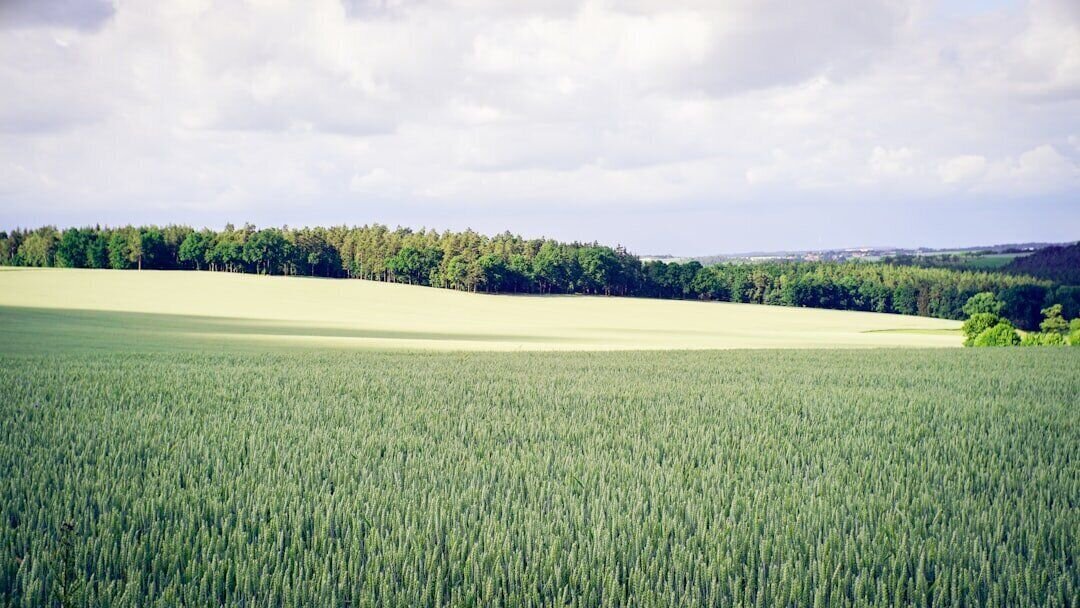
Thuringia (Thüringen in German) is a federal state in central Germany, about 6,244 square miles in size, with roughly 2.1 million residents and Erfurt as its capital. People often call it the “Green Heart of Germany” because forests and low mountains cover much of its territory.
That compact size matters in practical terms for visitors. Erfurt, Weimar, and Eisenach sit along a single rail corridor, and each stop carries a distinct chapter of German culture: medieval trade and Martin Luther’s student years, the writing of Goethe and Schiller, and the castle where Luther translated the New Testament into German.
A well-planned four to six days in Thuringia lets a traveler walk a medieval merchants’ bridge, tour Bauhaus and Classical Weimar sites, visit a UNESCO-listed castle, and hike a ridge trail in the Thuringian Forest, all within about 60 miles of each other.
Five UNESCO World Heritage listings fall inside those borders, a high concentration for a state of this size. The attractions reward travelers who move slowly between towns and see the region’s history and landscape as one connected story.
Thuringia holds an outsized place in German history because so many turning points happened inside its borders: Luther’s Bible translation, the literary movement known as Weimar Classicism, the founding of the Bauhaus school, and the signing of Germany’s first democratic constitution in 1919.
The state takes its name from the Thuringii, a Germanic people whose kingdom the Franks absorbed in 531 AD. Centuries later, the Landgraviate of Thuringia became a major power in central Germany, with Wartburg Castle as its seat.
The modern state formed in 1920, disappeared under East Germany’s district system in 1952, and returned in 1990 as one of the 16 federal states after German reunification.
For centuries, Thuringia was divided into small duchies ruled by branches of the House of Wettin. Saxe-Weimar, Saxe-Gotha, Saxe-Coburg, Saxe-Weimar-Eisenach, and Saxe-Altenburg each maintained their own court, theater, library, and palace.
That fragmentation explains the density of cultural buildings today. A state this small has an unusual number of residence palaces because it once had an unusual number of rulers.
Four layers of German history stack up here. The Protestant Reformation gained its German-language scripture at Wartburg; the German Enlightenment found its literary center in Weimar; the Weimar Republic took its name from the city where the 1919 constitution was signed; and the Bauhaus began in Weimar in 1919 under Walter Gropius.
The 40 years of East German rule left their own record, from prefabricated housing estates to the Buchenwald concentration camp memorial above Weimar. The National Socialist regime built the site in 1937, and the Soviets later used it as an internment camp.
Erfurt, Weimar, and Eisenach are the three essential stops, while Jena, Gotha, Gera, and Altenburg add depth for travelers with more than a long weekend. All seven sit within a 90-minute rail radius of Erfurt, so a single base can work.
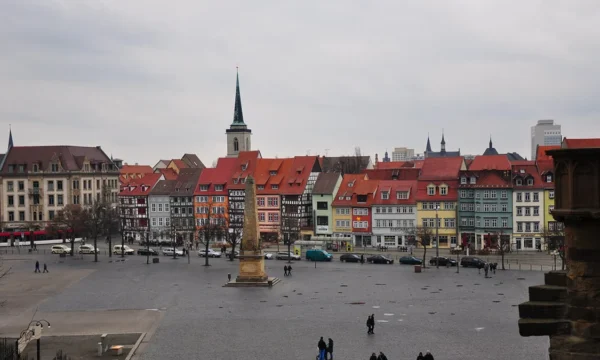
Erfurt has one of the largest intact medieval old towns (Altstadt) in Germany, with more than 2,000 half-timbered houses. Its centerpiece is the Krämerbrücke, or Merchants’ Bridge, the longest inhabited bridge in Europe, lined with shops and homes built directly onto the span.
Above Domplatz square rise Erfurt Cathedral (St. Mary’s) and the Church of St. Severus, a pair of Gothic buildings on a shared hill. The Anger is the main shopping street, while Fischmarkt holds the Renaissance town hall. Martin Luther lived as a monk at the city’s Augustinian monastery from 1505 to 1512.
Weimar carries two UNESCO listings: Classical Weimar, covering 11 buildings and parks tied to Johann Wolfgang von Goethe and Friedrich Schiller, and the Bauhaus and its sites, added in 1996.
Goethe lived in the city for more than 50 years and wrote much of Faust there. His main house on Frauenplan and Goethe’s Garden House in Park an der Ilm are both open to visitors, as is Schiller’s residence.
The Bauhaus Museum Weimar holds the world’s oldest Bauhaus collection. Weimar was European City of Culture in 1999 and has 27 museums in a city of about 65,000 people.
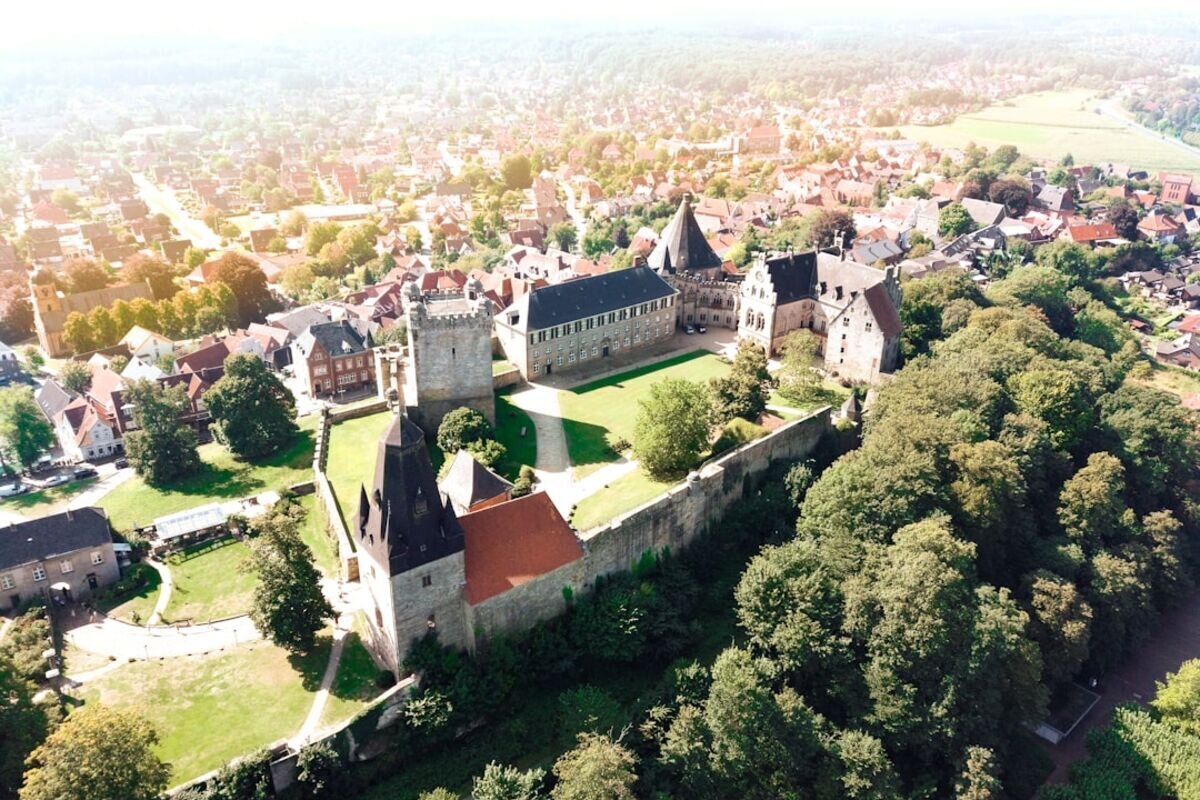
Eisenach delivers two national landmarks in one small town. Wartburg Castle, on a ridge above the center, became a UNESCO World Heritage Site in 1999 and is where Luther, hiding under the alias Junker Jörg, translated the New Testament into German in about 11 weeks in 1521 and 1522.
Johann Sebastian Bach was born in Eisenach in 1685. The Bachhaus museum there displays historical instruments and offers short live demonstrations.
The castle is a steep uphill walk from town, and a shuttle bus runs from the parking area.
Jena is a university city on the Saale, home to Friedrich Schiller Universität and the optics company Carl Zeiss, founded there in 1846. Its planetarium, opened in 1926, is among the oldest still operating.
Gotha holds Schloss Friedenstein, an early Baroque palace completed in 1654 with a surviving 17th-century court theater. Gera shows strong Art Nouveau and 1920s architecture and was the birthplace of painter Otto Dix.
Altenburg is the home of the German card game Skat and has a substantial castle and picture gallery.
Thuringia supplied both the language of German Protestantism and the core texts of German classical literature. The New Testament translation at Wartburg helped standardize written German, and the Weimar court of the late 1700s produced works that defined the German Enlightenment.
After the Diet of Worms in 1521 declared him an outlaw, Luther was taken to Wartburg Castle for protection by Frederick the Wise. He grew a beard, called himself Junker Jörg (Knight George), and translated the New Testament from Greek into German.
That translation reached a wide readership through print and shaped the written language for centuries. Luther also stayed in Schmalkalden, where Protestant princes formed their alliance against the emperor in 1531.
The Wartburg’s medieval Minnesingers’ hall is linked by tradition to the song contest that Wagner used in Tannhäuser.
Duke Carl August invited Goethe to Weimar in 1775, and the court became a center for literature, philosophy, and science. Schiller moved nearby in 1787 and to Weimar in 1799; the two men’s collaboration produced the period now called Weimar Classicism.
The Goethe-Schiller monument stands in front of the German National Theatre, where the 1919 constituent assembly met. The Duchess Anna Amalia Library, with its oval Rococo hall, preserves the collection those writers used.
It also connects directly to German Romanticism, which followed.
The many small duchies each funded music and theater, which is why performance traditions run deep across the state. Bach worked in Arnstadt, Mühlhausen, and Weimar before moving to Leipzig.
Meiningen’s court theater gained European fame in the 1870s and 1880s for its historically detailed staging and disciplined ensemble. Rudolstadt’s Heidecksburg palace holds a preserved Rococo state apartment, and the town hosts a large folk and world music festival each July.
Thuringia has about 9,900 miles of signposted hiking trails, 22 certified routes, and 13 long-distance cycle paths. The Thuringian Forest in the southwest is the main upland, while Hainich National Park, the Saale Valley, and the Kyffhäuser hills spread the outdoor options across the state.
The Rennsteig is Germany’s best-known ridge trail, running about 105 miles from Hörschel near Eisenach to Blankenstein on the Saale. It follows a watershed line and has been documented as a route since 1330.
Most walkers take six to eight days for the full trail, staying in villages along the way. Day sections are easy to reach by regional train and bus, and the trail links well with Germany’s broader hiking culture (Wandern).
The high point is the Großer Beerberg at 3,222 feet.
Hainich National Park protects one of Europe’s largest continuous broadleaf forests and joined the UNESCO Ancient and Primeval Beech Forests listing in 2011. Its Baumkronenpfad (treetop walkway) carries visitors through the canopy on an elevated path.
The Saale Valley below Jena is lined with vineyards and the three Dornburg Castles on a cliff above the river. To the north, the Kyffhäuser range and the nearby Unstrut River sit between Thuringia and Saxony-Anhalt, within reach of the Harz Mountains.
Mühlhausen preserves a large walled center and the churches where Thomas Müntzer preached before the 1525 peasant defeat at Frankenhausen, now marked by a vast circular panorama painting.
Saalfeld’s Feengrotten (Fairy Grottoes) are former alum slate mines noted for their mineral coloring. Schmalkalden has a Renaissance palace and dense half-timbered streets; Suhl was a center of gunsmithing; Ilmenau is a Goethe town at the edge of the forest.
Oberhof and Friedrichroda handle winter sports, with biathlon and cross-country facilities and marked ski trails.
Erfurt is the practical base for a Thuringia trip because ICE high-speed trains stop there and regional services fan out to Weimar, Eisenach, Jena, and Gotha. Four to six days covers the three main cities plus one day in the forest or a national park.
Erfurt Hauptbahnhof sits on the ICE line between Berlin, Leipzig, and Munich, as well as the Frankfurt to Dresden corridor. Travel time from Berlin takes under two hours; from Frankfurt, it takes about two and a half.
Erfurt-Weimar Airport handles limited traffic, so most travelers arriving by air use Leipzig/Halle, Nuremberg, or Frankfurt before continuing by train. FlixBus serves the larger cities. The A4 and A71 motorways cross the state, making it easier to reach forest trailheads. Anyone planning a trip to Germany should confirm current timetables and fares before booking.
Regional trains connect Erfurt to Weimar in about 15 minutes and to Eisenach in roughly 35 to 50 minutes. That makes day trips from one hotel quite workable. Jena is also about 45 minutes from Erfurt.
Thuringia borders Saxony, Saxony-Anhalt, Hesse, Lower Saxony, Bavaria, and Brandenburg, so the state pairs well with Leipzig, Halle, Dresden, or Franconia. Local buses reach smaller towns, though rural service becomes less frequent on Sundays. A rental car helps when visiting the Rennsteig, Hainich, and the Kyffhäuser.
May through October suits hiking and town walking, with long daylight hours and open palace schedules. July and August bring festivals, including Rudolstadt’s music festival.
Erfurt’s Weihnachtsmarkt (Christmas market) on Domplatz runs through December and ranks among Germany’s larger markets, with the cathedral steps as a backdrop. Snow reliability in the Thuringian Forest is best from January to early March at higher elevations around Oberhof. Consider the best time to visit Germany alongside seasonal opening hours, since some museums shorten their winter schedules.
Thüringer Rostbratwurst, a long grilled sausage with protected regional status, is the state’s signature dish. It’s usually served in a bread roll with mustard. Thüringer Klöße (potato dumplings) accompany roast pork or beef, while Thüringer Rostbrätl is a marinated grilled steak.
Hotel Am Kaisersaal in Erfurt sits within walking distance of the Krämerbrücke and Domplatz. Weimar and Eisenach both have small central hotels and guesthouses.
| Trip length | Suggested plan |
|---|---|
| 2 days | Erfurt old town plus a half day in Weimar |
| 4 days | Erfurt, Weimar, Eisenach with Wartburg |
| 6 days | Add Jena or Gotha and one hiking day on the Rennsteig or in Hainich |
For destination-level detail on individual sites and current visitor information, the Everything About Germany regions and destinations pages include city and landmark entries worth checking as you build the route.
Thuringia is known as the “Green Heart of Germany” for its forests and for the cultural history concentrated in Weimar, Erfurt, and Eisenach. Luther translated the New Testament at Wartburg Castle, Goethe and Schiller wrote in Weimar, Bach was born in Eisenach, and the Bauhaus was founded in Weimar in 1919.
Erfurt is the capital and largest city, with roughly 214,000 residents. It holds one of Germany’s largest preserved medieval old towns, including the Krämerbrücke and the cathedral complex on Domplatz.
Four to six days covers Erfurt, Weimar, and Eisenach, with time for one day of hiking or a national park visit. A two-day trip works for Erfurt and a half day in Weimar, since the two cities are 15 minutes apart by regional train.
ICE high-speed trains reach Erfurt from Berlin in under two hours and from Frankfurt in about two and a half. Erfurt-Weimar Airport has limited service, so most air travelers land at Leipzig/Halle, Nuremberg, or Frankfurt and take a train onward.
Yes. Wartburg Castle in Eisenach became a UNESCO World Heritage Site in 1999 because of its medieval architecture and important role in the Reformation. Opening hours and guided tour times vary by season, so check them before you travel.