
Erfurt Cathedral
Erfurt Cathedral (Dom St. Marien) is a magnificent Gothic masterpiece and the largest church…
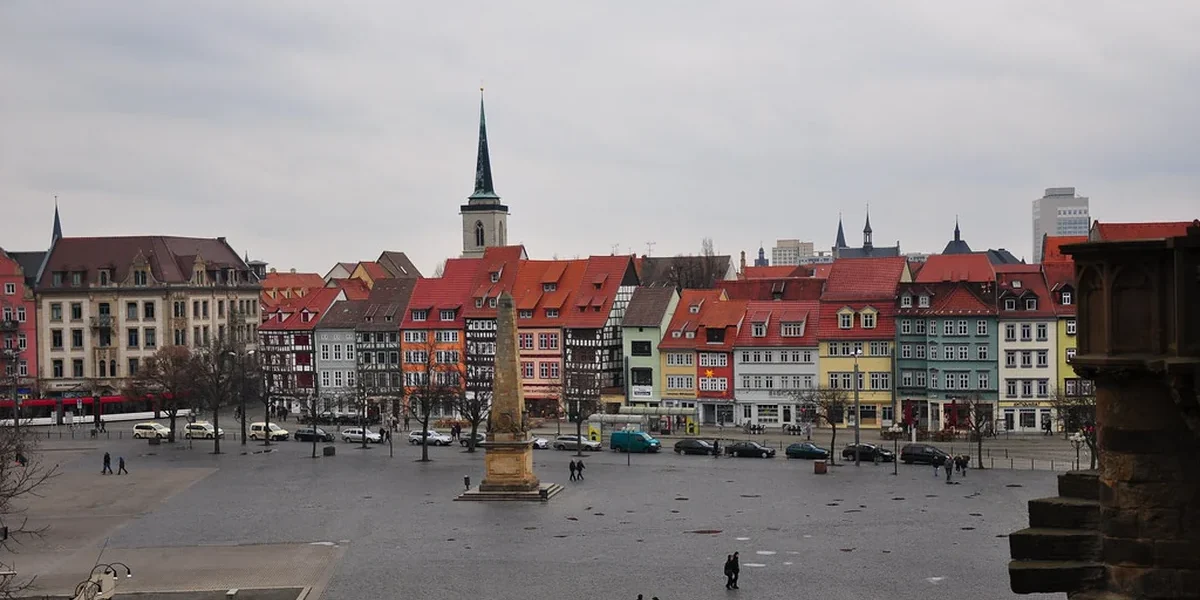
Erfurt is Thuringia‘s capital and Germany’s most complete medieval old town that still functions as a normal, lived-in city. Give it two days: one for the Krämerbrücke, Domplatz and the UNESCO-listed Jewish-medieval sites, and one for Petersberg Citadel, egapark and a day trip to Weimar. It is walkable, noticeably cheaper than Munich or Hamburg, and sits on the Berlin–Munich high-speed line, which makes it one of the easiest add-ons to any German rail itinerary.
Erfurt survived the twentieth century better than almost any German city of its size. Roughly 25 churches and monasteries, a bridge lined with 32 inhabited houses, and a cathedral hill you can photograph from three directions all came through the war and the GDR era intact, then got restored rather than replaced. The result is a centre of about 215,000 people where the medieval street plan is still the street plan, not a reconstruction.
The city earned its “City of Flowers” nickname honestly. Erfurt was a centre of European seed trading from the eighteenth century onward, hosted the East German International Horticultural Exhibition, and still runs one of the largest garden parks in Europe on its western edge. In September 2023 UNESCO added a third layer to the city’s identity by inscribing the Jewish-Medieval Heritage of Erfurt — the Old Synagogue, the Mikveh and the Stone House — as a World Heritage Site.
Yes, for two clear reasons. First, the density: the bridge, the cathedral, the citadel, the UNESCO sites, the Augustinian monastery where Martin Luther became a monk, and the main shopping street are all inside a 25-minute walk. Second, the price: hotel rates and restaurant prices in Erfurt run well below comparable old towns in Bavaria or along the Rhine, and the crowds are mostly German rather than international.
Skip it only if you have a single day in Germany and no interest in medieval architecture, or if you need big-city nightlife and international dining variety. Erfurt is a university town with a lively bar scene, but it is not Berlin.
The Krämerbrücke is the longest continuously inhabited bridge in Europe: a stone arch bridge finished in 1325 and built over completely, so that crossing it feels like walking a narrow lane rather than a bridge. Thirty-two half-timbered houses sit on it, occupied by galleries, a woad-dyeing workshop, chocolate and ceramics makers, and actual residents upstairs.
How to actually see it: walk it once for the shops, then go down to the Gera riverbank at Horngasse or the Rathausbrücke to photograph the houses from the side. The lane view and the side view look like two different landmarks, and most visitors only get one. Shops generally open late morning and close by early evening; the bridge itself is a public street and open around the clock.
Domplatz is one of the largest historic market squares in Germany, and the twin silhouette of Erfurt Cathedral and the Church of St. Severus above the 70-step Domstufen staircase is the city’s signature view. The cathedral holds the Gloriosa, cast in 1497 and one of the largest free-swinging medieval bells in the world, along with medieval stained glass and a Romanesque bronze candelabrum known as the Wolfram.
Entry to the nave is free outside services; the tower, treasury and guided tours are ticketed and run on limited seasonal schedules, so check the cathedral’s own calendar the week you travel. In August the Domstufen-Festspiele turn the staircase into an open-air opera stage, which is the single best reason to time a summer visit around a specific date.
Erfurt’s Jewish-Medieval Heritage became a UNESCO World Heritage Site on 17 September 2023. It covers three separate buildings, all within a few minutes of the Krämerbrücke, and it is the reason to give Erfurt a second day rather than a stopover.
Together they document a Jewish community that lived alongside a Christian majority from the late eleventh to the mid-fourteenth century, which is exactly the criterion UNESCO cited: an early and rare testimony to Jewish religious and secular architecture of the Middle Ages.
Rising directly behind Domplatz, the Petersberg Citadel is one of the largest and best-preserved baroque city fortresses in Europe, built from 1665 on the site of a Benedictine monastery. The ramparts are free to walk and give the best wide view over the old town roofscape, especially in the last hour of daylight.
Two paid extras are worth it if you have time: the Panorama Weg walkway along the upper fortifications, and guided tours of the underground listening galleries — narrow tunnels built so defenders could hear enemy mining. The tunnel tours require a guide, sell out in summer, and are not suitable for anyone uneasy in tight spaces.
egapark covers 36 hectares on the western edge of the city and is one of Europe’s largest garden and leisure parks, laid out in the 1960s and now a listed example of garden architecture. Inside you get formal flower beds, a rose garden, the Danakil desert-and-rainforest glasshouse, a horticultural museum and a large playground area, which makes it the strongest family half-day in Erfurt.
| Detail | 2026 information |
|---|---|
| Main season | 3 April – 18 October 2026, Tuesday to Sunday, 09:00–19:00 |
| July and August | Also open Mondays, 09:00–18:00 |
| Late October | 20–31 October 2026, 09:00–18:00 |
| Ticket offices and buildings | 09:00–18:00; last admission Danakil 17:15, Horticultural Museum 17:30 |
| Adult (26+), main season | €17.00 |
| Young adult (17–25) | €13.50 |
| Children and teens (4–17) | €5.00 |
| Family (2 adults, up to 5 children 7–16) | €39.00 |
| Family Mini (1 adult, up to 5 children 7–16) | €24.00 |
| Adult, off-season day ticket | €5.00 |
| Annual season ticket, adult | €75.00 |
Two planning notes that save money: the off-season adult day ticket is €5.00 rather than €17.00, so a winter visit for the glasshouses costs almost nothing, and holders of the ErfurtFamilyCard enter free. In high season you may stay in the park until sunset even after the ticket offices close.
Martin Luther studied at Erfurt’s university from 1501, entered the Augustinian monastery here in 1505 and was ordained a priest in 1507, which makes this complex more central to his early biography than Wittenberg. You can see the reconstructed monk’s cell, the Gothic church with original thirteenth-century glass, and a research library. It also operates as a conference house and guesthouse, so parts may be closed for events.
Two full days covers the city properly; three lets you add a day trip without rushing. Here is how the time splits in practice.
| Length of stay | What to prioritise | What to drop |
|---|---|---|
| Half day (rail stopover) | Anger to Fischmarkt, Krämerbrücke both views, Domplatz and the Domstufen from below | Interiors, museums, egapark |
| One day | The above plus cathedral nave, Petersberg ramparts at golden hour, one sit-down Thuringian meal | UNESCO interiors, egapark, day trips |
| Two days | Day 1 old town and cathedral hill; Day 2 Old Synagogue museum, Mikveh tour, Augustinian Monastery, egapark or Petersberg tunnels | Day trips |
| Three days | Add Weimar or Eisenach as a day trip by regional train | Nothing essential |
Erfurt Hauptbahnhof sits on the Berlin–Munich high-speed line and on the east–west route toward Frankfurt, which makes rail the obvious choice from almost anywhere in Germany. The station is a 10-minute walk from the Anger and about 15 minutes from the Krämerbrücke, so you will not need a taxi on arrival.
Walk the centre — it is compact, flat apart from the climb to Petersberg, and largely car-free. Use the tram network for egapark, the Zoopark and outlying hotels; lines run frequently from the Hauptbahnhof and Anger. Buy tickets from machines or the operator’s app before boarding and validate where required, since inspections are routine.
If you plan several paid attractions plus tram journeys, price up the ErfurtCard against individual tickets before buying. It only wins if you actually visit three or more ticketed sites in the covered period.
| Area | Best for | Trade-off |
|---|---|---|
| Altstadt around Fischmarkt and Krämerbrücke | First visits, short stays, walking everywhere | Highest rates, some street noise on weekends |
| Domplatz and Andreasviertel | Quieter medieval lanes, photography, cathedral views | Fewer restaurants open late |
| Anger and Hauptbahnhof | Rail arrivals, business travel, chain hotels and value | Less atmospheric, functional streetscape |
| Brühl and Löbervorstadt | Longer stays, apartments, families near egapark | Tram or 20-minute walk to the old town |
Book far ahead for three periods: the Christmas market weeks, the Krämerbrückenfest in June, and the Domstufen-Festspiele in August. Erfurt’s hotel stock is small enough that those dates sell out and prices roughly double.
Thuringian food is hearty, pork-heavy and specific enough that ordering well matters more than choosing a famous restaurant.
Practical note: many traditional kitchens stop serving hot food in the mid-afternoon and again before 21:00, and Sunday closures are common outside the main squares. Plan your main meal earlier than you would in southern Europe.
| Season | Why go | What to watch for |
|---|---|---|
| Spring (April–May) | egapark main season opens 3 April 2026; gardens at their freshest; low crowds | Changeable weather, some tours not yet at full frequency |
| Summer (June–August) | Krämerbrückenfest in June, Domstufen-Festspiele in August, long evenings on Petersberg | Hotels sell out around festival dates; book months ahead |
| Autumn (September–October) | Best light for old-town photography; egapark open to 18 October 2026 | Shorter attraction hours from late October |
| Winter (December) | Christmas market on Domplatz, with the cathedral and Severikirche as backdrop; €5.00 egapark adult tickets | Very busy weekends; several sites on reduced winter hours |
| Destination | Why go | Best for |
|---|---|---|
| Weimar | Goethe and Schiller houses, Bauhaus museums, Weimar Classicism UNESCO sites | Culture and literature; the strongest single pairing with Erfurt |
| Eisenach | Wartburg Castle, where Luther translated the New Testament, plus the Bach House | Castles and Reformation history |
| Gotha | Friedenstein Palace, one of Germany’s largest early baroque palace complexes | Palace interiors and art collections without crowds |
| Jena | University city, optics museums, hilltop viewpoints over the Saale valley | Modern city energy and walking |
| Buchenwald Memorial | Former concentration camp above Weimar, free to enter | Historical remembrance; allow a full half day and go without other stops |
The old town is flat but heavily cobbled, which is tiring for wheelchair users and anyone with mobility limits; the Domstufen staircase and the Petersberg approach both involve significant climbs, though there are gentler vehicle-access routes up the citadel. The Mikveh’s underground chamber and the Petersberg listening galleries involve stairs and confined space and are not step-free. egapark is largely paved and pram-friendly. Cash is still expected in some smaller Thuringian pubs and market stalls, so carry some even though card acceptance has improved.
Two full days covers the old town, cathedral hill, Petersberg Citadel and the UNESCO Jewish-medieval sites at a comfortable pace. Add a third day if you want a regional-train day trip to Weimar or Eisenach.
The Jewish-Medieval Heritage of Erfurt was inscribed on 17 September 2023. It comprises the Old Synagogue, whose oldest parts date to around 1100, a twelfth-century mikveh rediscovered in 2007, and the Stone House, a twelfth- to thirteenth-century Jewish secular building.
Main-season day tickets are 17.00 EUR for adults aged 26 and over, 13.50 EUR for ages 17 to 25, 5.00 EUR for ages 4 to 16 and 39.00 EUR for a family of two adults with up to five children. Off-season adult day tickets are 5.00 EUR.
Yes. The Krämerbrücke is a public street lined with 32 inhabited houses and is open at all hours, free of charge. The shops and workshops on it keep normal retail hours.
Erfurt is the better base for most trips because it has more accommodation, more restaurants and direct high-speed rail on the Berlin to Munich line. Weimar is easily visited as a short regional-train day trip from Erfurt.
Yes. The medieval mikveh is normally accessible only on guided tours with limited group sizes, so reserve a slot before travelling rather than arriving on spec.
Explore the historic Old Town (Altstadt) on foot and use the local S-Bahn/U-Bahn network.
Purchase a 24-hour transit day pass (Tageskarte) for unlimited city travel.
Discover curated walking tours, museum passes, and authentic experiences in Erfurt with instant confirmation.