Nuremberg
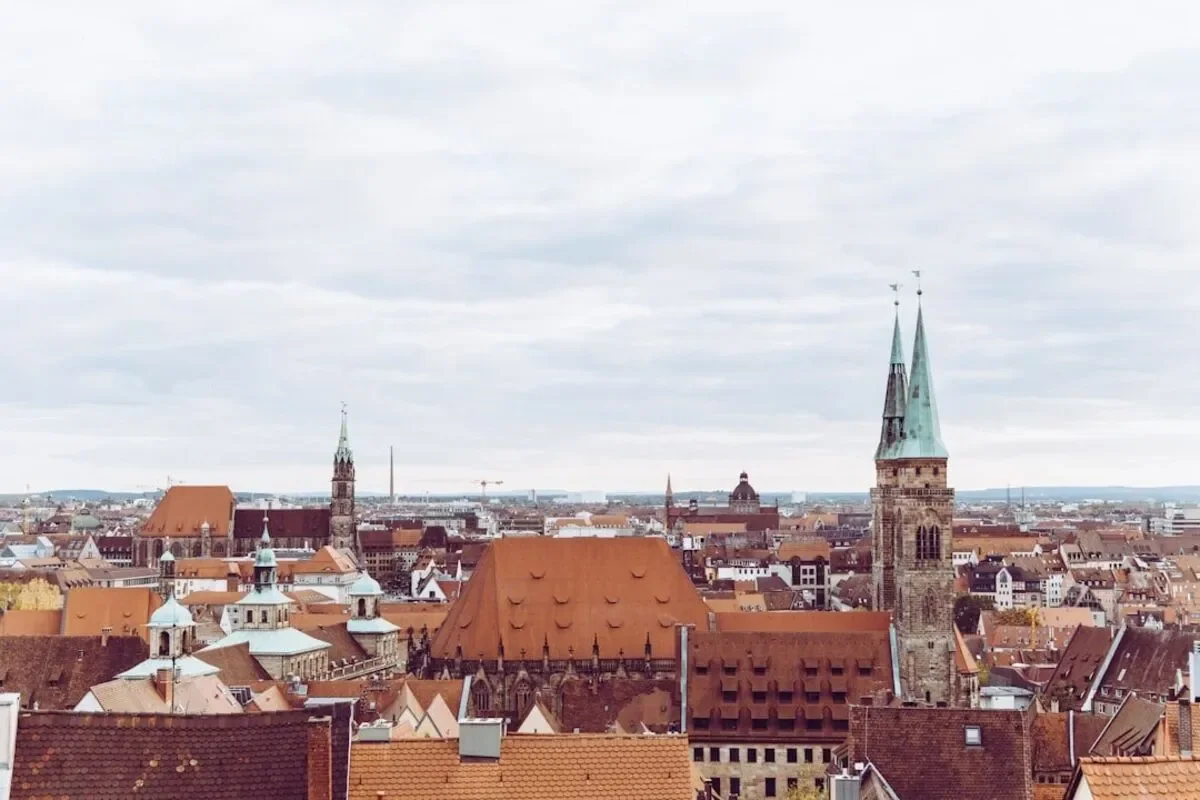
Nuremberg (Nürnberg) is Bavaria’s second-largest city and the historic center of Franconia, a region with its own dialect, food, and wine traditions that feel distinct from Munich’s Alpine Bavaria. Its Imperial Castle dates to the 11th century, and every Holy Roman Emperor between 1050 and 1571 spent time there.
That imperial past is only one layer. The Nazi Party later chose the city for its mass rallies, and the Allies selected it again as the site of trials that helped create modern international criminal law. Both groups of buildings still stand, roughly four kilometers from the medieval Altstadt.
Most travelers see Nuremberg’s medieval core and its 20th-century historical sites in two full days, and a single U-Bahn line connects the two halves of the city.
One day works, though, if you’re willing to choose between the castle district and the memorial sites. Prices, opening hours, and rally-grounds construction schedules change from year to year, so figures here are marked as fixed or variable. The Nuremberg Convention and Tourist Office remains the authority for current admission details.
Key Takeaways
- Two days covers the Altstadt and the World War II and trials sites without rushing either.
- The Imperial Castle, Hauptmarkt, and Lorenzkirche sit within a 15-minute walk of each other inside the old city walls.
- Nuremberg connects to Munich in about an hour and to Bamberg, Regensburg, and Rothenburg ob der Tauber by regional train.
How Should You Plan a First Visit to Nuremberg?
Plan Nuremberg as a walking city with one transit excursion. The Altstadt covers roughly one square kilometer and holds most things to do in Nuremberg.
The Nazi Party Rally Grounds sit southeast of the center, reachable by tram or U-Bahn in about 15 minutes.
Is Nuremberg Worth Visiting?
Nuremberg rewards visitors who want history with specific evidence attached to it. The castle, the churches by Veit Stoss and Adam Kraft, and Albrecht Dürer’s own house give the medieval period real objects and addresses.
The 20th-century sites do the same. Courtroom 600 is the actual room where the Nuremberg Trials opened in November 1945, and the Congress Hall was never finished.
For travelers already committed to a broader Germany travel guide route, Nuremberg fills the gap between Bavaria’s Alpine south and the Rhine.
How Many Days Do You Need in Nuremberg?
Two full days is the practical answer. Day one covers the Altstadt on foot; day two covers the rally grounds and the Memorium.
One day forces a decision. Three days allows a Franconian day trip without cutting anything.
When Is the Best Time to Visit Nuremberg?
Late May through September brings the longest daylight and open beer gardens. Late November through December 24 brings the Nuremberg Christmas Market, the Christkindlesmarkt, which fills the Hauptmarkt and sharply raises hotel rates.
The Volksfest, a folk festival held on the Dutzendteich fairgrounds each spring and autumn, is the local alternative to Munich’s Oktoberfest and draws far fewer international visitors. Consider the best time to visit Germany alongside Nuremberg’s own calendar if the trip covers several cities.
A One-Day and Two-Day Nuremberg Itinerary
One day:
- Morning: Imperial Castle, Sinwell Tower, Castle Gardens
- Midday: Weißgerbergasse, Albrecht Dürer House, Tiergärtnertorplatz
- Afternoon: Hauptmarkt, Schöner Brunnen, Lorenzkirche
- Late afternoon: Bratwurst dinner near the Pegnitz
Two days: Add a second morning at the Documentation Center Nazi Party Rally Grounds and an afternoon at Memorium Nuremberg Trials. Both need transit time, so treat them as a single half-day block each.
How to Use the NÜRNBERG CARD + Fürth
The NÜRNBERG CARD + Fürth covers admission to more than 30 museums and attractions in Nuremberg and neighboring Fürth, plus public transport across both cities, for two consecutive days. It pays off if the plan includes the castle, the Germanisches Nationalmuseum, and the Documentation Center.
Card pricing and the included list change annually. Verify both with the Nuremberg Convention and Tourist Office before buying.
Which Sights Define Nuremberg’s Old Town?
The Altstadt (Old Town) is divided by the Pegnitz River, ringed by five kilometers of surviving medieval wall, and topped by the Imperial Castle on a sandstone ridge. Walking from the castle down to Lorenzkirche takes about 15 minutes and passes the Hauptmarkt, the Schöner Brunnen, and several half-timbered streets rebuilt after 1945 on their original plans.
Imperial Castle and the Castle Gardens
The Imperial Castle (Kaiserburg) is the single highest point in the Altstadt and the logical first stop. Visitors can enter the Imperial Castle Museum, see the Deep Well’s guided water demonstration, and climb the round Sinwell Tower for views over the rooftops.
The Castle Gardens sit along the outer wall and are free to enter during daylight hours. Allow 90 minutes to two hours for the paid interiors.
Hauptmarkt, Lorenzkirche, and Medieval Churches
The Hauptmarkt (Market Square) is Nuremberg’s civic center and holds the Schöner Brunnen, a 14th-century fountain shaped like a Gothic spire with 40 figures. Visitors turn the brass ring set into its railing for luck.
Lorenzkirche (St. Lorenz Church) holds two works that define late medieval Nuremberg sculpture: the Annunciation suspended in wood by Veit Stoss and the tabernacle carved in stone by Adam Kraft. Sebalduskirche, across the river, is the older of the two main parish churches.
Albrecht Dürer House and the Germanisches Nationalmuseum
The Albrecht Dürer House stands below the castle and is where Albrecht Dürer lived from 1509 until his death in 1528. Restored rooms include a working replica printing press.
The Germanisches Nationalmuseum (Germanic National Museum) holds the largest collection of German cultural history anywhere, from medieval altarpieces to the Behaim Globe of 1492. Two hours covers the highlights, though a full day is possible.
Weißgerbergasse, Weinstadel, and Henkersteg
Weißgerbergasse, the former tanners’ lane, retains around 20 half-timbered houses and is the best-preserved street in the Altstadt. Cafés occupy several ground floors.
Just downstream, the Weinstadel is a long 15th-century timber building on the Pegnitz, once a wine store and later student housing. The Henkersteg (Hangman’s Bridge) runs alongside it, named for the executioner who lived in the adjoining tower.
Handwerkerhof and the Toy Museum
The Handwerkerhof sits inside the Königstor gate beside the main station and gathers workshops selling pewter, leather, and Lebkuchen in a walled courtyard. It’s convenient rather than historic, having been built in 1971.
The Toy Museum reflects Nuremberg’s centuries as a center of toy manufacture, with tin figures, dollhouses, and 20th-century tinplate trains. It’s a good indoor option for anyone visiting Germany with kids.
How Does Nuremberg Confront Its World War II History?
Nuremberg presents its Nazi-era and postwar history through two purpose-built museums on the original sites, both with permanent exhibitions and audio guides in English. The Documentation Center occupies the unfinished Congress Hall on the former rally grounds; Memorium Nuremberg Trials sits inside the working Palace of Justice.
The Nazi Party Rally Grounds and Documentation Center
The Nazi Party Rally Grounds (Reichsparteitagsgelände) cover about 11 square kilometers southeast of the center. The party staged annual mass rallies there from 1933 to 1938.
Surviving structures include the Congress Hall, the Zeppelinfeld grandstand, and the Great Road. The Documentation Center Nazi Party Rally Grounds explains how the rallies were planned, filmed, and used as propaganda.
Parts of the building have been under renovation, with the exhibition operating in an interim form, so confirm the current setup before travelling. Allow two hours.
Memorium Nuremberg Trials and Courtroom 600
Memorium Nuremberg Trials documents the trial of 21 leading Nazi figures that opened on November 20, 1945, and ran until October 1946. The exhibition covers the charges, the defendants, the verdicts, and the 12 subsequent Nuremberg proceedings.
Courtroom 600 remains an active Bavarian courtroom. Public access depends on the court calendar, and the room closes to visitors when hearings are in session.
The Palace of Justice and the Legacy of International Law
The Allies chose the Palace of Justice in 1945 partly because it had survived the bombing largely intact and had an attached prison. The trials established that individuals, including heads of state, can face criminal responsibility for waging aggressive war, war crimes, and crimes against humanity.
Those principles fed directly into the 1948 Genocide Convention and later into the statute of the International Criminal Court.
How to Visit Memorial Sites Respectfully
Read the exhibition captions before photographing structures, and keep voices low in the Zeppelinfeld grandstand and Courtroom 600. Photography rules differ between the two museums and are posted at each entrance.
Nazi symbols and salutes are illegal in Germany and enforced at these sites. Visitors extending this history through the city center can follow the Stolpersteine walking guide to the brass memorial stones marking the last freely chosen addresses of people deported under Nazi rule. Background on the wider Holocaust also gives the museum exhibitions context.
What Food, Beer, and Seasonal Traditions Is Nuremberg Known For?
Nuremberg has two protected regional specialties: Nürnberger Rostbratwürste, small grilled sausages sold in threes, and Nürnberger Lebkuchen, a spiced honey-and-nut cake. Both carry EU protected designation status, meaning producers can make them only to set recipes within the city.
Nürnberger Rostbratwürste and Franconian Food
Nürnberger Rostbratwürste are no longer than 9 centimeters and weigh 25 grams or less. They get seasoned with marjoram and grilled over beechwood.
Restaurants serve 6, 8, 10, or 12 on a pewter plate with sauerkraut and horseradish, or three in a roll as Drei im Weggla. Wider Franconian food runs to Schäufele (roast pork shoulder with a crisp rind), Sauerbraten, and Karpfen (carp) in the months containing an “r”.
This is separate from Bavaria’s Weisswurst, which belongs to Munich morning tradition.
Lebkuchen and the Christkindlesmarkt
Nuremberg Lebkuchen has been made since at least the 14th century. The top grade, Elisenlebkuchen, contains at least 25 percent nuts and no more than 10 percent flour. Bakeries sell it year-round in decorated tins.
The Christkindlesmarkt runs on the Hauptmarkt from the Friday before Advent to December 24. It has about 180 wooden stalls and an opening speech by the Nuremberg Christkind. Details on the Nuremberg Christkindlesmarkt help with timing, while the wider German Christmas market guide compares it with markets in other cities.
Franconian Beer and Local Drinking Culture
Franconia has one of the highest densities of breweries in the world, especially in the countryside around Bamberg and Bayreuth. Nuremberg’s own tradition includes Rotbier, a reddish amber lager brewed here since the Middle Ages and now revived by several small producers.
Local cellar pubs and beer gardens serve half-liter glasses as standard. The regional context of German beer styles also explains why Franconian brews taste maltier than Munich’s.
Gostenhof and Contemporary Nuremberg
Gostenhof, west of the Altstadt, is Nuremberg’s design and independent-café district, locally shortened to “GoHo”. Studios, record shops, and Middle Eastern and Vietnamese kitchens fill the streets around Austraße.
It’s a 10-minute walk from the western city wall or one U-Bahn stop from Plärrer.
How Do You Get Around and Where Should You Stay?
Nuremberg’s transit system puts the airport 12 minutes from the main station by U-Bahn. It also connects the Altstadt to the rally grounds in under 20 minutes. The main station sits directly against the medieval wall, so most visitors walk from the train to their hotel.
Arriving at Nuremberg Airport and Nürnberg Hauptbahnhof
Nuremberg Airport (NUE) lies about 5 kilometers north of the center. U-Bahn line U2 runs from the airport to Hauptbahnhof. The airport handles European connections, with Frankfurt, Vienna, and London among the direct routes; details on Nuremberg Airport cover the terminal layout and transfers.
Nürnberg Hauptbahnhof is one of Bavaria’s busiest stations. It opens onto the Königstor gate and the Handwerkerhof.
Using the U-Bahn, Trams, and VGN Tickets
The city runs three U-Bahn lines, five tram lines, and an extensive bus network, all under VGN (Verkehrsverbund Großraum Nürnberg) fares. A single ticket in the city zone covers one direction with transfers. A day pass costs less than three singles.
U1 and U2 both stop at Hauptbahnhof. U2 continues to the airport, while U2 or U3 reaches Dutzendteich for the rally grounds.
Rail, Coach, and Day-Trip Connections
ICE trains connect Nuremberg to Munich in about 1 hour 5 minutes, Frankfurt in roughly 2 hours 10 minutes, and Berlin in about 3 hours. Prague is reachable in around 3 hours 30 minutes by direct coach.
FlixBus operates from a stop near the main station, with lower fares but slower journey times. Practical fare advice appears in the guide to visiting Germany on a budget.
Where to Stay in Nuremberg
| Area | Best for | Walk to Hauptmarkt |
|---|---|---|
| Altstadt (inside walls) | First visits, sightseeing on foot | 0 to 10 min |
| Near Hauptbahnhof | Rail arrivals, day trips | 12 min |
| Gostenhof | Cafés, independent shops | 20 min |
| Dutzendteich | Trade fair visitors | U-Bahn, 15 min |
Hotels in Nuremberg fill months ahead for the Christkindlesmarkt and for trade fairs at the Messe. Book early for late November and December.
Day Trips to Bamberg, Rothenburg ob der Tauber, and Regensburg
Bamberg is 40 minutes by regional train. Its UNESCO World Heritage old town is known for smoked Rauchbier. Regensburg takes about 1 hour 10 minutes and has a 12th-century stone bridge over the Danube.
Rothenburg ob der Tauber requires a change at Steinach and takes about 1 hour 20 minutes in total. It sits on the Romantic Road. Würzburg, about 1 hour away, and Bayreuth, also about 1 hour away, round out the Franconian options.
The Nuremberg Transport Museum, near the Altstadt, covers German railway history if a rail day gets rained out.
Frequently Asked Questions
What can you see in Nuremberg in one day?
One day covers the Imperial Castle, Weißgerbergasse, the Albrecht Dürer House, the Hauptmarkt with the Schöner Brunnen, and Lorenzkirche. They’re all within walking distance. Adding the Documentation Center or Memorium Nuremberg Trials means cutting one or two Altstadt stops. Nuremberg tourist information at the Hauptmarkt office hands out a free Nuremberg old town map.
How many days do you need to see Nuremberg?
Two full days is the standard recommendation: one for the Altstadt and one for the World War II and trials sites. A third day allows a Franconian day trip or a slower visit to the Germanisches Nationalmuseum.
What are the best free things to do in Nuremberg?
The Castle Gardens, the walk along the surviving city walls, and the Pegnitz riverside path past the Weinstadel and Henkersteg are all free. So are the interiors of Lorenzkirche and Sebalduskirche. The Zeppelinfeld grandstand at the rally grounds is open to walk on at no charge, with interpretive signage on site.
What food is Nuremberg famous for?
Nürnberger Rostbratwürste and Nürnberger Lebkuchen are the city’s two EU-protected specialties. Franconian menus also feature Schäufele, roast pork shoulder with crackling, and carp in the colder months.
Is it better to stay in Munich or Nuremberg?
Nuremberg makes the better base for exploring Franconia, Bamberg, and Würzburg. It also costs less per night than Munich. Munich, on the other hand, works well for travelers heading to the Alps, Neuschwanstein Castle, or Oktoberfest. Since ICE trains cover the 170 kilometers in about an hour, many itineraries include both cities.
Notable Figures Associated with Nuremberg
- Albrecht Dürer — Historical legacy, birthplace, and memorials in the city.
Recommended Local Attractions, Events & Cultural Guides
- Nuremberg Christkindlesmarkt — Comprehensive visitor guide, logistics, and insider recommendations.
💡 Essential Travel Tips
Explore the historic Old Town (Altstadt) on foot and use the local S-Bahn/U-Bahn network.
🥨 Local Insights & Food Culture
Purchase a 24-hour transit day pass (Tageskarte) for unlimited city travel.
🎟️ Top Activities & Experiences in Nuremberg
Discover curated walking tours, museum passes, and authentic experiences in Nuremberg with instant confirmation.