Bremen
Northern Germany's fairy-tale city combines Hanseatic trading traditions with modern space technology and maritime…
Bremen is a city-state in northern Germany, home to 681,202 residents across just 419 km² — making it Germany’s smallest federal state by area, yet one of its most storied. Don’t let the size fool you. Bremen packs 1,200 years of trading history, UNESCO World Heritage architecture, and a fiercely independent spirit into a footprint you can explore in a long weekend.
Here’s what makes Bremen unusual: the state actually consists of two separate cities — Bremen itself and Bremerhaven, located 60 kilometers north at the mouth of the Weser River. Bremen anchors the state’s cultural and commercial heart, while Bremerhaven serves as its deep-water port and emigration gateway, from which 7.2 million Europeans sailed to America between 1830 and 1974.
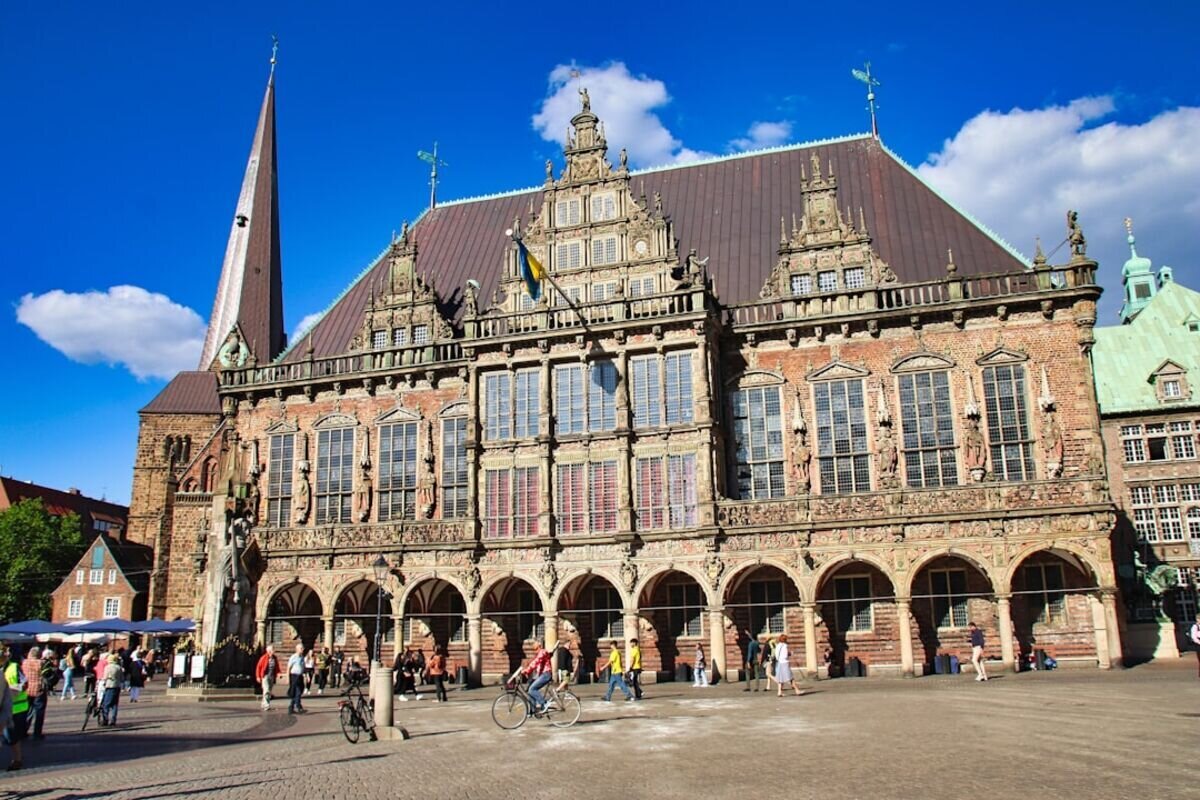
Bremen belongs to the historic Hanseatic League, and locals still wear that legacy proudly. The official name — Freie Hansestadt Bremen (Free Hanseatic City of Bremen) — signals centuries of self-governance that predate modern Germany by hundreds of years. The Bremen Roland statue and the Town Hall, both standing on the Market Square, earned UNESCO World Heritage status in 2004 as symbols of civic freedom and market rights.
The Weser River runs through the city, connecting Bremen to the North Sea and shaping everything from its coffee-roasting industry to its shipbuilding heritage. Bremen roasts a significant share of Germany’s coffee, and the city’s Kaffeequartier still hums with the aroma. Meanwhile, Airbus and OHB anchor Bremen’s aerospace sector, earning the city a reputation as the “City of Space” — the European Space Agency’s Columbus module for the International Space Station was built right here.
And then there are the Town Musicians. The Brothers Grimm immortalized a donkey, dog, cat, and rooster who set out for Bremen to become street musicians. Their bronze statue stands beside the Town Hall, and rubbing the donkey’s front hooves supposedly grants wishes. Millions have tried.
By air: Bremen Airport (BRE) sits just 3.5 kilometers from the city center — one of the shortest airport-to-downtown distances in Europe. Tram line 6 connects the terminal to the main station in about 11 minutes, running every 10 minutes. Direct flights link Bremen to Munich, Frankfurt, Vienna, Zurich, London, Istanbul, and dozens of seasonal Mediterranean destinations.
By train: Bremen Hauptbahnhof is a major ICE hub. Reach Hamburg in 55 minutes, Hanover in 60 minutes, Berlin in roughly 3 hours, Cologne in about 3 hours, and Amsterdam via Hanover or Osnabrück. Regional trains to Bremerhaven take 35 to 45 minutes, making the port city an easy day trip.
By car: The A1 (Hamburg–Ruhr) and A27 (Bremerhaven–Walsrode) motorways intersect at Bremen. Drive times: Hamburg 1 hour 15 minutes, Hanover 1 hour 30 minutes, Amsterdam about 4 hours. Note that Bremen enforces an environmental zone (Umweltzone) covering the city center — your vehicle needs a green emissions sticker.
By cruise ship: Bremerhaven’s Columbus Cruise Center welcomes major North Sea and Baltic itineraries, with shuttle connections into Bremen.
By bus: Long-distance coaches stop at the ZOB beside the main station, offering the cheapest routes from Hamburg, Berlin, and the Netherlands.
Bremen is wonderfully compact and shockingly bike-friendly. Roughly 25% of all trips in the city happen by bicycle — among the highest rates of any major German city. Flat terrain, protected lanes, and a dense network make cycling the fastest, cheapest way to move.
Walking handles the Altstadt easily. The historic center measures barely 1 kilometer across, so the Market Square, Böttcherstraße, Schnoor quarter, Cathedral, and Schlachte promenade all sit within a 15-minute stroll of each other.
Trams and buses operate under the BSAG network, with 8 tram lines and dozens of bus routes covering the entire city. Single tickets, day passes, and group tickets are available; the Deutschlandticket works across all local transport. Trams run frequently until roughly midnight, with night buses on weekends.
Bike rentals are everywhere, including the WK-Bike sharing system and traditional shops near the station. Expect around €10–15 per day.
Car rental makes sense only if you’re exploring the surrounding Lower Saxony countryside or the North Sea coast. Inside Bremen, parking costs money and cycling beats driving.
Ferries and boat tours on the Weser add a scenic dimension — the Sielwallfähre passenger ferry connects the Osterdeich to the Stadtwerder, and harbor cruises reveal Bremen’s working port up close.
Bremen locals — Bremer — are famously understated, dryly funny, and quietly proud. Northern German reserve is real, but it melts fast once you show genuine interest.
Altstadt (Old Town) holds Bremen’s greatest hits: the UNESCO-listed Town Hall and Roland statue, St. Peter’s Cathedral, the Market Square, and the Ratskeller — one of Germany’s oldest wine cellars, storing vintages dating back centuries.
Schnoor is the emotional heart of Bremen. This 15th-century fishermen’s quarter features Bremen’s oldest surviving residential buildings, with lanes so narrow you can nearly touch both walls. Boutiques, goldsmiths, cafés, and one of the city’s most photographed streetscapes fill every corner.
Böttcherstraße stretches barely 100 meters yet delivers extraordinary Art Deco and Expressionist architecture commissioned by coffee merchant Ludwig Roselius in the 1920s and 30s. Don’t miss the glockenspiel and the Paula Modersohn-Becker Museum — the world’s first museum dedicated to a female painter.
Das Viertel (Ostertor and Steintor) is Bremen’s creative, bohemian pulse. Independent bookshops, vintage stores, vegan cafés, live music venues, and the Kunsthalle Bremen art museum cluster along Ostertorsteinweg. Nightlife here runs late and feels genuinely local.
Schlachte lines the Weser with restaurants, beer gardens, and moored historic ships. Summer evenings here are pure golden-hour magic.
Überseestadt shows Bremen’s future: a 300-hectare former harbor district reborn with lofts, waterfront restaurants, coworking spaces, and industrial-chic architecture. It’s one of Europe’s largest urban regeneration projects.
Findorff and Neustadt offer residential charm, weekly markets, and affordable dining away from tourist paths.
Bremerhaven deserves its own day: the Klimahaus (which walks you along the 8th meridian through every climate zone), the German Emigration Center, the German Maritime Museum, and the Zoo am Meer all sit within the Havenwelten waterfront complex.
Bremen’s identity rests on trade, freedom, and the sea. The city joined the Hanseatic League in the 13th century, and its merchants built wealth through wool, coffee, tobacco, and shipping. That independence is literally carved in stone: the Roland statue, erected in 1404, faces the Cathedral as a defiant symbol of Bremen’s imperial immediacy and market rights.
The Bremen Town Hall, built between 1405 and 1410 and later remodeled in Weser Renaissance style, ranks among Europe’s finest examples of civic architecture. UNESCO recognized both the Town Hall and Roland statue as World Heritage in 2004, praising them as monuments to civic autonomy.
St. Peter’s Cathedral (Bremer Dom) traces its origins to 789 and displays Romanesque and Gothic layers, a lead cellar with mummified bodies, and a tower offering sweeping city views.
The Bremen Town Musicians connect the city to global storytelling. The Brothers Grimm published the tale in 1819, and the 1953 bronze sculpture by Gerhard Marcks has since become Bremen’s unofficial mascot and most-touched landmark.
Bremen’s maritime heritage runs deeper than tourism. The Bremen Cog, a 1380 medieval trading vessel discovered in the Weser in 1962, is displayed at the German Maritime Museum in Bremerhaven — one of the best-preserved medieval ships in the world.
Coffee culture defines Bremen’s palate. The city pioneered decaffeination when Ludwig Roselius developed the process that became Sanka, and Bremen remains a major European coffee-trading and roasting center.
Football matters enormously. SV Werder Bremen, founded in 1899, has won four Bundesliga titles and six DFB-Pokal trophies. Matchdays at the Weserstadion turn the whole city green and white.
Museums and arts thrive here: the Kunsthalle Bremen holds significant collections spanning the 14th century to today, Universum Bremen makes science genuinely thrilling, and Focke Museum tells 1,200 years of Bremen’s story under one roof.