Berlin Brandenburg Airport (BER)
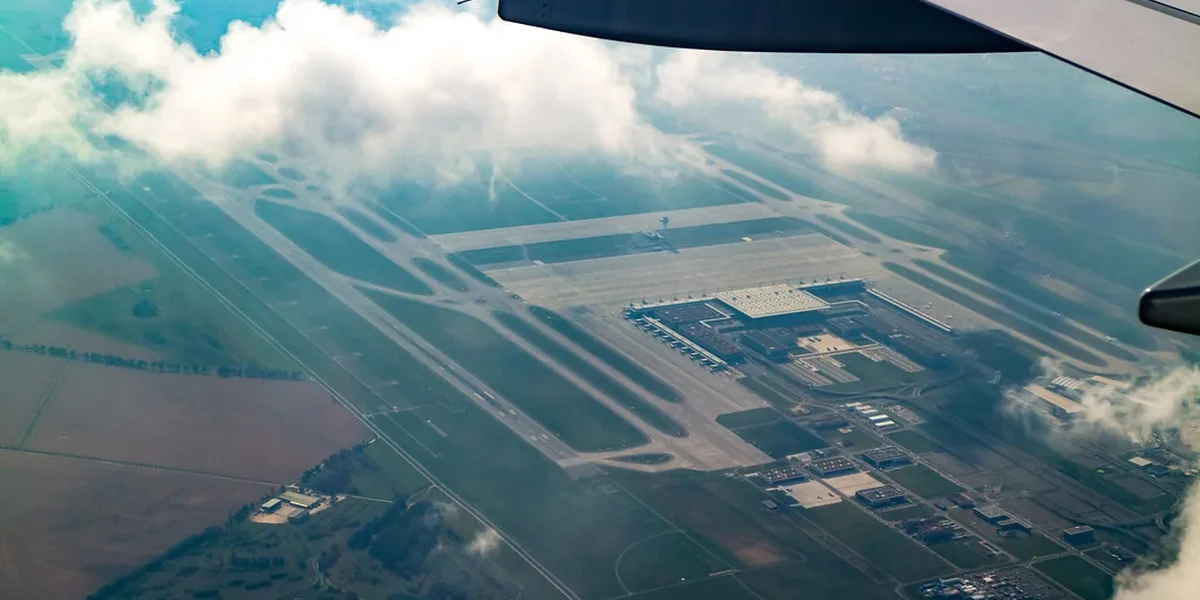
Berlin Brandenburg Airport (BER), officially Flughafen Berlin Brandenburg “Willy Brandt,” opened on 31 October 2020 in Schönefeld, in the state of Brandenburg, about 18 kilometres (11 miles) southeast of the city centre. It is the only commercial airport serving Berlin and the surrounding region.
Two passenger terminals handle every flight, a rail station sits directly beneath Terminal 1, and the Airport Express reaches Berlin Hauptbahnhof in roughly half an hour. That makes BER easier to navigate than its long construction history might suggest.
The airport also carries the weight of a city that once operated three airports at the same time. Tegel, Tempelhof, and Schönefeld each served a divided or reunifying Berlin, and BER now brings that traffic together at one site.
Key Takeaways
- BER sits in Schönefeld, Brandenburg, and replaced Berlin’s Tegel, Tempelhof, and Schönefeld airports.
- Terminal 1 and Terminal 2 handle all passenger flights; Terminal 5 is permanently closed.
- Trains to central Berlin leave from a station under Terminal 1, and the fare must cover zones A, B, and C.
What Is BER and Where Is It Located?
BER is the international airport serving Germany’s capital region. It occupies the site of the former Berlin-Schönefeld Airport, just south of the city boundary. It handled around 23 million passengers in 2023 and holds a four-star Skytrax rating, awarded in January 2025.
Airport Codes, Name, and Setting in Schönefeld
The airport uses the IATA code BER and the ICAO code EDDB. Its full German name, Flughafen Berlin Brandenburg “Willy Brandt,” honours the former chancellor and Berlin mayor.
Although travellers call it the new Berlin airport, the site lies in Schönefeld, in the state of Brandenburg, rather than within Berlin’s city limits. That distinction matters for public transport fares, as explained further down.
How BER Replaced Tegel, Tempelhof, and Schönefeld Airports
For decades, Berlin split its air traffic across three airports. Tempelhof, the wartime terminal known for the 1948 airlift, closed in 2008.
Tegel served West Berlin from its hexagonal terminal until November 2020, while Schönefeld Airport, the East German gateway, became part of the new complex.
When BER opened, the operator Flughafen Berlin Brandenburg GmbH (FBB) ended that split. All scheduled passenger flights for the capital region now depart from one location.
Runways, Airlines, and Route Network
BER operates two parallel runways. Its route network focuses heavily on European destinations, while a smaller group of carriers provides intercontinental services.
The largest operators at BER include:
- easyJet, which treats BER as a focus city
- Ryanair
- Eurowings
- Condor
- Sundair
Airline schedules change with the seasons, so check the airline’s own timetable before booking connecting travel. Other German hubs, including Frankfurt Airport and Munich Airport, handle more long-haul traffic.
Which Terminal Should You Use?
Terminal 1 handles most flights, while Terminal 2 takes overflow and low-cost traffic. The two buildings sit in the same complex, only a short walk apart. Terminal 5, the old Schönefeld building, no longer serves passengers.
Terminal 1: Check-In, Departures, and Arrivals
Terminal 1 is the main building. It has a U-shaped design spread across four above-ground levels and two underground floors. Arrivals sit on the ground floor (Level E0), while departures and the shopping area occupy Level E1.
The rail station lies directly beneath Terminal 1. Travellers can reach it by escalator or lift from the arrivals level, and gates are grouped into piers A through D.
Terminal 2 and Low-Cost Carrier Flights
Terminal 2 is a smaller, separate building used mainly by low-cost carriers during busy periods. It has its own check-in area, security controls, and baggage claim.
Passengers using Terminal 2 walk for a few minutes to reach the Terminal 1 rail station because no train runs directly beneath Terminal 2. Allow extra time for that transfer if the train connection is tight.
Why Terminal 5 Is No Longer in Use
Terminal 5 is the former Berlin-Schönefeld Airport building. It closed to passengers in February 2021 and remains shut.
Older signs, travel articles, and booking confirmations sometimes still mention it. Verify any flight listed for Terminal 5 on the BER live flight information display, since departures now use Terminal 1 or Terminal 2 only.
How Do Arrivals and Departures Work at BER?
Arriving passengers walk from the gate to passport control, but only on non-Schengen flights. They then collect baggage on Level E0 before leaving through the arrivals hall.
Departing passengers check in on Level E1, clear security, and continue to the gate piers.
From Landing to Baggage Claim and the Arrivals Hall
After leaving the aircraft, follow signs marked Gepäckausgabe (baggage claim). Belts are on the ground floor of each terminal.
The arrivals hall exits lead toward the rail station entrance in Terminal 1. With luggage, the walk from a distant gate to the platform takes about 10 to 15 minutes.
Passport Control for Schengen and Non-Schengen Travelers
Flights arriving from within the Schengen Area skip passport control entirely, so passengers go straight to baggage claim. Travellers arriving from outside the Schengen Area, including the United States and the United Kingdom, pass through Grenzkontrolle (border control) first.
Border processing at European airports has been changing as the EU Entry/Exit System rolls out. Build in extra time for non-Schengen arrivals during peak hours.
Check-In, Fast Bag Drop, Security, and Boarding
Check-in counters and self-service kiosks are on Level E1 of Terminal 1. Passengers who check in online can use Fast Bag Drop counters to hand over hold luggage more quickly.
Standard hand-luggage rules apply: liquids must be in containers of up to 100 ml and packed in a one-litre clear bag. Some security lanes use CT scanners that allow larger containers, but travellers can’t choose those lanes in advance, so pack according to the 100 ml rule.
How Does easyPass Work?
easyPass is Germany’s automated border control system. It uses facial recognition to match a traveller with the chip in an electronic passport, replacing a manual check by an officer.
Eligibility covers holders of biometric passports from the EU, EEA, Switzerland, and several additional countries, with a minimum age requirement. Signs in the border control area show which lanes are open.
How Do You Get Between BER and Central Berlin?
Rail is the fastest and cheapest link. The FEX Airport Express reaches Berlin Hauptbahnhof in roughly 30 minutes, with fares starting at around €4 to €5. Buses, taxis, and rental cars cover the same route, each with different trade-offs.
Airport Express and Regional Trains to Berlin Hauptbahnhof
The FEX (Flughafen-Express) runs between the station beneath Terminal 1 and Berlin Hauptbahnhof (Berlin Central Station), stopping at Ostkreuz and Gesundbrunnen. Trains leave roughly every 30 minutes.
Regional trains RE8 and RB23 also serve the airport station and reach different parts of the city. They all use the same platforms below Terminal 1.
S-Bahn S9, Buses, and Local Connections
The S-Bahn S9 links the airport with Ostkreuz, Alexanderplatz, and Friedrichstraße. It takes longer than the FEX but stops more often, which suits travellers heading to eastern districts.
Bus routes X7 and X71 connect BER with Rudow U-Bahn station, where line U7 continues into the city. Local buses also serve Terminal 5’s former site and nearby Brandenburg towns.
Taxis, Car Rental, and Long-Distance Travel
Licensed taxis queue outside the arrivals level of both terminals. A ride into central Berlin takes 35 to 60 minutes, depending on traffic, and costs considerably more than a train ticket.
Car rental desks sit in the Terminal 1 building, with vehicle pickup in the adjacent parking structures. Long-distance buses and regional coaches use a dedicated bus station near the terminal. It can be useful for onward trips to Dresden, Leipzig, or Poland.
Tickets, Fare Zones, and the Berlin WelcomeCard
BER sits in fare zone C, so any ticket into central Berlin must cover zones ABC. A short-trip or AB ticket isn’t valid from the airport, and inspectors do check.
Buy the ABC single ticket from machines in the rail station or through the BVG app before boarding. Validate paper tickets at the platform stamper.
The Berlin WelcomeCard in its ABC version covers the airport transfer, unlimited city travel, and discounts at attractions. It suits visitors planning several days of sightseeing. Travellers watching costs will find more fare-planning advice in this guide to visiting Germany on a budget.
What Services Are Available Before and After Your Flight?
BER offers several parking categories, paid lounges, shops and restaurants on Level E1, and free unlimited Wi-Fi throughout the terminals. Most services are concentrated in Terminal 1.
Parking and Valet Parking Options
Parking is spread across multi-storey garages and outdoor lots with different price levels. Rates fall the farther a lot sits from the terminal, and advance online booking costs less than driving up.
Valet parking is available for travellers who want to hand over the car at the terminal entrance and collect it on return. Short-term drop-off areas allow brief stops for passenger pickup.
Lounges, Food, Shops, and Airport Amenities
Paid lounges and airline lounges operate airside in Terminal 1, and several accept walk-up entry or lounge membership programmes. Travellers can book Fast Track security access separately.
The main shopping and dining area runs along Level E1, with bakeries, cafés, restaurants, pharmacies, and duty-free stores. Free Wi-Fi is available across the airport without a time limit.
Maps, Flight Information, and Digital Travel Tools
Live departure and arrival boards, terminal maps, and gate details appear on the airport’s official website and mobile app. Flights appear up to a week ahead, but check the terminal assignment there instead of relying on an older booking confirmation.
Travellers arriving from outside Europe can buy an eSIM for mobile data before landing, which helps avoid roaming charges. Keep in mind that airport websites and apps use cookies for analytics and personalized ads; you can adjust the consent settings on your first visit.
For ideas about what to see once you’re in the city, Everything About Germany covers Berlin’s museums, Kreuzberg and Charlottenburg neighbourhoods, and the Brandenburg Gate.
Frequently Asked Questions
How far is Berlin Brandenburg Airport from Berlin city centre?
BER lies about 18 kilometres (11 miles) southeast of central Berlin, in Schönefeld, Brandenburg. The FEX Airport Express reaches Berlin Hauptbahnhof in roughly 30 minutes.
By road, allow 35 to 60 minutes, depending on traffic.
Which terminal does my flight use at BER?
Most flights depart from Terminal 1, while Terminal 2 handles extra low-cost carrier traffic during busy periods. You can find the terminal on your boarding pass, the airport’s live flight information display, and the BER app.
Flights appear online up to one week in advance.
Is Terminal 5 at Berlin Brandenburg Airport open?
No. Terminal 5, the former Berlin-Schönefeld Airport building, closed to passengers in February 2021 and hasn’t reopened. Any booking or article that mentions Terminal 5 is out of date.
All passenger flights now use Terminal 1 or Terminal 2.
What ticket do I need from BER to central Berlin?
You need an ABC ticket because the airport sits in fare zone C. An AB ticket or short-trip ticket won’t cover the journey.
Buy your ticket at machines in the rail station or through the BVG app, and validate paper tickets before boarding.
How early should I arrive at Berlin Brandenburg Airport?
Arrive two hours before a Schengen flight and three hours before a non-Schengen departure. Border control can add time, so plan accordingly.
If you’re using Terminal 2, add another 10 to 15 minutes for the walk from the Terminal 1 rail station. Also, check your airline’s bag-drop cut-off times.