Brandenburg Gate
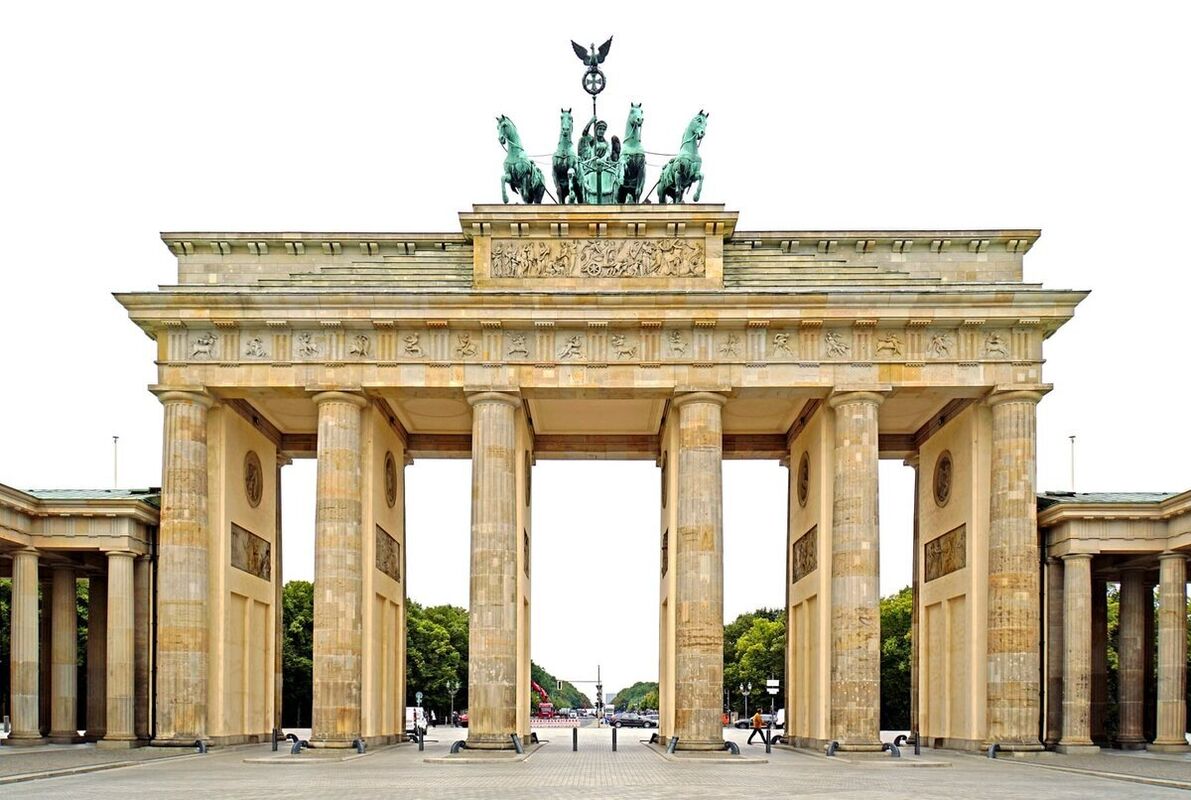
The Brandenburg Gate (Brandenburger Tor) is an 18th-century neoclassical city gate in central Berlin. Completed in 1791, it stands 26 meters tall at the western end of Unter den Linden and remains the last surviving gate of the 18 that once pierced Berlin’s customs wall.
Visitors can walk through the monument at any hour, free of charge, at Pariser Platz 1 in Berlin-Mitte. The same five passageways that once carried Prussian carriages now open onto one of Europe’s most documented political sites.
The gate carries two layers of meaning that people often blur together. King Frederick William II commissioned it as a Friedenstor (peace gate), yet people later reinterpreted the winged figure on top as a goddess of victory after Napoleon’s army carried the statue to Paris in 1806.
Germany’s history has passed beneath it ever since: imperial parades, wartime bombing, 28 years inside a sealed border zone, and the crowds who gathered here when the border opened in 1989.
Key Takeaways
- The gate was built between 1788 and 1791 as a peace monument, then absorbed centuries of victory, war, and division symbolism.
- Its position directly behind the Berlin Wall made it unreachable from both East and West Berlin for 28 years.
- Entry is free and unrestricted 24/7 at Pariser Platz, within walking distance of the Reichstag, Tiergarten, and Unter den Linden.
Why Is It One of Berlin’s Most Important Landmarks?
The gate is Berlin‘s most recognized landmark because it has stood at the center of nearly every turning point in modern German history, from Prussian ceremony to the night the Berlin Wall opened. Governments and movements have repeatedly rewritten its meaning while controlling the square around it.
From Prussian Gateway to National Symbol
The structure began with an ordinary function: it served as a checkpoint on the road west toward Brandenburg an der Havel. Prussian monarchs used it as a ceremonial entrance to the royal city, and the avenue behind it connected directly to the palace.
That practical role faded over the 19th century. Military parades, state processions, and later national celebrations turned a customs gate into a stage.
A Monument to Peace, Freedom, and Reconciliation
The original commission framed the gate as a symbol of peace, and the modern era has reclaimed that idea. Since 1989, the site has hosted reunification commemorations, memorials, and public gatherings tied to democracy and reconciliation.
The monument’s resilience is physical as well as symbolic. It survived bombardment, occupation, and decades of isolation, while the sandstone structure standing today includes extensive postwar restoration.
Its Place in German and European History
Few European monuments have belonged to so many opposing regimes. Prussian kings, the German Empire, the Nazi state, Soviet occupation authorities, and the divided German republics each used the same colonnade for their own purposes.
That layered record is why historians treat the site as a compressed timeline. Readers tracing the wider arc can follow it through the German Empire and on to German reunification.
How Was the Monument Designed and Built?
Carl Gotthard Langhans designed the gate between 1788 and 1791 for King Frederick William II of Prussia. He modeled it on the Propylaea, the ceremonial gateway to the Acropolis in Athens. Sculptor Johann Gottfried Schadow created the Quadriga that crowns it.
Frederick William II and the Former Customs Wall
Frederick William II ordered a new gate to replace a simple opening in Berlin’s customs wall. The barrier regulated goods entering the city and helped control desertion from the army. Workers demolished the wall itself in the 19th century.
The gate outlived the structure it belonged to. People removed all 17 other Berlin gates, leaving this one as the sole survivor.
Neoclassical Architecture Inspired by Athens
Langhans worked in the neoclassical style that Prussia had adopted for monumental public buildings, drawing directly on Greek precedent. The Athenian reference was deliberate: it linked the Prussian capital to classical ideas of civic order rather than to Roman triumphal arches.
The result became one of Berlin’s earliest major neoclassical works and set the visual tone for the buildings later added around it.
The Doric Columns, Passageways, and Bas-Reliefs
The gate has 12 Doric columns, six on each side, arranged to form five passageways. The central passage served the royal family, while ordinary traffic used the outer four.
Bas-reliefs on the gate and its flanking wings depict scenes from Greek mythology, including the labors of Hercules. The sandstone facade measures roughly 65 meters wide and 26 meters high.
What Does the Quadriga Represent?
Schadow’s Quadriga is a four-horse chariot driven by a winged female figure. He originally conceived her as Eirene, the Greek goddess of peace, matching the gate’s intended message.
After the statue returned from Paris in 1814, artists redesigned the figure with an iron cross topped by a Prussian eagle. People then widely read her as Victoria, goddess of victory. The version visitors see today is a postwar copy cast from surviving molds.
How Did War and Division Change Its Meaning?
Military defeat, aerial bombing, and the construction of the Berlin Wall repeatedly stripped the gate of its original peace symbolism and turned it into an instrument of state power. Each conflict left physical marks and created a new political reading.
Napoleon, Paris, and the Return of the Quadriga
After defeating Prussia at the Battle of Jena-Auerstedt in 1806, Napoleon marched through the gate and had the Quadriga dismantled and shipped to Paris as war booty. It stayed there for eight years.
Prussian forces recovered the statue in 1814 and returned it to Berlin. The redesign that followed added the iron cross, converting a peace emblem into a victory monument.
World War I, World War II, and Postwar Reconstruction
The gate served as a backdrop for nationalist demonstrations after World War I and for torchlit processions under the Nazi government. During the Second World War, bombing and the 1945 Battle of Berlin left the columns pockmarked and destroyed the Quadriga, except for a single horse’s head.
East and West Berlin authorities cooperated on restoration in 1957 and 1958, making it one of the period’s few joint projects. Workers cast a new Quadriga from original molds preserved in the West.
The Berlin Wall and the Cold War Exclusion Zone
When the Berlin Wall went up in August 1961, it ran directly in front of the gate on the western side. The monument sat inside East Berlin territory but within the sealed border strip, unreachable to residents of either half of the city.
No civilian passed through for 28 years. Viewing platforms on the western side let visitors look at it across the barrier, and both American presidents who spoke nearby, John F. Kennedy in 1963 and Ronald Reagan in 1987, used that setting deliberately.
From the Fall of the Wall to Reunification
The border opened on 9 November 1989, and crowds climbed the Wall in front of the gate. The crossing point at the Brandenburg Gate itself opened on 22 December 1989, when tens of thousands walked through in both directions.
Formal reunification of East Germany and West Germany followed on 3 October 1990. Since then, the gate has hosted national anniversary events.
How Do You Visit and Explore the Surrounding Area?
The gate is free to visit and open around the clock at Pariser Platz 1 in Berlin-Mitte. Its own S-Bahn and U-Bahn station sits a few steps away. There is no ticket, no interior, and no queue.
Location, Access, and Admission
| Detail | Information |
|---|---|
| Address | Pariser Platz 1, Berlin-Mitte |
| Opening access | 24/7 |
| Admission | Free |
| Interior access | None; the monument is viewed and walked through |
| Illumination | Lit after dark |
Access details and event closures can change. Public gatherings, New Year’s celebrations, and state ceremonies close Pariser Platz to pedestrians on specific dates, so verify conditions before traveling.
Getting There by S-Bahn and U-Bahn
- S-Bahn: Brandenburger Tor station (lines S1, S2, S25, S26)
- U-Bahn: Brandenburger Tor station (line U5)
- Nearby stop: Unter den Linden station, one block east
Both platforms exit directly onto Pariser Platz. The gate is also an easy walk from Potsdamer Platz and from the Hauptbahnhof via the Tiergarten paths.
Pariser Platz, Unter den Linden, and Tiergarten
Pariser Platz sits on the eastern side of the gate. It was rebuilt after 1990 with the Hotel Adlon, embassies, and the Academy of Arts. Unter den Linden runs east from the square toward Berlin‘s historic core.
West of the gate, Straße des 17. Juni cuts through the Tiergarten toward the Victory Column. The park covers 210 hectares and offers the least crowded approach on foot.
Nearby Sites for a Berlin History Walk
- Reichstag Building and the German Bundestag, a five-minute walk north
- Memorial to the Murdered Jews of Europe, two minutes south of Pariser Platz
- Museum Island and the Berlin Cathedral, 25 minutes east along Unter den Linden
- Berlin Wall Memorial on Bernauer Straße, reached by U-Bahn
- Checkpoint Charlie, the former Allied crossing point in Friedrichstraße
Everything About Germany maintains destination profiles for these sites alongside broader regions coverage, useful when building a multi-day route through the capital.
Frequently Asked Questions
Why was the Brandenburg Gate built?
King Frederick William II commissioned it between 1788 and 1791 to replace a plain opening in Berlin’s customs wall with a formal ceremonial entrance. He conceived it as a Friedenstor, a gate of peace, and it served as the western approach to the royal avenue Unter den Linden.
What does the Quadriga statue on the Brandenburg Gate represent?
The Quadriga is a chariot pulled by four horses and driven by a winged female figure. Johann Gottfried Schadow originally sculpted her as Eirene, the goddess of peace. After the statue returned from Paris in 1814, officials added an iron cross and Prussian eagle, and people began identifying her as Victoria, goddess of victory.
Was the Brandenburg Gate part of the Berlin Wall?
The gate wasn’t part of the Wall itself, but the barrier ran directly in front of it from 1961. That placed the monument inside the sealed border strip. It stood on East Berlin territory, and authorities closed it to civilians from both sides for 28 years.
Was the Brandenburg Gate destroyed in World War II?
The gate suffered heavy damage but wasn’t destroyed. Bombing and the 1945 Battle of Berlin scarred the columns and wrecked the Quadriga, leaving only one horse’s head. East and West Berlin authorities then carried out a joint restoration in 1957 and 1958.
Can visitors walk through the Brandenburg Gate?
Yes. Pedestrians can use all five passageways at any time of day, and there’s no ticket or admission fee. Vehicle traffic is restricted, though, and the square sometimes closes for state events or large public gatherings.
💡 Visitor Tips & Best Experience
Visit early in the morning to avoid tour groups and wear comfortable walking shoes for cobblestones.
🚆 How to Get There & Public Transit
Accessible via Deutsche Bahn regional and intercity rail networks.
🎟️ Popular Tours & Tickets for Brandenburg Gate
Compare tickets and guided experiences. Check available dates, what is included, and the provider's cancellation terms before booking.