Theresienwiese (Oktoberfest Grounds)
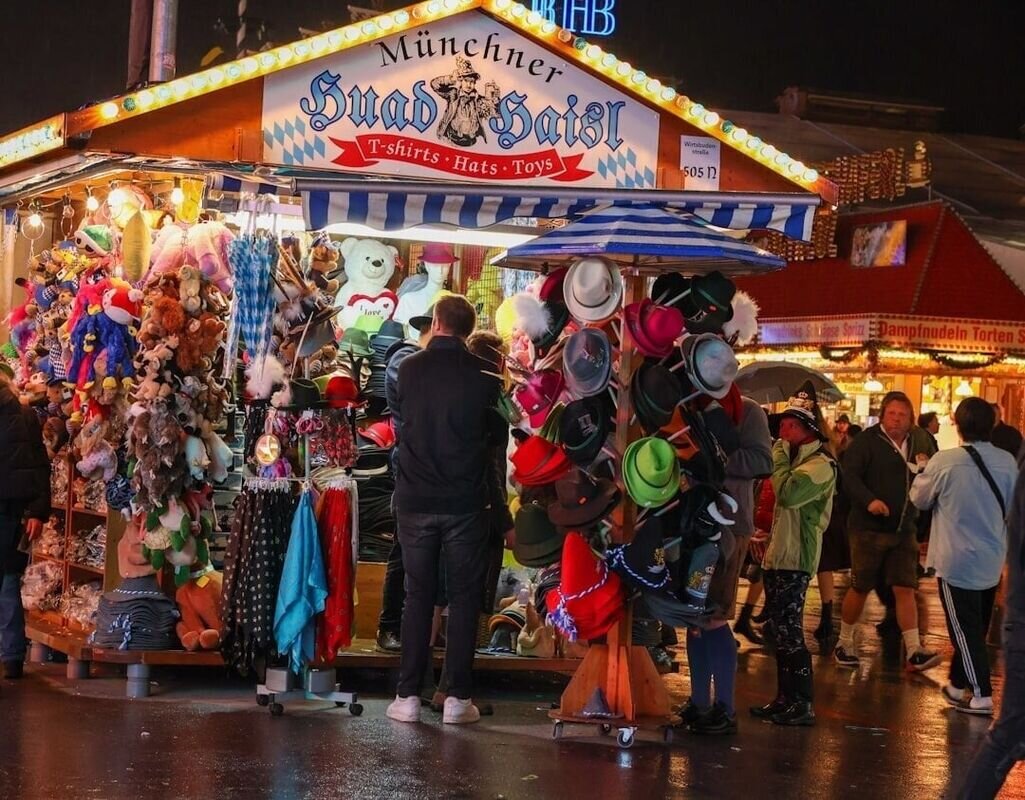
Theresienwiese is Munich’s 42-hectare public festival ground in the Ludwigsvorstadt-Isarvorstadt district. It has hosted Oktoberfest every year since 1810. Locals call it the Festgelände (festival grounds), and for most of the year it remains open and free to walk across.
The site takes its name from Therese von Sachsen-Hildburghausen, whose 1810 wedding to Crown Prince Ludwig ended with a horse race on this meadow outside the old city walls. Organizers repeated the race the next year, and the meadow kept her name.
Visitors can walk the grounds year-round without a ticket, reach them directly by U-Bahn at Theresienwiese station, and see the 18-meter Bavaria statue and Ruhmeshalle on the western edge at any time of year.
Understanding the space helps in a practical way. Knowing which entrances face which transit stops, when the Frühlingsfest and Winter-Tollwood take over sections of the field, and where the quieter approach routes run can make the difference between a smooth arrival and an hour in a crowd.
Key Takeaways
- Theresienwiese is a free, open 42-hectare public space in Munich named after a royal bride from 1810.
- Oktoberfest is the largest event held here, but spring festivals, flea markets, and a winter culture festival fill other months.
- The U4 and U5 subway lines stop directly at Theresienwiese station, with Goetheplatz, Poccistraße, and Hackerbrücke as useful alternatives.
Munich’s Historic Festival Grounds at a Glance
Theresienwiese is a paved, gently sloping open field covering 42 hectares, roughly the size of 60 soccer fields, in central Munich (München). It functions as a Volksfest ground, or public folk festival site, for several weeks a year and as ordinary open civic space the rest of the time.
Where Is the Site Located in Ludwigsvorstadt-Isarvorstadt?
The grounds sit in the Ludwigsvorstadt section of the Ludwigsvorstadt-Isarvorstadt borough, about two kilometers southwest of Marienplatz. The common address for the site is Bavariaring 5, 80336 München.
Bavariaring curves around the western and southern edges, below the Bavaria statue. Esperantoplatz marks the northeastern corner, near the main pedestrian approach from the city center and the Hauptbahnhof area.
Residential streets bound the field on nearly all sides. That’s why event traffic gets routed so carefully during large festivals.
Why Is Oktoberfest Called the Wiesn?
Wiesn is the Bavarian dialect form of Wiese, meaning meadow, and it is a short form of Theresienwiese. Munich residents rarely say “Oktoberfest” in conversation; they say they are going auf die Wiesn.
The word now carries a double meaning. It names the place and the festival at once, so “Wiesn 2026” refers to the event, while “on the Wiesn” refers to the ground itself. Visitors reading local signs or transit announcements will see the term used both ways.
What Does the 42-Hectare Site Look Like Outside Major Events?
For most of the year, the field is an empty paved expanse with wide marked lanes, low kerbs, and long sightlines toward the Bavaria statue. Skateboarders, inline skaters, runners, and dog walkers use it daily.
Grass strips and mature trees line the edges along Bavariaring, giving the western side a park-like feel. The central area stays open because it must accommodate tent construction each summer.
Oktoberfest setup begins months in advance, so parts of the field become construction zones from roughly July onward.
How Did a Royal Wedding Create Oktoberfest?
Oktoberfest began on 12 October 1810 as a public celebration of Crown Prince Ludwig’s marriage to Princess Therese von Sachsen-Hildburghausen. The festivities ended with a horse race on the meadow that later took her name.
Organizers held the race again the following year, turning a one-time royal party into an annual Bavarian tradition.
Therese von Sachsen-Hildburghausen and Crown Prince Ludwig
Therese von Sachsen-Hildburghausen married Crown Prince Ludwig, later König Ludwig I (King Ludwig I) of Bavaria, in October 1810. The citizens of Munich were invited to the celebrations on the fields in front of the city gates.
The area became Theresienwiese, “Therese’s meadow,” in her honor. She became Queen of Bavaria in 1825, when Ludwig took the throne.
The 1810 Pferderennen and Andreas Michael Dall’Armi
The closing event of the wedding festivities was a Pferderennen (horse race), staged on the open meadow before a large public crowd. Andreas Michael Dall’Armi, an officer of the Bavarian National Guard, is credited with proposing the public celebration.
The race drew thousands of spectators and proved popular enough for organizers to repeat it in 1811, pairing it with an agricultural show.
From an Annual Race to Bavaria’s Defining Festival
The horse race remained the centerpiece for decades before losing importance and eventually disappearing. Beer stands appeared during the 1800s and grew into the large wooden halls that define the modern festival.
The dates also shifted. Organizers moved most of the festival into September for milder weather, which is why an “October festival” now largely takes place in September. Our Oktoberfest history guide traces that development in more detail.
Political History, Nationalsozialismus, and the 1980 Memorial
The grounds served as a political assembly site in the 20th century, including during the era of Nationalsozialismus (National Socialism). The regime used the space for rallies and propaganda events.
On 26 September 1980, a bomb exploded at the main entrance during Oktoberfest, killing 13 people and injuring more than 200. A memorial stands near that entrance on Bavariaring, and commemorative ceremonies take place there each year.
What Happens Here Beyond Oktoberfest?
Theresienwiese hosts several large public events throughout the year, including a spring folk festival, Bavaria’s largest flea market, a classic car meeting, and a winter arts and market festival. Munich publishes these under the heading Veranstaltungen auf der Theresienwiese (events on the Theresienwiese).
Münchner Frühlingsfest: Munich’s Spring Festival
The Münchner Frühlingsfest (Munich Spring Festival), sometimes called the Springfest in English, first took place on the Theresienwiese in 1965. It gave showpeople income after the winter break.
The 2026 edition runs from April 17 to May 10, extended to three weeks for the first time to mark its 60th anniversary. It occupies the northern section of the grounds, along Streets 1 and 2 between Wirtsbudenstraße and Schaustellerstraße.
| Detail | Frühlingsfest 2026 |
|---|---|
| Tents | Festhalle Bayernland (Augustiner), Hippodrom (Spaten) |
| Beer price | €13.50 / €14.50 per liter |
| Admission | Free |
| Rides | Around 30, plus 100+ vendors |
| Tent hours | Mon–Thu 11:00–23:00, Fri to 23:30, Sat/Sun from 10:00 |
Two fireworks displays are scheduled for 22:00 on April 24 and May 8, with a hot-air balloon Night Glow on April 29.
Riesenflohmarkt and the Oldtimerfestival
The Riesenflohmarkt (giant flea market) takes place on the first Saturday of the Frühlingsfest, set for April 18, 2026. The Bavarian Red Cross organizes it, and around 2,500 sellers attend, making it Bavaria’s largest Flohmarkt.
The classic car meeting, the Oldtimerfestival, falls on the second Sunday, April 26, 2026. The Automobil-Club München e.V. hosts it in the southern part of the grounds, where VW Beetles, Porsches, and American imports line up from early morning.
Winter-Tollwood and Other Seasonal Cultural Events
The Tollwood Festival holds its winter edition on the Theresienwiese, filling part of the field with a market selling crafts and gifts, organic food stalls, and a concert and theater program. Winter-Tollwood runs through the Advent season and closes around New Year.
The summer Tollwood-Festival takes place elsewhere in Munich, so only the winter edition affects the Theresienwiese calendar. During that period, sections of the paved field are fenced off for tents and stages.
For readers comparing German winter markets, the Nuremberg Christkindlesmarkt offers a more traditional format.
Oide Wiesn and the Bavarian Central Agricultural Festival
The Oide Wiesn (“old Wiesn”) is a fenced historic section within Oktoberfest, on the southern part of the grounds. It features restored vintage rides, a historic tent with folk music, and quieter surroundings. Admission costs extra, unlike at the main festival.
Every four years, the Oide Wiesn area gives way to the Bayerisches Zentral-Landwirtschaftsfest, the Bavarian Central Agricultural Festival. The livestock and farm machinery show connects to the 1811 agricultural show that followed the original horse race.
Which Landmarks Overlook the Festival Grounds?
Two 19th-century monuments commissioned by Ludwig I dominate the western edge of the Theresienwiese: the colossal Bavaria statue and the Ruhmeshalle behind it. St. Paul’s Church rises just north of the field and provides the highest public view over the fairground.
The Bavaria Statue and Ruhmeshalle
The Bavaria-Statue is an 18-meter bronze female figure representing the Bavarian homeland. Sculptor Ludwig Schwanthaler designed it, and Ferdinand von Miller cast it. She stands on a stone plinth, holding a wreath, with a lion at her side.
Behind her stands the Ruhmeshalle (Hall of Fame), an open Doric colonnade holding busts of notable Bavarians. Ludwig I commissioned both in the mid-1800s, and together they frame the entire field from the raised western terrace.
Can Visitors Climb the Bavaria Statue?
Yes. A narrow internal staircase leads through the hollow bronze figure to a small viewing chamber in the head, with openings that look east across the grounds toward the city.
The climb is tight and steep, and the statue closes seasonally. Entry is ticketed and managed separately from the Ruhmeshalle terrace, which visitors can enter free of charge. Confirm opening times before making the trip, since the monument’s schedule changes with the seasons and during event setup.
St. Paul’s Church and Its Oktoberfest Viewing Platform
St. Paul’s Church (Paulskirche), the neo-Gothic church on the northern edge of the field, opens its tower Aussichtsplattform (viewing platform) to visitors during Oktoberfest. The climb is long, and the parish limits access to specific hours.
From the tower, you can read the full layout of tents, midway rides, and entrances in a way that isn’t possible from ground level.
Live Cams and Views Across the Fairground
Munich operates public Live-Cams pointed at the Theresienwiese during Oktoberfest, so people can check crowd levels before setting out. The feeds cover the main avenues and entrance areas.
On the ground, the Ferris wheel offers the widest paid view over the Fahrgeschäfte (rides) and Festzelte (festival tents), reaching more than 50 meters. On clear days, you can see the Alps to the south.
How Do You Get There and Plan a Visit?
Theresienwiese stays open around the clock as public space, costs nothing to enter, and sits directly above its own U-Bahn station. Event days can change access patterns, with some entrances closed and pedestrian traffic routed one-way.
Address, Access, and When the Grounds Are Open
The address is Bavariaring 5, 80336 München. The grounds remain open 24/7 as ordinary public space, with no gates or fences outside event periods.
During large festivals, organizers set entry hours, close certain gates, and may restrict access when the site reaches capacity. Event-specific hours and admission rules change from year to year, so verify the current details before traveling. Everything About Germany publishes destination context for the site alongside its wider Munich coverage.
Arriving by U-Bahn, S-Bahn, and on Foot
The most direct option is the U4 or U5 subway to Theresienwiese station, which exits at the northeastern corner of the field.
Useful alternatives:
- Goetheplatz (U3, U6) on the eastern side
- Poccistraße (U3, U6) to the south
- Hackerbrücke (S-Bahn) to the north, a signposted 10-minute walk
- Schwanthalerhöhe (U4, U5) to the west
- Hermann-Lingg-Straße (tram 18, 19)
Walking from the Hauptbahnhof takes about 15 minutes. From Marienplatz, allow roughly 25 minutes on foot.
How to Avoid the Busiest Oktoberfest Arrival Routes
Theresienwiese station becomes severely congested during Oktoberfest, and staff periodically halt platform access for safety. Getting off one stop earlier solves most of the problem.
Practical alternatives during peak hours:
- Use Poccistraße and approach from the south, near the Oide Wiesn
- Use Goetheplatz and walk in from the east
- Arrive by S-Bahn at Hackerbrücke and follow the signed route
- Enter through the Bavariaring side, below the statue
Weekday mornings and the first hours after opening are the calmest times on the grounds.
Admission, Safety Services, and Event-Day Preparation
Entry to the Theresienwiese and to Oktoberfest itself is free, as is entry to the Frühlingsfest tents. You pay separately for table reservations, individual rides, and the Oide Wiesn.
Oktoberfest Guided Tour with Tent Lunch & Beer
ℹ️ Hosted experience package. General entry to festival grounds and tents is free.
We may earn a commission when you book through these links, at no extra cost to you.A permanent Sanitätsstation (first aid station) operates below the Bavaria statue during Oktoberfest, with staff from the Bavarian Red Cross. A dedicated Feuerwehr (fire brigade) post remains on the grounds throughout the festival, and security screening applies at every entrance, with bag-size limits.
Bring cash for smaller stalls, wear shoes suited to long walks on pavement, and agree on a meeting point in advance, since mobile networks slow under heavy load. Readers new to the country may find the general visiting Germany for the first time tips useful for broader planning.
Frequently Asked Questions
Where is Theresienwiese in Munich?
Theresienwiese lies in the Ludwigsvorstadt-Isarvorstadt district, about two kilometers southwest of Marienplatz. The standard address is Bavariaring 5, 80336 München. The Bavaria statue and Ruhmeshalle mark its western edge.
How do you pronounce Theresienwiese?
It is pronounced roughly u0022teh-RAY-zee-en-VEE-zuh,u0022 with the u0022wu0022 sounding like an English u0022v.u0022 The shortened local name, Wiesn, sounds like u0022VEE-zn.u0022 Both refer to the same place.
Is Theresienwiese open when Oktoberfest is not taking place?
Yes. The grounds are open 24/7 as public space and cost nothing to enter. Outside festival periods, the paved field is used by skaters, runners, and walkers, though sections are fenced during event setup and teardown.
Do you need tickets to enter Theresienwiese or Oktoberfest?
No ticket is required to enter the grounds or the Oktoberfest site, and tent entry is free. You pay separately for table reservations, rides, food, drinks, and the Oide Wiesn section. Reservation policies differ by tent, so check with the operator directly.
Which U-Bahn station is best for Theresienwiese?
Theresienwiese station, on the U4 and U5 lines, is the closest option. Exit at the northeastern corner. During Oktoberfest, though, the station gets heavily congested, so Poccistraße or Goetheplatz on the U3 and U6 lines may be better choices at peak hours.
💡 Visitor Tips & Best Experience
Visit early in the morning to avoid tour groups and wear comfortable walking shoes for cobblestones.
🚆 How to Get There & Public Transit
Accessible via Deutsche Bahn regional and intercity rail networks.
🎟️ Popular Tours & Tickets for Theresienwiese (Oktoberfest Grounds)
Compare tickets and guided experiences. Check available dates, what is included, and the provider's cancellation terms before booking.