Lübeck
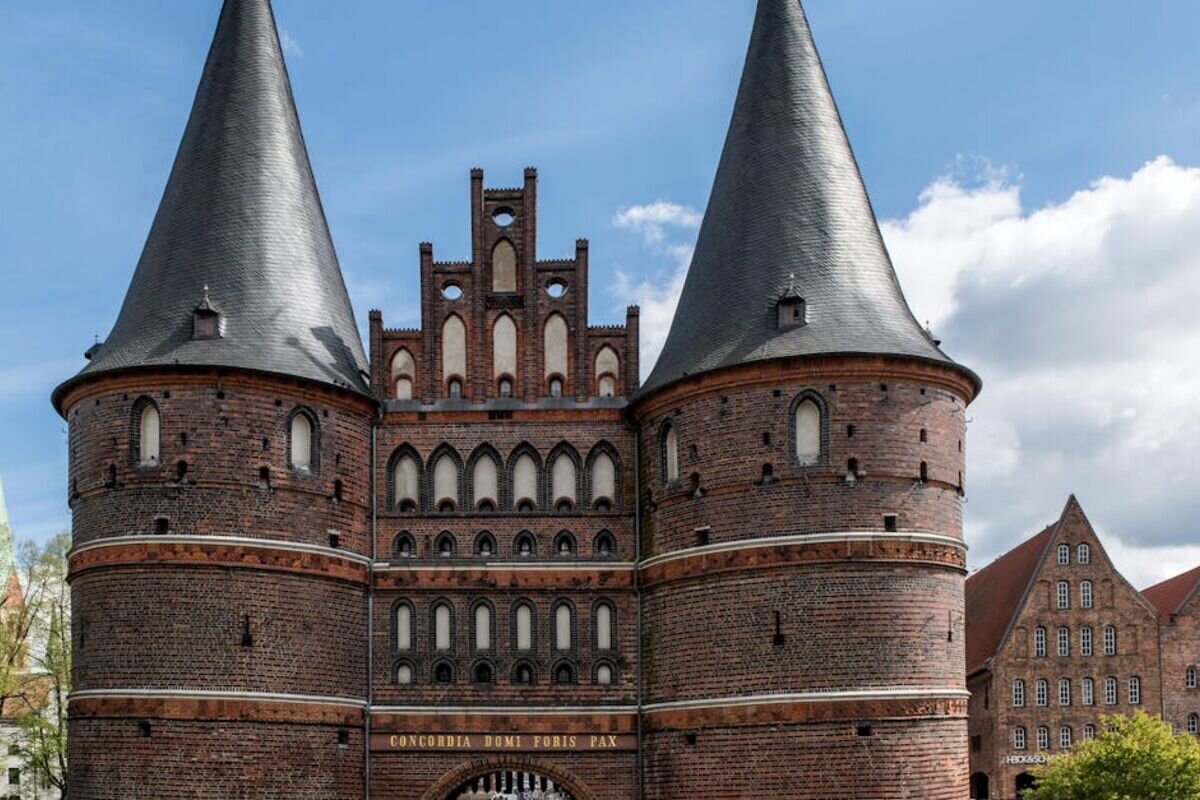
Lübeck sits on an island in the River Trave in Schleswig-Holstein, and its Altstadt (Old Town) has been a UNESCO World Heritage Site since 1987. The city was once called the Queen of the Hanseatic League, and much of what visitors see today, from salt warehouses to seven church spires, comes directly from that trading past.
A first-time visitor can walk the entire UNESCO-listed Old Town island in a single day, but two days allow time for the churches, the museums, and a trip out to the Baltic Sea coast at Travemünde.
Northern Germany has few places where medieval city planning survives so completely. The island layout still follows the social and economic order of a merchant republic: warehouses by the water, churches at the center, and almshouses tucked behind gates in narrow lanes. Hansestadt Lübeck, the city’s official name, remains part of everyday signage and identity.
Key Takeaways
- Lübeck’s Old Town island holds the Holstentor, Brick Gothic churches, merchant houses, and roughly 90 courtyards and alleys within walking distance.
- The city’s Hanseatic and salt-trading history explains its warehouses, civic buildings, church art, and Baltic Sea connection at Travemünde.
- Two days suits most first-time visitors, with Hamburg about an hour away by regional train.
What Are the Essential Things to Do in Lübeck?
The essential things to do in Lübeck cluster on one river island: the Holstentor gate, the Salzspeicher salt storehouses, the Brick Gothic church skyline, and the network of alleys and courtyards behind the main streets. Nearly all of it is walkable, with the Trave River on one side and the Wakenitz River on the other.
Start at the Holstentor and Salzspeicher
The Holstentor (Holsten Gate) is the city’s best-known building and a natural starting point for a walk into the Altstadt. Its two round towers lean visibly because soft ground lies beneath the foundations.
Beside it stand the Salzspeicher, six gabled brick warehouses built between the 16th and 18th centuries. They stored salt brought overland from Lüneburg before it traveled across the Baltic Sea, and their position at the water’s edge shows how directly trade shaped the townscape.
Walk the UNESCO-Listed Altstadt
The Old Town island is compact enough to cross on foot in about 20 minutes. Breite Straße forms the main commercial spine, while the Koberg, a preserved medieval square in the northern quarter, gives a clear sense of the original street plan.
Merchant houses with stepped gables line the older streets. At the northern end, the Burgtor marks the second surviving city gate, smaller than the Holstentor and much quieter.
See the Seven-Spired Brick Gothic Skyline
Seven towers define Lübeck’s profile from the water, and they belong to five churches. Brick Gothic architecture developed here because northern Germany lacked building stone, so masons worked with fired clay and pushed it to cathedral scale.
The style influenced medieval architecture across the Baltic region, from Denmark to Poland. Viewing the skyline from the far bank of the Trave gives the fullest sense of that silhouette.
Find Lübeck’s Alleys and Courtyards
Behind the main streets sit around 90 Gänge and Höfe, alleys and courtyards built as housing for workers and the poor. Many are private, though several remain open to respectful visitors during daylight.
Notable examples include the Dunkelgrüner Gang, Von-Höveln-Gang, and Kalandsgang, along with the courtyards of Glandorps Hof, Haasenhof, and Füchtingshof. Doorways are low and passages are narrow. Residents live there year-round, so quiet is expected.
How Does Lübeck’s Hanseatic Past Shape Its Landmarks?
Almost every major landmark in Lübeck exists because of the Hanseatic League. Merchant wealth paid for the churches, town hall, and almshouses, while the later loss of that wealth helped so much survive into the modern era.
Understand the Hanseatic League and the Salt Trade
The Hanseatic League was a trading and defensive alliance of northern European merchant cities that dominated Baltic and North Sea commerce from the 13th to the 15th centuries. Lübeck served as its leading city and hosted its assemblies.
Salt drove much of that trade. Preserved herring fed much of medieval Europe, and salt made that preservation possible. That’s why storehouses stood at the harbor rather than inland. This maritime heritage still marks Lübeck’s role as a Hansestadt.
Visit St. Mary’s Church and Lübeck Cathedral
St. Mary’s Church (Marienkirche) was built by the city’s merchant class between roughly 1250 and 1350 as a statement of civic power. Its vaults rise about 38.5 meters, making them some of the tallest brick vaults anywhere.
Lübeck Cathedral (Lübecker Dom) is older, founded in the 12th century, and holds a monumental triumphal cross carved by Bernt Notke in 1477. Together, the two buildings mark the split between church authority and merchant authority in the medieval city.
Explore Civic Buildings and Medieval Social Institutions
The Rathaus (Lübecker Rathaus, or Lübeck Town Hall) has served the city since the 13th century. Its dark glazed brick walls have wind holes that reduce storm pressure. Nearby, the Haus der Schiffergesellschaft was built in 1535 as the guildhall of ship captains.
The Heiligen-Geist-Hospital, founded in 1286, is one of Europe’s oldest surviving social welfare institutions. The city motto, Concordia domi foris pax (harmony within, peace abroad), appears above the Holstentor.
Trace War, Reconstruction, and the Cold War Border
An air raid in March 1942 destroyed about a fifth of the Old Town, including the roofs and bells of St. Mary’s Church. Two fallen bells remain on the floor where they landed as a memorial.
Reconstruction continued for decades and followed historic footprints. After the Second World War, Lübeck sat directly on the inner-German border, and the Cold War frontier ran only a few kilometers east until 1989.
Which Museums, Literary Sites, and Foods Define Lübeck?
Lübeck’s museums, literary houses, and marzipan trade all connect back to merchant families and their fortunes. The European Hansemuseum explains the trading system, the Buddenbrookhaus explains what happened to those families, and Niederegger sells the confection their sugar imports made possible.
Learn Hanseatic History at the European Hansemuseum
The European Hansemuseum opened in 2015 near the Burgtor and covers the full arc of the Hanseatic League across northern Europe. Reconstructed rooms and archaeological finds sit alongside documents from the League’s assemblies.
It’s the most thorough single explanation of Hanseatic trade in Germany, and it’s worth visiting before walking the Old Town.
Follow the Mann Family’s Literary Lübeck
Thomas Mann set Buddenbrooks, his 1901 novel about a declining merchant family, in Lübeck. The Buddenbrookhaus on Mengstraße was the home of his grandparents and now serves as a museum for Thomas Mann and his brother Heinrich Mann.
The building has been under long-term redevelopment, with exhibition content shown at a nearby site during the works. The Willy Brandt House honors the Lübeck-born chancellor and Nobel Peace Prize laureate.
See Sacred Art and Decorative Arts at Museumsquartier St. Annen
The St. Annen Museum occupies a former Augustinian convent from 1502 and holds one of Germany’s strongest collections of medieval sacred art, including carved altarpieces from Lübeck churches. The wider Museumsquartier St. Annen also houses contemporary art.
The Museum Behnhaus Drägerhaus, set in two neoclassical merchant houses, shows 19th and 20th century painting alongside period interiors.
Where to Try Lübecker Marzipan
Lübecker Marzipan carries protected geographical status and has been made in the city since at least the 19th century. The tradition rests on almonds and sugar arriving through the Baltic ports.
Niederegger, founded in 1806, runs its main shop and Niederegger Café opposite the Rathaus, with a small Marzipan Museum on the upper floor showing life-size marzipan figures. Everything About Germany covers regional food traditions like this alongside city guides for Hamburg, Munich, and other German destinations.
How Should You Plan a Lübeck Itinerary and Baltic Coast Extension?
Two days covers Lübeck comfortably: one for the Old Town island and its churches, and one for museums plus a trip to the Baltic Sea coast. The city works equally well as a day trip from Hamburg or as a base for exploring Schleswig-Holstein.
How Many Days Do You Need in Lübeck?
One full day is enough to see the Holstentor, walk the Altstadt, enter two churches, and stop for marzipan. Distances inside the island are short, and few sights are more than 15 minutes apart on foot.
Two days adds the European Hansemuseum, the St. Annen Museum, and a boat trip on the Trave. Three days makes sense when combining the city with the coast or nearby lake country.
Add Travemünde and the Baltic Sea Coast
Travemünde sits at the mouth of the Trave, about 20 kilometers from the Old Town, and is part of Lübeck itself. Travemünde Strand offers a long sand beach, a promenade, and ferry traffic bound for Scandinavia and the Baltic states.
Regional trains and local buses connect the two, and boats run along the Trave in the warmer months. The beach draws crowds in July and August.
Choose Day Trips Around Schleswig-Holstein
Several destinations sit within about an hour of Lübeck by train or car:
- Hamburg for its harbor, Speicherstadt, and museums
- Schwerin for Schwerin Castle on its island setting
- Ratzeburg and Mölln, small lake towns south of the city
- Plön in the Holstein lake district, and Kiel on the Baltic
- Schleswig for Viking-era history, and Rostock further east along the coast
- The Schaalsee biosphere reserve, once split by the inner-German border
When Is the Best Time to Visit Lübeck?
May through September brings the mildest weather and the longest daylight, with average summer highs around 21°C (70°F). Coastal wind keeps the city cooler than inland Germany.
Late November and December bring the Lübeck Christmas Market, which spreads across the Rathausmarkt and several squares. Winter days are short and damp, so indoor sights take up more of the itinerary. Broader seasonal planning for German Christmas markets helps when timing a December trip.
How Do You Get Around and Where Should You Stay?
Lübeck is easiest to reach by regional train from Hamburg, a journey of roughly 45 to 75 minutes, and the Old Town is best covered on foot. Lübeck Hauptbahnhof stands about a 10-minute walk west of the Holstentor.
How to Get to Lübeck From Hamburg and Beyond
Deutsche Bahn regional trains run frequently between Hamburg Hauptbahnhof and Lübeck Hauptbahnhof throughout the day. Hamburg Airport is the main international gateway, with rail and bus links onward.
Lübeck Airport handles limited traffic. FlixBus services stop at the Lübeck ZOB, the central bus station beside the main railway station.
Use Trains, Buses, and Local Connections
The Schleswig-Holstein-Ticket allows a day of regional travel across the state for one fare. Additional travelers can join at a reduced rate, which makes it useful for day trips to Kiel or Travemünde.
City buses cover routes beyond the island, but the Old Town itself needs no transport. Cobblestones are common, so consider leaving the wheeled luggage and thin soles at home.
Where to Stay in Lübeck
Staying inside or immediately beside the Altstadt gives you the shortest walks to the churches, museums, and evening dining. The Radisson Blu Senator Hotel sits on the Trave with views toward the Old Town skyline.
The Atlantic Hotel Lübeck stands near the station and Holstentor. Travemünde offers seafront hotels for travelers who prioritize the beach, with a 20-minute train ride into the city.
What Should Visitors Check Before Arrival?
Opening hours for churches, museums, and the Buddenbrookhaus change with the season and ongoing building work, so confirm times directly before traveling. Some courtyards close to visitors outside daylight hours.
Card payment is widely accepted, though smaller cafés and market stalls still favor cash. A little practical preparation like this pairs well with general first-time travel tips for Germany.
Frequently Asked Questions
Is Lübeck worth visiting for a day trip from Hamburg?
Yes. Regional trains link Hamburg and Lübeck in roughly 45 to 75 minutes, and the UNESCO World Heritage Old Town is compact enough to see the Holstentor, two churches, and the Rathaus in a single day.
Travelers who want to visit museums as well should plan an overnight stay.
What is Lübeck famous for?
Lübeck is known as the former leading city of the Hanseatic League, for its Brick Gothic architecture and seven church spires, and for Lübecker Marzipan. The Holstentor appears on postcards and once featured on German banknotes and coins.
What are the best free things to do in Lübeck?
Walking the Altstadt, viewing the Holstentor and Salzspeicher from outside, and exploring the open courtyards and alleys cost nothing. Riverside paths along the Trave and Wakenitz also provide free views of the skyline.
Entry to some churches is free or by donation.
Where is Lübeck located in Germany?
Lübeck lies in the state of Schleswig-Holstein in northern Germany, about 20 kilometers inland from the Baltic Sea on the River Trave. Hamburg sits roughly 65 kilometers southwest.
Is Lübeck still a free city?
No. Lübeck was once a Free Imperial City and later a free city-state. It lost that status in 1937 and became part of Schleswig-Holstein.
Still, the official name Hansestadt Lübeck preserves the city’s historical connection.
💡 Essential Travel Tips
Explore the historic Old Town (Altstadt) on foot and use the local S-Bahn/U-Bahn network.
🥨 Local Insights & Food Culture
Purchase a 24-hour transit day pass (Tageskarte) for unlimited city travel.
🎟️ Top Activities & Experiences in Lübeck
Discover curated walking tours, museum passes, and authentic experiences in Lübeck with instant confirmation.