Neuschwanstein Castle
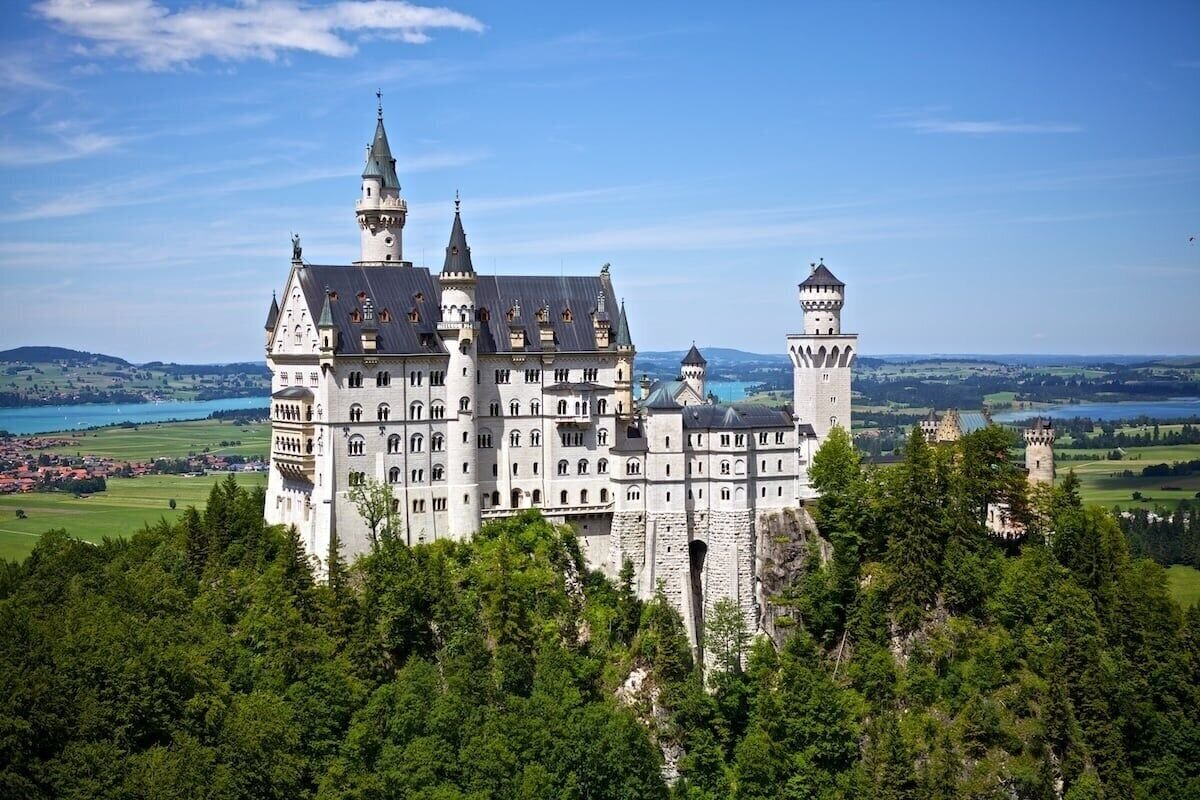
Perched on a rocky ridge above the village of Hohenschwangau in southern Bavaria, Neuschwanstein Castle draws roughly 1.4 million visitors a year. King Ludwig II commissioned it in the late 1860s as a private retreat shaped by medieval legend and Richard Wagner‘s operas.
He never saw it finished, and the public entered the castle within weeks of his death in 1886.
You can only see the interior on a timed guided tour, so book online in advance, plan about 30 to 40 minutes to walk uphill from the ticket center in Hohenschwangau, and arrive at least an hour before your printed entry time. That one rule shapes almost every other decision about your visit, from which train you take out of Munich to when you stop at Marienbrücke for photos.
The castle sits near Füssen, at the edge of the Alps, roughly two hours south of Munich. Its towers rise above the Alpsee and Schwansee lakes, with the Pöllat Gorge cutting below the eastern wall.
Key Takeaways
- Ludwig II built Schloss Neuschwanstein as a Wagner-inspired retreat, and it opened to visitors shortly after his death in 1886.
- Entry is by timed guided tour only, sold through the official online shop and, if seats remain, the same day at Ticket Center Hohenschwangau.
- Photography is allowed outside but not in the interior rooms, so plan your shots from Marienbrücke, the Alpsee shore, or the village below.
What Is the History Behind Neuschwanstein Castle?
Neuschwanstein was the personal project of one man: Ludwig II, King of Bavaria from 1864 until 1886. Construction began in 1869 on the ruins of two small medieval fortresses, based on designs by architect Eduard Riedel and theater set designer Christian Jank.
The result is a 19th-century historicist palace built to look older than it is. Its rooms tell stories from German legend rather than Bavarian state history.
King Ludwig II and the Swan King Vision
Ludwig II came to the throne at 18 and withdrew from public court life over the next two decades. People remember him as the Swan King, a nickname linked to the swan imagery found throughout his building projects.
The swan was already the heraldic animal of the Counts of Schwangau, whose lands his family had acquired. Ludwig made the symbol part of his own style, and it appears in Neuschwanstein’s murals, door fittings, and decorative objects.
From Hohenschwangau to a Romantic Mountain Retreat
Ludwig spent part of each year growing up at Hohenschwangau Castle, the yellow neo-Gothic residence his father, Maximilian II, restored in the valley below. From its windows, he could see the ruined hilltop where he would later build.
Neuschwanstein was designed as a private retreat, not a working royal residence or a defensive castle. Hohenschwangau is the family home of the Bavarian royal family; Neuschwanstein is Ludwig’s own creation, built a generation later. Keeping the two straight saves confusion at the ticket counter.
Richard Wagner, Lohengrin, and Medieval Legends
Ludwig admired Richard Wagner deeply and became his patron in 1864. The castle’s interiors draw directly on Wagner’s operas and their medieval sources.
You will see themes from these works as you move through the rooms:
- Lohengrin and the Swan Knight legend, in the living room murals
- Tannhäuser, in the study and the artificial grotto
- Parsifal and the grail legend, echoed in the Throne Hall’s design
- Tristan and Isolde, in the king’s bedroom
The Wartburg in Thuringia, where the historic singers’ contest in the Tannhäuser story takes place, served as a model for parts of the layout. Everything About Germany’s coverage of Wartburg Castle in Eisenach explains that older fortress and its place in German cultural memory.
Construction, Incompletion, and Opening to the Public
Work continued for 17 years and cost far more than planned. Ludwig moved into the unfinished palas, the main residential wing, in 1884 and spent only a handful of nights there altogether.
He died in Lake Starnberg in June 1886, days after officials declared him unfit to rule. Roughly 14 of the planned rooms were complete, while workers never built the great keep and chapel.
The castle opened to paying visitors within weeks, partly to help pay off the debts.
Why the Castle Became a Global Cultural Icon
The silhouette became internationally famous in the 20th century through postcards, film, and travel posters. Walt Disney visited Europe, and the castle’s towers are widely credited as an influence on Sleeping Beauty Castle at Disneyland.
Still, the Disney design also borrowed from several other European buildings. Bavaria’s Romantic-era ideals, along with its fascination with legend and untouched landscape, survive here in physical form.
That helps explain why the site draws visitors from every continent rather than mainly German day trippers.
How Do You Get to Neuschwanstein Castle From Munich?
The trip from Munich takes about two and a half hours by public transport and roughly two hours by car. You travel to Füssen first, transfer to the village of Hohenschwangau, and then climb the hill.
Neuschwanstein & Linderhof Day Trip from Munich
ℹ️ Organized transport from Munich; castle interior tickets depend on selected option.
We may earn a commission when you book through these links, at no extra cost to you.Premium Neuschwanstein & Linderhof Luxury Coach Tour
ℹ️ Includes castle entrance fees and luxury coach transport; compare exact inclusions.
We may earn a commission when you book through these links, at no extra cost to you.Traveling From Munich to Füssen by Train or Car
Regional trains run from München Hauptbahnhof to Füssen, the last stop on the line. Direct services take about two hours, while some connections require a change at Buchloe or Kaufbeuren and take slightly longer.
A Bayern-Ticket covers the regional route for one to five travelers on weekday trains after 9:00 a.m. and all day on weekends. If you’re comparing fare options, the guide to regional day tickets explains when each pass works best.
By car, take the A7 south toward Füssen and follow the signs for Hohenschwangau. Paid parking lots sit in the village, but they fill early in summer.
Getting From Füssen to Hohenschwangau
Buses 73 and 78 run from the Füssen station forecourt to the Hohenschwangau stop in about 10 minutes. They meet arriving trains, and your regional ticket usually covers the fare.
Taxis wait outside the station as a backup. The walk is around 5 kilometers along the road, which is workable but hardly scenic.
Walking, Shuttle Buses, and Horse-Drawn Carriages Up the Hill
From the ticket center, the castle sits about 1.5 kilometers uphill, roughly 150 meters higher.
| Option | Time uphill | Notes |
|---|---|---|
| Walking | 30–40 min | Steady paved climb, free |
| Shuttle bus | ~10 min | Drops at Marienbrücke, then 10 min downhill walk |
| Horse-drawn carriage | ~20 min | Stops short of the gate, 5–10 min walk remains |
Shuttle buses don’t run in icy conditions or heavy snow. No vehicle takes you all the way to the castle door.
When to Arrive for a Timed Entry
Reach the ticket center at least 60 minutes before your entry time in high season, and 90 minutes if you plan to ride the carriage or stop at the bridge first. Entry times are strict, and late arrivals lose their slot without a refund.
How Do Tickets and Tours Work?
Every interior visit runs as a guided tour with a fixed entry time, sold in limited numbers per hour. The official channel run for the Wittelsbacher Ausgleichsfonds sells the tickets, and the Bavarian Palace Administration directs visitors to the same system.
Why Advance Booking Is Essential
Capacity depends on how many groups the narrow stairwells can handle, and summer dates sell out weeks ahead. On busy days, on-site waits have lasted more than three hours.
Booking online also lets you choose a time that matches your train. That can mean the difference between a calm day and a sprint uphill.
Using the Official Online Ticket Shop
Tickets are sold through the official online shop at hohenschwangau.de, with a booking fee of 2.50 euros per ticket. Choose your date, castle, and entry time, then print or download the confirmation.
One rule trips up families: children need their own free ticket to enter, and that free ticket also carries the 2.50 euro booking fee. Reserve a seat for every person in your group, including infants in carriers.
Buying Same-Day Tickets at Ticket Center Hohenschwangau
Ticket Center Hohenschwangau sells remaining tickets for that day only, subject to availability. You can’t reserve them by phone or email.
If you try this route, arrive early in the morning and be prepared to accept a much later entry time, or none at all.
What to Expect on a Guided Tour
The interior tour lasts about 30 minutes and covers around 14 completed rooms. Tours run in German and English, with audio guides available in other languages at designated times.
You climb and descend a fair number of stairs, and the group moves at a set pace. Time your arrival at the gate so you’re in the courtyard when your number appears on the display board.
Combining the Royal Castles and Museum of the Bavarian Kings
Combination tickets cover both royal castles, Neuschwanstein and Hohenschwangau, plus the Museum of the Bavarian Kings on the Alpsee shore. Each castle still requires its own timed slot; a combination pass doesn’t replace that.
Allow at least three hours between the two castle entry times, since the walk between them takes 30 minutes uphill.
Where Is the Best Photo Spot?
Marienbrücke, the footbridge over the Pöllat Gorge, gives the classic three-quarter view of the castle with the Alpine foothills behind it. It’s also the busiest viewpoint on the mountain, and it closes without much notice.
Viewing the Castle From Marienbrücke
The bridge sits above the gorge, roughly a 10-minute uphill walk from the castle or a short walk down from the shuttle bus stop. It’s narrow, so staff limit how many people can stand on it at once.
Morning light falls on the castle’s front, while late afternoon puts it in shadow. Expect to queue in July and August.
Other Exterior Views Around Hohenschwangau and Alpsee
Several quieter angles work well:
- The Alpsee shore, a short walk from the ticket center, framing the castle above the treeline
- The bridge over the Pöllat below the castle, showing the gorge and the eastern wall
- The meadows near Schwangau village, giving a wide view with the Alps behind
- The castle’s own upper courtyard and balconies, looking out over the Forggensee and the valley
- The Tegelberg cable car area, for high views across the whole valley
Photography Rules Inside and Around the Castle
Photography and filming aren’t permitted inside the castle rooms, and staff enforce this rule throughout the guided tour. Put your camera away before you enter.
Outside, you may photograph the exterior, courtyards, and views freely for personal use. Tripods and drones remain restricted on the grounds.
Weather, Seasonal Access, and Safe Viewpoint Planning
Marienbrücke closes during ice, snow, high winds, and maintenance work, sometimes for months at a time. Check its current status before building a day around it.
Mountain weather changes quickly here. Bring a rain layer and shoes with good grip because the uphill path and gorge trails stay slick after rain. Restoration scaffolding may also cover parts of the facade in some seasons.
Practical Visitor Information
Neuschwanstein sits above Hohenschwangau in the municipality of Schwangau, about 4 kilometers from Füssen. The valley village contains all visitor services, including tickets, parking, and the museum.
Address, Location, and Current Opening Information
The castle address is Neuschwansteinstraße 20, 87645 Schwangau. Ticket Center Hohenschwangau is at Alpseestraße 12 in the same village.
Tours run daily except 24, 25, and 31 December and 1 January. Summer hours are longer than winter hours. Seasonal schedules and restoration closures can change, so confirm current times with the Bavarian Palace Administration before you travel.
Admission Prices and Family Entry Rules
Adult admission to Neuschwanstein generally costs between 21 and 23 euros, while combination tickets for both castles and the museum cost more. The operator sets prices and revises them periodically.
Children and teenagers under 18 enter free, but each person still needs a ticket. Students and seniors can receive reduced rates with valid ID.
What You Can See Inside
The tour covers the completed rooms of the palas, the main residential wing:
- Throne Hall, a Byzantine-style hall with a mosaic floor and no throne, since it was never delivered
- The king’s bedroom, carved in oak with Tristan and Isolde murals
- The living room, with Lohengrin and Swan Knight scenes
- The study and artificial grotto, tied to Tannhäuser
- The dining room, smaller than expected and connected to the kitchen below
- The Singers’ Hall, modeled on the Wartburg
- The conservatory, a small winter garden off the living room
Accessibility, Bags, and Security Restrictions
The route includes several hundred stairs, and the castle has no public elevator. The uphill approach is steep, too, so visitors with limited mobility should contact the castle administration in advance to discuss assisted-access arrangements.
Visitors must leave large backpacks, suitcases, and strollers in the lockers or storage area. Animals aren’t permitted inside, and staff check bags at the entrance.
Nearby Stops for a Full-Day Visit
Hohenschwangau Castle takes about 45 minutes, including its own tour, and sits five minutes from the ticket center. The Museum of the Bavarian Kings on the Alpsee explores the Wittelsbach family across several centuries.
Ludwig’s smaller, fully completed Linderhof Palace lies about 60 kilometers east and works well as a second-day trip. Füssen itself, at the southern end of the Romantic Road, has a walkable old town worth an hour.
Frequently Asked Questions
Can you go inside Neuschwanstein Castle without a tour?
No. Interior access is only available on a guided tour with a fixed entry time, and the castle offers no self-guided visits. You may walk up to the castle and enter the lower courtyard without a ticket.
How much time do you need to visit Neuschwanstein Castle?
Budget four to five hours in Hohenschwangau for the uphill walk, the 30-minute tour, Marienbrücke, and the descent. If you add Hohenschwangau Castle or the Museum of the Bavarian Kings, plan on spending a full day.
Is Neuschwanstein Castle open in winter?
Yes, tours run year-round except on 24, 25, and 31 December and 1 January. Daily hours are shorter from October through March. Marienbrücke and the shuttle bus often close in snow and ice, so check conditions before you go.
Did Neuschwanstein Castle inspire Disney?
Neuschwanstein is widely cited as one influence on Disney’s Sleeping Beauty Castle, along with several other European buildings. Walt Disney traveled through Europe, and the resemblance between the towers is clear, though the Disney design isn’t a copy of any single castle.
Why can’t you take pictures inside Neuschwanstein Castle?
Photography and filming are banned inside to protect the original 19th-century textiles and painted surfaces from flash exposure. The rule also keeps tour groups moving through the narrow rooms on schedule. Official images are available in the shop and online.
Which German city is closest to Neuschwanstein Castle?
Füssen is the nearest town, about 4 kilometers away. Frequent local buses connect it with Hohenschwangau. Munich is the closest major city, roughly two hours north by regional train or car.
💡 Visitor Tips & Best Experience
Book entrance tickets weeks in advance online; walk to Marienbrücke for the classic postcard viewpoint.
🚆 How to Get There & Public Transit
Train from Munich to Füssen, then bus 78/73 to Hohenschwangau.
🎟️ Popular Tours & Tickets for Neuschwanstein Castle
Compare tickets and guided experiences. Check available dates, what is included, and the provider's cancellation terms before booking.