Alexander von Humboldt
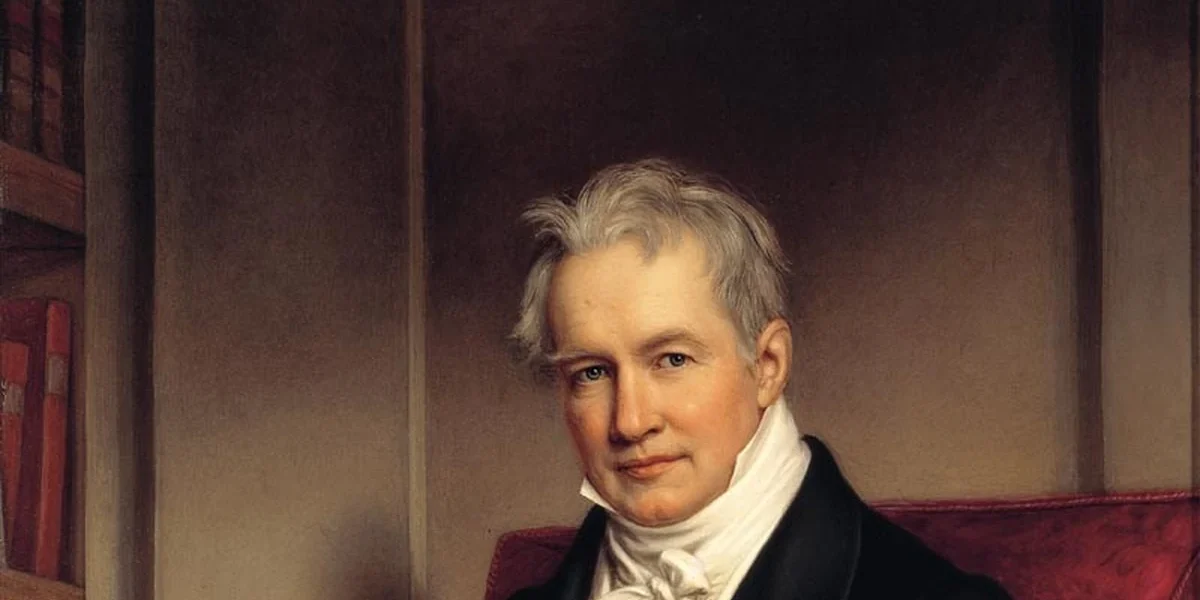
⭐ Historical Significance
Founded modern geography and biogeography; considered the father of ecology and environmentalism for his holistic vision of nature and early recognition of human-caused climate change
Few figures in German history embody the restless curiosity of the Enlightenment and Romantic eras as fully as Alexander von Humboldt. A nobleman who traded palace life for malaria-ridden jungles, he redefined how humans understand nature—not as a collection of isolated facts, but as an interconnected, living system. Charles Darwin called him “the greatest scientific traveller who ever lived,” and his name adorns more places, plants, and animals on Earth than any other human being’s.
Early Life, Upbringing & Education
Friedrich Wilhelm Heinrich Alexander von Humboldt was born on 14 September 1769 in Berlin, into a wealthy Prussian aristocratic family. His father, a former army officer and royal chamberlain, died when Alexander was nine, leaving him and his elder brother Wilhelm (later a renowned philosopher and linguist) under the strict, intellectually demanding supervision of their mother, Marie-Elisabeth. The brothers were raised at Tegel Palace outside Berlin, tutored privately by leading Enlightenment thinkers who instilled in Alexander an early fascination with plants, minerals, and the natural sciences.
Humboldt studied at the University of Frankfurt (Oder), the Hamburg Business Academy, and the Freiberg Mining Academy, where he trained under geologist Abraham Gottlob Werner. He briefly worked as a mining inspector for the Prussian government, a job that honed his skills in geology, chemistry, and surveying but left him yearning for something greater. When his mother died in 1796, Alexander inherited enough wealth to finally pursue his true ambition: to travel the world and study nature on a scale no one had attempted before.
Major Breakthroughs, Works, and Expeditions
In 1799, Humboldt and French botanist Aimé Bonpland set sail for South America with permission from the Spanish crown—an almost unprecedented privilege for foreigners at the time. Over five years, they traveled through present-day Venezuela, Cuba, Colombia, Ecuador, Peru, and Mexico, covering roughly 9,650 kilometers largely on foot, by canoe, and on mule. Humboldt measured everything: altitude, temperature, magnetism, humidity, and the distribution of plant species across elevation zones.
- Chimborazo Ascent (1802): Humboldt climbed to roughly 5,878 meters on the Ecuadorian volcano Chimborazo, then believed to be the world’s highest peak—a record for the highest altitude reached by a European at the time.
- Naturgemälde: His famous cross-section diagram of Chimborazo correlating altitude, climate, and vegetation zones became a founding document of biogeography and ecological thinking.
- Discovery of the Humboldt Current: He documented the cold Pacific ocean current off South America’s western coast, later named in his honor.
- Personal Narrative and Cosmos: His 30-volume account of the Americas expedition and his later magnum opus, “Kosmos” (1845–1862), synthesized astronomy, geology, botany, and meteorology into a unified vision of nature.
- Central Asia Expedition (1829): At age 59, Humboldt undertook a grueling journey across Russia and Siberia at the invitation of Tsar Nicholas I, studying geology and climate across the continent.
Humboldt spent much of his later life in Paris, the scientific capital of Europe, before returning to Berlin in 1827 to serve as chamberlain to the Prussian king—a role that gave him financial security while he continued writing and mentoring a generation of scientists, including a young Charles Darwin, who carried Humboldt’s “Personal Narrative” aboard the HMS Beagle.
Historical Context: Germany and Global Impact
Humboldt came of age during a golden period of German intellectual life—the era of Goethe, Schiller, and Kant—when Romantic philosophy encouraged viewing nature as an interconnected whole rather than a set of mechanical parts. This worldview, combined with Enlightenment rigor in measurement and classification, made Humboldt uniquely positioned to bridge poetic wonder and empirical science.
His influence radiated far beyond Germany. He corresponded with Thomas Jefferson, inspired Simón Bolívar’s vision of a united, ecologically aware South America, and shaped the founding principles of American conservationism through figures like Henry David Thoreau and George Perkins Marsh. Humboldt’s insight that deforestation, irrigation, and human activity could alter regional climate—first articulated after observing environmental degradation around Lake Valencia in Venezuela—makes him arguably the first scientist to describe human-caused climate change, over 150 years before the term became common.
Complex Legacy, Ethical Debates & Controversies
Humboldt is widely celebrated, but modern scholarship has added nuance to his legacy. He traveled through colonial Spanish America with official sanction, and while he was a vocal critic of slavery and indigenous exploitation—writing scathingly about the brutal treatment he witnessed—his expeditions still relied on colonial infrastructure and networks of extraction that he simultaneously condemned in his writing.
There has also been ongoing debate about his personal life; Humboldt never married, had no children, and letters suggest close romantic attachments to men, a subject historians continue to explore with more openness today. Additionally, some scholars note that Humboldt’s fame occasionally overshadowed the contributions of collaborators like Aimé Bonpland and various local guides, scientists, and communities whose knowledge underpinned his discoveries.
Memorials, Museums & Where to Experience This History Today
Germany honors Humboldt extensively, and several sites offer genuine insight into his life and thought.
- Humboldt Forum, Berlin: Housed in the reconstructed Berlin Palace, this major museum complex (opened 2021) explores global culture and science through a Humboldtian lens of interconnected knowledge. Located at Schlossplatz, central Berlin; check current hours online as they vary by exhibition.
- Humboldt-Universität zu Berlin: Founded by his brother Wilhelm in 1810, the university bears both brothers’ names and houses historical archives related to their work.
- Schloss Tegel, Berlin: The Humboldt family estate, still partly accessible, where Alexander spent much of his childhood and is buried in the family cemetery.
- Alexander von Humboldt Statue, Unter den Linden: A prominent statue stands outside Humboldt University, part of a paired monument with Wilhelm.
- Deutsches Museum, Munich: Features exhibits connecting Humboldt’s scientific methods to the broader history of German science and exploration.
Beyond Germany, Humboldt’s name appears on the Humboldt Current, Humboldt penguins, Humboldt County in California, dozens of mountains, towns, and craters on the Moon—an extraordinary global footprint for a Berlin-born naturalist.
Key Facts Summary
| Category | Detail |
|---|---|
| Full Name | Friedrich Wilhelm Heinrich Alexander von Humboldt |
| Born | 14 September 1769, Berlin, Kingdom of Prussia |
| Died | 6 May 1859, Berlin |
| Profession | Polymath, Geographer, Naturalist, Explorer |
| Key Expedition | Latin America, 1799–1804 |
| Major Work | “Kosmos” (1845–1862) |
| Legacy | Father of modern geography, biogeography, and ecological thinking |
Alexander von Humboldt died in Berlin on 6 May 1859, just as his final volume of “Kosmos” reached readers worldwide. His vision—that nature must be understood as a unified, living web rather than a catalogue of isolated curiosities—remains the intellectual foundation of modern environmental science, making him not merely a historical figure but an urgently relevant one for the climate-conscious 21st century.