Wernher Magnus Maximilian Freiherr von Braun
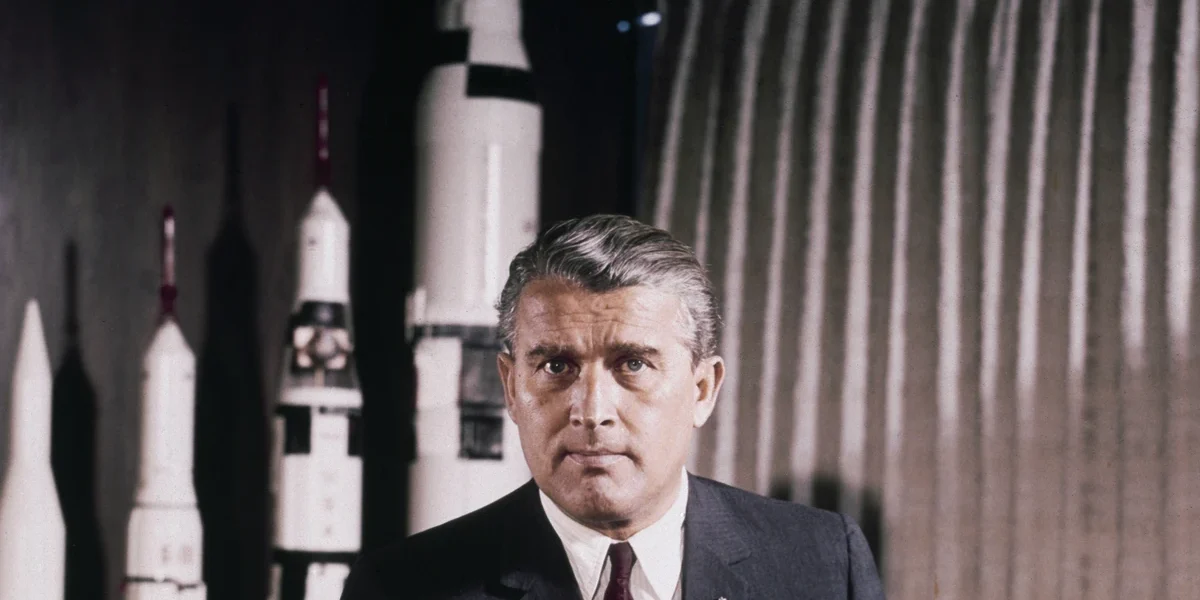
⭐ Historical Significance
Led development of the V-2 rocket for Nazi Germany and later the Saturn V rocket that took Apollo astronauts to the Moon for NASA
Few figures embody the twentieth century’s collision of scientific brilliance and moral catastrophe as starkly as Wernher von Braun. The man who gave Nazi Germany its terrifying V-2 rocket later handed the United States the Saturn V that carried astronauts to the Moon. His story is inseparable from Germany’s darkest chapter and humanity’s greatest technological triumph — a paradox that still fuels fierce debate about science, complicity, and ambition.
Early Life, Upbringing & Education
Wernher Magnus Maximilian von Braun was born on 23 March 1912 in Wirsitz, then part of the German Empire (now Wyrzysk, Poland), into an aristocratic Prussian family. His father was a conservative politician and later Reich Minister of Agriculture; his mother encouraged his early fascination with astronomy, gifting him a telescope for his confirmation. As a teenager, von Braun read Hermann Oberth’s foundational work on rocketry and became consumed by the idea of space travel, even attaching fireworks to a wagon as a boy in a stunt that reportedly ended with police involvement.
He studied mechanical engineering at the Technical University of Berlin and later earned a doctorate in physics from the University of Berlin in 1934, with a dissertation on liquid-fuel rocket engines that was kept classified due to its military applications. During this period he joined the amateur rocketry group Verein für Raumschiffahrt (Society for Space Travel), where his talents caught the attention of the German Army, which was quietly funding rocket research to circumvent Treaty of Versailles restrictions on conventional weapons.
Major Breakthroughs, Inventions & Milestones
In 1937, von Braun became technical director of the Peenemünde Army Research Center on the Baltic coast, where he led the team that developed the A-4 rocket — better known as the V-2, the world’s first long-range guided ballistic missile. Launched operationally from 1944, the V-2 killed thousands of civilians in London, Antwerp, and other Allied cities. Its production, however, relied on the brutal exploitation of concentration camp prisoners at the Mittelwerk underground factory near Nordhausen, where an estimated 20,000 forced laborers died from starvation, disease, and execution.
As Germany collapsed in 1945, von Braun orchestrated the surrender of his team to American forces rather than Soviet troops, correctly gambling that the U.S. would value his expertise. Brought to America under Operation Paperclip, he worked first on military missiles at Fort Bliss and Huntsville, Alabama, before becoming director of NASA’s Marshall Space Flight Center in 1960. There he led development of the Saturn I, Saturn IB, and ultimately the colossal Saturn V rocket — still the most powerful machine ever successfully launched — which carried the Apollo astronauts to the Moon in 1969. He also became a household name in the 1950s through Disney television specials and popular writing that sold the American public on the dream of spaceflight.
Historical Context: Germany and Global Impact
Von Braun’s career mirrors the twentieth century’s central fracture points. In Nazi Germany, rocketry was framed as a nationalist triumph, a way to strike Allied cities without risking German aircrews, and von Braun—an SS officer from 1940—operated within, and benefited from, a regime built on slave labor and genocide. In Cold War America, the same technology became a symbol of democratic ingenuity and a decisive front in the U.S.–Soviet space race, culminating in the Apollo 11 landing that von Braun’s Saturn V made possible. Germany’s postwar reckoning with him remains uneasy: celebrated as a genius engineer, questioned as a willing participant in atrocity.
Complex Legacy, Ethical Debates & Controversies
Von Braun’s legacy is among the most contested of any modern scientist. Defenders note he was not formally charged with war crimes and argue he was an apolitical engineer swept up by totalitarian demands.
Critics point to documented evidence that he visited Mittelwerk, was aware of the horrific conditions, and personally selected slave laborers with needed skills — facts that surfaced clearly only decades after his 1977 death. His American rehabilitation, enabled by Operation Paperclip’s deliberate scrubbing of Nazi records, is itself a case study in Cold War moral compromise. The tension between “rocket scientist as hero” and “rocket scientist as war criminal beneficiary” remains a defining subject in the ethics of science.
Memorials, Museums & Where to Experience This History Today
- Historisch-Technisches Museum Peenemünde (Baltic coast, Mecklenburg-Vorpommern) — built on the original rocket test site, with V-2 hardware and unflinching exhibits on forced labor.
- KZ-Gedenkstätte Mittelbau-Dora, near Nordhausen, Thuringia — the memorial to the concentration camp that supplied slave labor for V-2 production; essential for a full, honest picture.
- Deutsches Museum, Munich — rocketry and spaceflight exhibits covering von Braun’s technical contributions.
- U.S. Space & Rocket Center, Huntsville, Alabama — displays Saturn V hardware and von Braun’s American career.
- Smithsonian National Air and Space Museum, Washington D.C. — Apollo program artifacts connected to his work.
Visitors to Peenemünde should pair the visit with Mittelbau-Dora for the complete, uncomfortable story — the museum itself encourages this, presenting von Braun’s engineering triumphs alongside the human cost that made them possible.
Key Facts Summary
| Full Name | Wernher Magnus Maximilian von Braun |
| Born | 23 March 1912, Wirsitz, German Empire (now Wyrzysk, Poland) |
| Died | 16 June 1977, Alexandria, Virginia, USA |
| Nationality | German (later naturalized U.S. citizen, 1955) |
| Key Roles | Rocket engineer, Peenemünde technical director; NASA Marshall Space Flight Center director |
| Major Works | V-2 rocket (A-4); Saturn V rocket (Apollo program) |
| Controversy | SS membership; awareness of forced/slave labor at Mittelwerk factory |