Reichstag Building
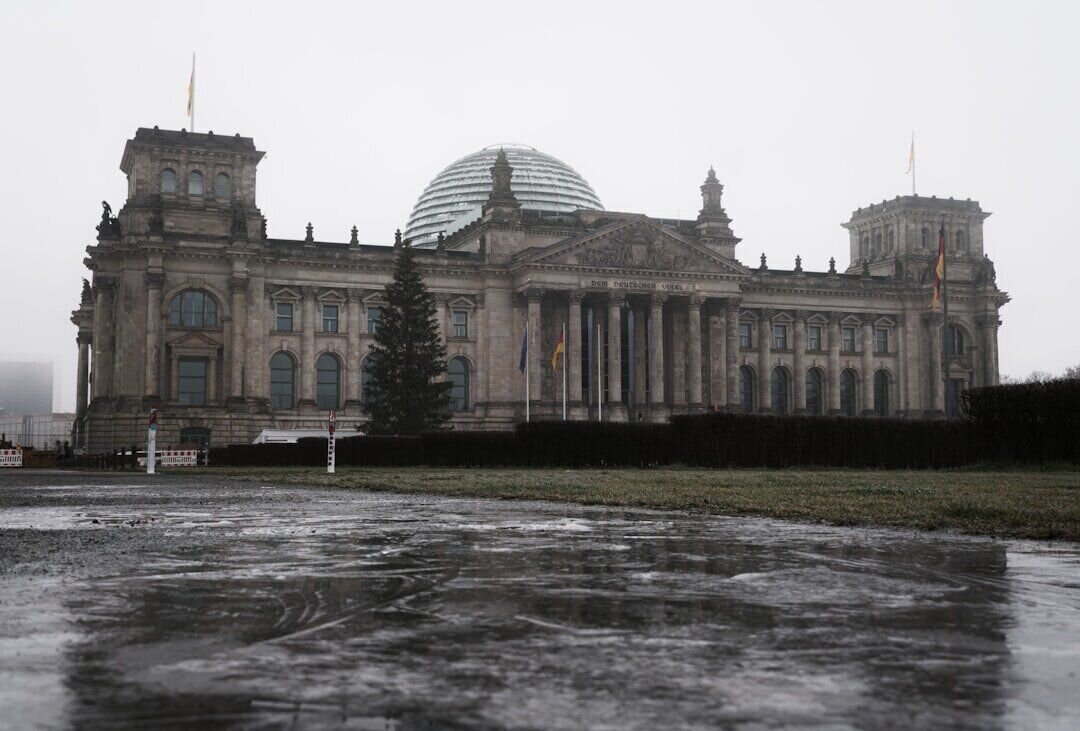
The Reichstag Building (in German, Reichstagsgebäude) stands at Platz der Republik 1 in central Berlin. It has served as the seat of the Bundestag, Germany’s national parliament, since 1999. Its glass dome is open to the public free of charge, though visitors must register in advance.
Entry to the dome and roof terrace costs nothing, but the Bundestag requires online registration before arrival. Popular time slots can fill weeks ahead.
Few buildings carry so much of a country’s political record in one structure. The same walls held the imperial legislature of 1894, burned in February 1933, took artillery fire from the Red Army in 1945, sat half-forgotten beside the Berlin Wall, and now house a working democratic parliament under a spiral of glass and steel.
Key Takeaways
- The Reichstag Building houses the Bundestag and traces German political history from empire through dictatorship, division, and reunification.
- Norman Foster’s glass dome, completed in 1999, makes parliamentary transparency a physical design principle.
- Dome visits are free but require advance registration through the Bundestag’s visitor service.
What Is the Reichstag’s Role in German Democracy?
The Reichstag Building is the working home of the Bundestag, the elected chamber that passes federal laws and holds the German government to account. It also hosts the Federal Convention, the special assembly that elects Germany’s president.
From Imperial Legislature to the Bundestag
Construction began in 1884 under Kaiser Wilhelm I and finished in 1894, during the reign of Wilhelm II. The building housed the imperial Reichstag of the German Empire, a legislature with real elected members but limited power over the monarch’s ministers.
After 1918 it served the Weimar Republic, Germany’s first parliamentary democracy. From a window of this building, Philipp Scheidemann proclaimed the republic on 9 November 1918.
The dedication Dem Deutschen Volke (“To the German People”) was added to the west facade only in 1916, after decades of imperial hesitation about the phrase.
How the Plenary Chamber and Federal Convention Are Used
The plenary chamber sits directly beneath the dome. Members debate bills, question ministers, and vote there during sitting weeks, scheduled around committee work and constituency time.
Every five years, the Federal Convention meets in the same chamber. It combines all Bundestag members with an equal number of delegates chosen by the state parliaments. Its single task is electing the federal president.
Why the Building Represents Parliamentary Transparency
Visitors stand above the chamber and look down through the dome’s glass floor at the seats where laws are made. That arrangement was a deliberate design decision: the public occupies the higher position.
Sunlight reflected by the dome’s central mirrored cone lights the chamber below. This ties the symbolism to the building’s daily function. Everything About Germany treats this design as the clearest architectural statement of postwar German constitutional thinking.
How Did the Building’s History Reflect Germany’s Political Upheavals?
Each major rupture in twentieth-century German history left a mark on this structure. The 1933 fire helped end civil liberties, while Soviet inscriptions remain visible on the interior walls.
The building became a ruin, museum, border curiosity, and finally parliament again.
The Reichstag Fire and the End of Civil Liberties
On the night of 27 February 1933, fire gutted the plenary chamber. Marinus van der Lubbe, a Dutch bricklayer, was arrested at the scene and later executed. Historians continue to debate whether he acted alone.
Adolf Hitler had been chancellor for four weeks. The next day, President Paul von Hindenburg signed the Reichstag Fire Decree, suspending freedom of speech, assembly, press, and protection from arbitrary arrest.
Thousands of political opponents were detained within days. Parliament moved to the Kroll Opera House across the square, where it passed the Enabling Act in March 1933 and effectively dissolved itself as a check on power. The Nazi dictatorship had its legal scaffolding.
World War II, the Red Army, and Soviet Graffiti
Allied bombing damaged the empty shell throughout the war. In late April 1945, the building became a military objective of enormous symbolic weight for the Red Army, which fought room to room to raise a Soviet flag on its roof.
Soviet soldiers wrote their names and hometowns on the interior walls in Cyrillic. During the 1990s renovation, roughly 100 square meters of this graffiti was conserved and left visible, at the Bundestag’s own decision.
Workers removed some inscriptions because the language was obscene. Visitors on guided tours can still read the rest.
West Berlin, Reunification, and the Return of Parliament
After 1961 the building stood a few meters from the Berlin Wall, in West Berlin but with no parliament to hold. A partial restoration in the 1960s and 1970s turned it into a museum of German history.
The official ceremony marking German reunification took place there on 3 October 1990, with Chancellor Helmut Kohl present. The Bundestag met in the building on 4 October 1990 and, in 1991, voted to move the seat of government from Bonn to Berlin.
What Makes Its Architecture So Distinctive?
The building combines Paul Wallot’s heavy nineteenth-century sandstone with Norman Foster’s transparent late-twentieth-century dome. The contrast is intentional. Foster kept the scars of war and occupation visible instead of smoothing them away.
Paul Wallot’s Neo-Renaissance Design
Wallot won the design competition in 1882 and worked in a Neo-Renaissance style, with four corner towers, a monumental west portico, and richly carved stone. The sculptor Otto Lessing produced much of the exterior ornament.
The original had a steel and glass dome over the central hall, an engineering statement in its own right for the 1890s. That dome was damaged in 1933 and demolished in 1954.
Norman Foster’s Restoration and Glass Dome
Sir Norman Foster and Foster + Partners won the 1993 competition to convert the building for parliamentary use, ahead of a field that included Gottfried Böhm. Foster’s first schemes did not include a dome. The Bundestag pressed for one, and he developed the glass version that opened in 1999.
Two spiral ramps climb the inside of the cupola. A mirrored cone at the center directs daylight into the plenary chamber below and vents warm air upward, cutting the building’s energy demand.
The Cupola, Roof Terrace, and Views Across Central Berlin
The dome sits roughly 47 meters above ground level. Walking the ramp takes about 20 to 30 minutes at an unhurried pace, with an audio guide keyed to the changing view.
From the roof terrace, the sightlines run west across the Tiergarten, south toward the brandenburg-gate/” rel=”noopener” target=”_blank”>Brandenburg Gate, and north over the Spree to the chancellery.
How Do You Visit the Dome and Parliament?
Access is free, and every visitor must register in advance with the Bundestag’s visitor service. The service requires each person’s full name, date of birth, and identity document details. Staff check photo ID at the entrance.
Registration, Admission, and Security Requirements
Visitors can submit dome requests for the current month and the following month. Confirmation arrives by email and must be shown on arrival, either printed or on a phone.
Visitors pass through airport-style screening at a separate entrance pavilion on the north side of Platz der Republik. Large bags, luggage, and prohibited items cannot come inside. There is no cloakroom for suitcases.
Dome visits close during parliamentary business, certain special events, and severe weather. High wind or ice on the ramps can shut the roof terrace at short notice.
Guided Tours and Plenary Session Visits
A dome ticket covers the roof terrace and cupola only. Seeing the interior, including the plenary chamber and the conserved Cyrillic graffiti, requires a separate guided tour, usually booked several weeks ahead.
Members of the public can also watch debates from the visitors’ gallery when the Bundestag is sitting. These slots are limited and registered through the same visitor service.
Getting There and What to See Nearby
The address is Platz der Republik 1, in the Mitte district on the edge of the Tiergarten park. Bundestag and Brandenburger Tor stations are both a short walk away.
The Brandenburg Gate stands about 500 meters south. The Memorial to the Murdered Jews of Europe lies just beyond it, making a compact walking route through central Berlin.
Why Was the Wrapped Reichstag a Landmark Art Event?
For 14 days in the summer of 1995, Christo and Jeanne-Claude covered the entire building in silver polypropylene fabric. More than five million people came to see it. The project took 23 years of negotiation before the Bundestag approved it.
Christo and Jeanne-Claude’s 1995 Installation
Ninety professional climbers and 120 installation workers completed the wrapping on 24 June 1995. More than 90,000 square meters of aluminum-coated fabric was secured with blue polypropylene rope.
The artists funded the roughly $15 million cost themselves through sales of preparatory drawings, refusing sponsors and public money. They recycled all the materials afterward.
How Temporary Art Reframed a National Symbol
The wrapping erased the building’s ornament and left only its mass, a shape people had to look at again without the weight of its detail. It happened after reunification and before Foster’s renovation, in the narrow window when the building’s future function was settled but its new form did not yet exist.
Photographs of the silver building have since become shorthand for Berlin in the 1990s. The Bundestag’s own debate on approving the project, held in February 1994, was one of the few parliamentary votes ever taken on a work of art in Germany.
Frequently Asked Questions
Do you need tickets to visit the Reichstag dome?
Yes, a registered time slot is required, and it functions as the ticket. Register through the Bundestag’s visitor service website, giving each visitor’s name, date of birth, and ID details. Then bring the confirmation and matching photo ID.
Is entry to the Reichstag Building free?
Entry to the glass dome, roof terrace, and guided tours costs nothing. The Bundestag charges no admission for any of its public visitor programs, though advance registration is mandatory for all of them.
How far in advance should you register for a Reichstag visit?
Dome requests can be submitted for the current month and the following month, so book as soon as your dates fall within that window. Guided tours of the interior and plenary chamber often need several weeks’ lead time.
Can visitors see a Bundestag plenary session?
Yes, the public gallery above the plenary chamber is open during sitting weeks, with places allocated through the visitor service. Sitting weeks are set in advance, and the Bundestag publishes its calendar. Check the dates before planning around a debate.
What happened at the Reichstag Building during World War II?
Allied bombing damaged the building, which had already been gutted. In April 1945, the Red Army fought through it during the final battle for Berlin. Soviet soldiers left inscriptions on the interior walls, and the 1990s renovation preserved about 100 square meters of them.
💡 Visitor Tips & Best Experience
Visit early in the morning to avoid tour groups and wear comfortable walking shoes for cobblestones.
🚆 How to Get There & Public Transit
Accessible via Deutsche Bahn regional and intercity rail networks.