Rakotzbrücke (Devil’s Bridge)
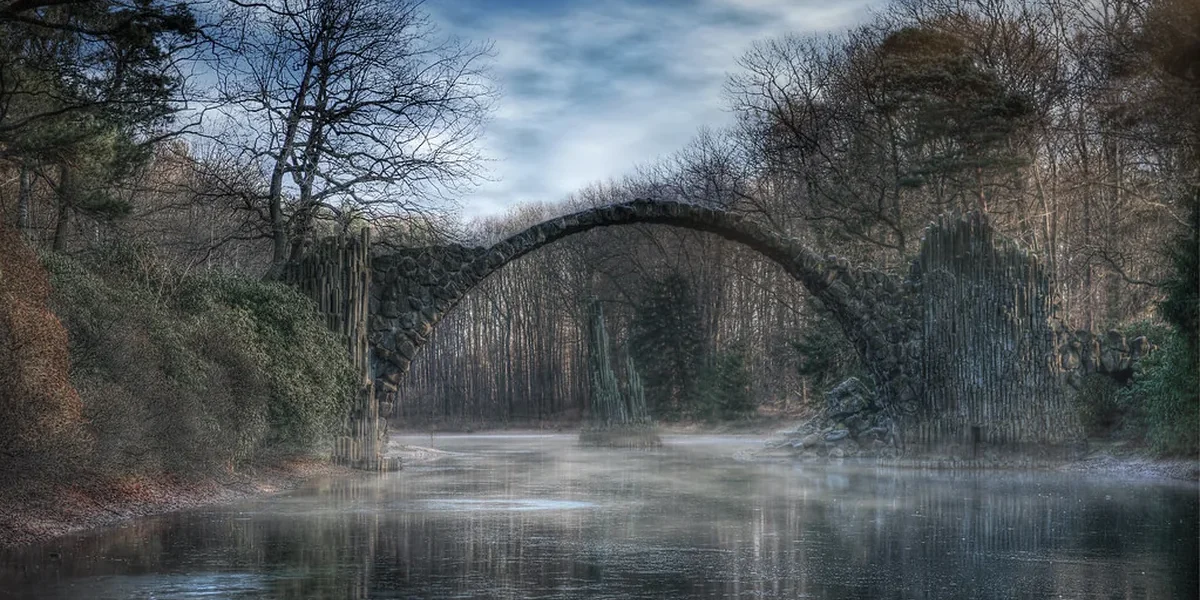
Deep in the Kromlauer Park, part of the vast Muskauer Park landscape in the Lusatia (Lausitz) region of eastern Saxony, stands one of Germany’s most photographed and least understood structures: the Rakotzbrücke, popularly known as the Devil’s Bridge. Built in the mid-19th century from rugged basalt columns, this slender, arching bridge was never meant to be crossed on foot in the conventional sense. Its entire purpose was optical illusion — when the water beneath sits still, the bridge and its mirror image form a perfect stone circle, an effect so precise that legend attributes it to a pact with the devil himself.
The bridge was commissioned by Friedrich Hermann Rötschke around 1860 as part of the English-style landscape garden surrounding Kromlau Castle. Rötschke was inspired by the Rakotz Boulders, a striking natural basalt formation nearby, and he had the columns transported and arranged to create both the bridge and a series of grottoes throughout the park. The result is a piece of Romantic-era garden architecture designed purely for aesthetic and emotional effect — a 19th-century Instagram moment built a century and a half before smartphones existed.
Top Highlights & Architectural Wonders
- The signature circular reflection, best seen on calm, windless mornings when the pond acts as a mirror
- Rugged, jagged basalt columns quarried and stacked without mortar, forming a deliberately dramatic silhouette against the smoother stonework of the era
- The wider Kromlauer Park, with additional grottoes, ponds, and rare tree specimens planted in the 1840s–1880s
- Rhododendron and azalea blooms in the park during late spring, which frame the bridge in color
- Autumn foliage reflections, considered by many photographers the most dramatic time to visit
Practical Visitor Information
Kromlauer Park is open 24/7 with free admission, and the Rakotzbrücke itself is freely accessible year-round as part of the public park grounds. There is no ticket booth and no reservation system. However, visitors are strictly prohibited from walking on the bridge itself — it is fragile, structurally delicate, and closed to foot traffic to preserve both the stonework and the reflection effect for future visitors. Barriers and signage enforce this rule, and rangers do patrol during peak season.
| Detail | Information |
|---|---|
| Entry Fee | Free (donation boxes available) |
| Opening Hours | Open 24/7 (outdoor park) |
| Best Visiting Window | Sunrise to 9:00, and just before sunset |
| Walking on Bridge | Not permitted |
| Parking | Paid lot near park entrance, small fee (€2-3) |
How to Get There
Kromlau is a small village near Gablenz in the far east of Saxony, close to the Polish border. The nearest larger towns are Weißwasser and Bad Muskau.
By car, Kromlau is roughly 90 minutes from Dresden via the A4 and B156, with free-flowing roads outside peak weekends. By train, take a DB regional service to Weißwasser (Oberlausitz) station from Dresden or Cottbus, then continue by taxi or local bus (line 250) to Kromlau, roughly a 15-minute onward journey. There is no direct rail link to the village itself, so a car or taxi transfer for the final leg is advisable, especially outside summer schedules.
Best Time to Visit & Seasonal Events
May and early June bring the park’s famous rhododendron and azalea blooms, drawing the heaviest crowds of the year. October offers arguably the best photography conditions, with golden foliage doubling in the still water. Winter visits are quieter and atmospheric, though the water may partially freeze, altering the reflection. Whatever the season, arrive at or before sunrise — by mid-morning on weekends, dozens of photographers and tour groups can crowd the narrow viewing bank, and wind picks up later in the day, disrupting the mirror effect entirely.
Local Insider Tips
- Visit on a weekday morning for a near-empty viewing bank and glassy water
- Bring a wide-angle or standard lens; the classic shot works well without special gear
- Check wind forecasts — calm mornings after clear nights give the sharpest reflections
- Small cafés and snack kiosks near the park entrance serve coffee and simple meals in season; options are limited off-season, so pack water and snacks
- Respect the barriers — fines apply for climbing on the bridge, and it causes real damage
Nearby Excursions & Day Trips
The Rakotzbrücke sits within striking distance of the UNESCO-listed Muskauer Park (Park Muzakowski) straddling the German-Polish border in Bad Muskau, one of Europe’s largest English-style landscape parks, roughly 20 minutes away. The Findlingspark Nochten, a striking garden built around glacial boulders, is also nearby and pairs well as a same-day stop. Further afield, the Spreewald biosphere reserve, famous for its canal boat trips and gherkins, makes an excellent full-day extension for travelers basing themselves in the wider Lusatia region.
💡 Visitor Tips & Best Experience
Visit at sunrise on a calm weekday for the clearest circular reflection; walking on the bridge is prohibited
🚆 How to Get There & Public Transit
Nearest station: Weißwasser (Oberlausitz), then local bus/taxi (~15 min); by car ~90 min from Dresden via A4/B156