Johann Carl Friedrich Gauss
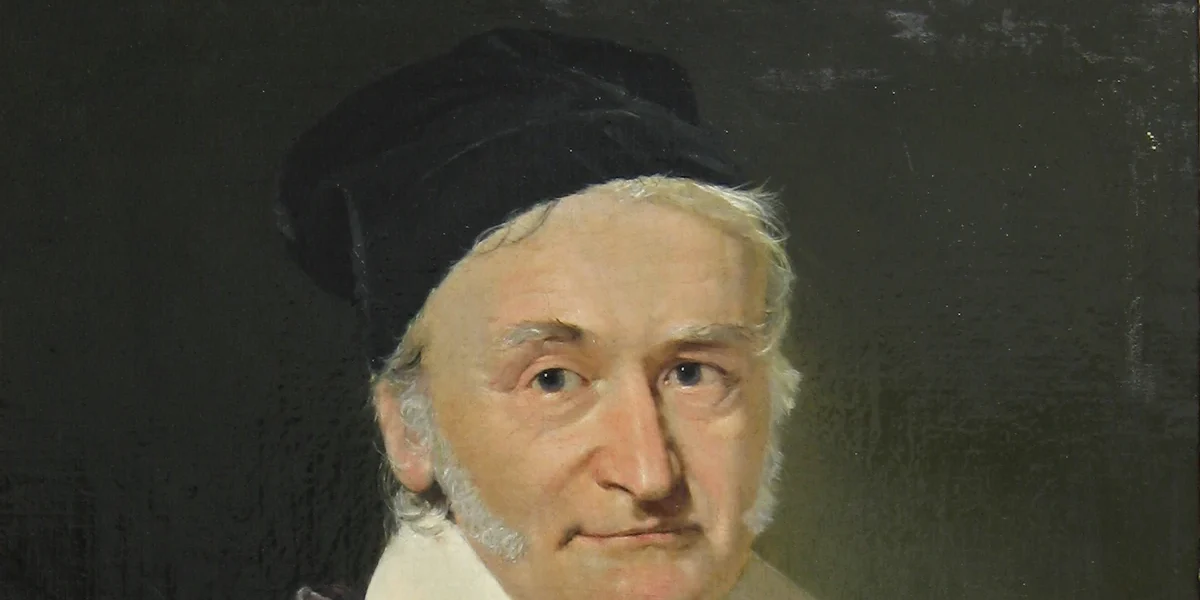
⭐ Historical Significance
Gauss's methods underlie statistics (normal distribution), surveying, astronomy, and pure mathematics, earning him timeless reverence as the 'Prince of Mathematicians'
Few names carry as much quiet authority in the history of science as Carl Friedrich Gauss. Dubbed the “Prince of Mathematicians” (Princeps mathematicorum) by his contemporaries, Gauss reshaped number theory, astronomy, geodesy, and physics with a rigor and originality that still underpins modern statistics, satellite navigation, and magnetism research. Born into modest circumstances in Brunswick, he rose through sheer intellectual force to become one of the towering minds of the 19th century — a legacy Germany celebrates on its former 10-Deutsche Mark banknote and in institutions bearing his name to this day.
Early Life, Upbringing & Education
Johann Carl Friedrich Gauss was born on 30 April 1777 in Brunswick (Braunschweig), then part of the Duchy of Brunswick-Wolfenbüttel, into a poor working-class family. His father worked variously as a gardener, bricklayer, and canal tender, and had little patience for his son’s academic leanings. His mother, Dorothea, and her brother Friedrich, however, recognized the boy’s extraordinary gifts and encouraged his education.
Gauss’s precocity became legendary early on. Multiple accounts describe him correcting his father’s payroll arithmetic as a toddler, and at around age ten, famously summing the integers from 1 to 100 almost instantly by recognizing the pattern of pairing numbers (1+100, 2+99, and so on) — a story that, whether embellished or not, captures the essence of his lifelong gift for spotting elegant structure in numbers.
His talent reached the attention of Carl Wilhelm Ferdinand, Duke of Brunswick, who became his patron and funded his education at the Collegium Carolinum (1792–1795) and later the University of Göttingen (1795–1798), then part of the Electorate of Hanover. It was at Göttingen, on 30 March 1796, that the 19-year-old Gauss made his first major mathematical breakthrough: proving that a regular 17-sided polygon (heptadecagon) could be constructed using only a compass and straightedge — the first advance in this field since antiquity. This discovery convinced Gauss to devote himself to mathematics rather than philology, and he reportedly asked to have a regular 17-gon engraved on his tombstone (the stonemason declined, deeming it indistinguishable from a circle).
Major Breakthroughs, Works & Milestones
Gauss earned his doctorate in 1799 from the University of Helmstedt, with a dissertation providing the first substantially rigorous proof of the Fundamental Theorem of Algebra. Two years later, in 1801, he published his masterwork, Disquisitiones Arithmeticae — a systematic, rigorous treatment of number theory that essentially founded the field as a modern discipline. It introduced concepts such as modular arithmetic (congruences) that remain foundational today.
That same year, Gauss achieved sudden public fame beyond mathematics: when the astronomer Giuseppe Piazzi discovered the dwarf planet Ceres but then lost track of it as it passed behind the sun, Gauss used his newly developed method of least squares to predict its position with astonishing accuracy, allowing astronomers to relocate it in December 1801. This feat established his reputation as Europe’s leading astronomical calculator and led to his appointment as director of the Göttingen Observatory in 1807, a post he held until his death.
- Normal distribution: Gauss’s error analysis work gave rise to what is now universally known as the “Gaussian distribution” or bell curve, central to statistics, science, and social sciences.
- Geodesy: From 1818, Gauss led the trigonometric survey of the Kingdom of Hanover, developing the heliotrope (a mirror-based surveying instrument) and laying groundwork for differential geometry through his “Theorema Egregium” on curved surfaces.
- Magnetism and electricity: Working with physicist Wilhelm Weber from 1831, Gauss studied terrestrial magnetism and, in 1833, built one of the world’s first electromagnetic telegraphs, sending messages across Göttingen.
- Gauss’s Law: His formulation remains one of Maxwell’s four fundamental equations of electromagnetism.
- The unit “gauss”: The CGS unit of magnetic flux density is named in his honor.
Historical Context: Germany and Global Impact
Gauss lived through the Napoleonic Wars, the collapse of the Holy Roman Empire, and the fragmented political landscape of the German states before unification. Remarkably apolitical and famously reluctant to travel — he rarely left the Kingdom of Hanover — Gauss nonetheless corresponded with leading scientists across Europe and became a symbol of German scientific excellence at a time when French and British institutions dominated the sciences. His insistence on rigorous proof over intuition set a new standard that shaped mathematics worldwide, influencing figures from Bernhard Riemann and Richard Dedekind (his own students) to modern cryptographers who rely on number theory he pioneered for encryption algorithms like RSA.
Complex Legacy, Ethical Debates & Controversies
Gauss’s legacy, while overwhelmingly celebrated, is not without complexity. He was notoriously secretive about his work, often delaying publication of major discoveries — including early findings on non-Euclidean geometry — for fear of controversy or “the clamor of the Boeotians” (his term for critics he considered intellectually inferior). This meant credit for several important ideas later went to other mathematicians, such as János Bolyai and Nikolai Lobachevsky for non-Euclidean geometry, even though Gauss had explored similar ideas privately years earlier.
His personal life was also marked by tension: he had strained relationships with several of his children, actively discouraging some from pursuing mathematics, and his famously demanding intellectual standards made him a difficult mentor to some students. Modern historians also note that his work on the Hanover survey and geodesy served practical state interests, including taxation and administrative control, reminding us that even “pure” science was entangled with 19th-century statecraft.
Memorials, Museums & Where to Experience This History Today
Göttingen remains the essential pilgrimage site for Gauss enthusiasts. The city where he spent nearly six decades preserves his intellectual footprint vividly.
- Gauss Observatory (Sternwarte Göttingen): The historic observatory building where Gauss lived and worked as director; part of the University of Göttingen campus, viewable from outside with occasional open days.
- Gauss-Weber Memorial: A statue in Göttingen commemorating Gauss and Wilhelm Weber standing beside a telegraph, marking their pioneering 1833 experiment.
- Braunschweigisches Landesmuseum, Brunswick: Displays exhibits related to Gauss’s birthplace and early life; the site of his childhood home is marked with a memorial plaque (the original house was destroyed in WWII bombing).
- Gauss statue, Brunswick: A prominent bronze monument in his honor stands in his native city.
- Deutsches Museum, Munich: Features exhibits on Gauss’s contributions to geodesy, magnetism, and telegraphy within the broader history of German science.
- The old 10 Deutsche Mark note: Though no longer in circulation since the euro’s introduction in 2002, it featured Gauss’s portrait and the normal distribution curve — collectible examples can still be found at numismatic dealers.
Visitors to Göttingen can also walk the compact historic university district, much of which retains its early 19th-century character, and combine a Gauss-themed visit with the city’s broader “town of science” heritage, including sites linked to over 40 Nobel laureates associated with the university.
Key Facts Summary
| Category | Details |
|---|---|
| Full Name | Johann Carl Friedrich Gauss |
| Born | 30 April 1777, Brunswick, Duchy of Brunswick-Wolfenbüttel |
| Died | 23 February 1855, Göttingen, Kingdom of Hanover |
| Profession | Mathematician, Astronomer, Physicist |
| Key Works | Disquisitiones Arithmeticae (1801), Theoria Motus (1809) |
| Major Achievements | Founded modern number theory, method of least squares, normal distribution, geodesic surveying, electromagnetic telegraph |
| Legacy | Unit “gauss” for magnetic flux density; Gauss crater on the Moon; former face of the 10 DM note |