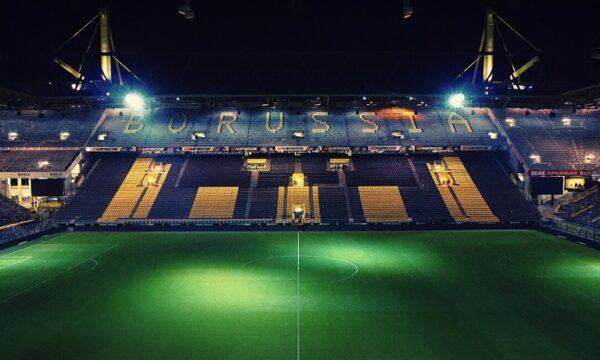
Signal Iduna Park
Home stadium of Borussia Dortmund, famous for its Yellow Wall and incredible atmosphere.

Dortmund is the largest city in the Ruhr region, home to about 600,000 people and Signal Iduna Park, Germany’s biggest football stadium, with a capacity of just over 81,000. It sits in the middle of North Rhine-Westphalia, less than an hour by regional train from Essen, Bochum, and Düsseldorf.
Coal mines and steel mills built this city. When they closed, Dortmund rebuilt itself around high-tech industry, software, logistics, and museums housed in former factories.
A brewery tower is now an arts center, while a colliery has become a UNESCO-linked heritage site.
A well-planned two-day visit covers Dortmund’s football culture, industrial heritage sites, and at least one large public park, all reachable on a single regional transit ticket. That combination makes this Dortmund travel guide useful for a short break rather than a full week.
Football supporters come for the Yellow Wall. Families come for the zoo and Westfalenpark. Rail travelers use the city as a base for the whole Ruhr Valley.
Start with the compact city centre, then choose one museum and one industrial heritage site. Dortmund’s core attractions sit within a 15-minute walk of the main station, while the Ruhr’s mining history is best seen at Zeche Zollern in the northwest of the city.
The city centre holds two medieval churches and a market square. The Dortmunder U covers modern art, and the German Football Museum sits opposite the station.
Zeche Zollern shows what the coal industry looked like from the inside.
Reinoldikirche (St. Reinold’s Church) marks the historic center of Dortmund and takes its name from the city’s patron saint. Its tower is a fixed reference point for anyone walking the pedestrian streets.
Directly across the road stands Marienkirche (St. Mary’s Church), the older of the pair, with Romanesque roots and a notable winged altarpiece. The two churches face each other across a busy crossing on Ostenhellweg.
A short walk west brings you to Alter Markt (Old Market), the city’s historic square, and the Altes Stadthaus, a large early 20th-century municipal building. Kleppingstraße and Kampstraße frame this quarter and carry most of the centre’s cafés and bars.
Postwar rebuilding shaped nearly all of this area. What survives are the churches, the street pattern, and a handful of façades.
The Dortmunder U is a former brewery tower, now a center for art and creativity, and the clearest symbol of Dortmund’s post-industrial transformation. The illuminated “U” on the roof refers to the Union Brewery that once filled the building.
Inside, the Museum Ostwall (Ostwall Museum) holds Dortmund’s collection of modern and contemporary art across two floors. It includes 20th-century painting, sculpture, and installation work.
Rotating exhibitions occupy other levels of the U-Tower. For older material, the Museum für Kunst und Kulturgeschichte (Museum of Art and Cultural History) covers regional archaeology, design, and Art Nouveau objects.
It sits a few minutes away on Hansastraße. Check current opening days before visiting, since most German municipal museums close on Mondays.
The German Football Museum (Deutsches Fußballmuseum) stands directly opposite Dortmund Hauptbahnhof, making it the easiest major attraction to fit into a tight schedule. It is the national museum of the German Football Association.
Exhibits trace the 1954 World Cup win, the 1974 and 1990 tournaments, the 2014 title, and the women’s national team. Original shirts, trophies, and match footage anchor the displays.
The museum is a national institution and covers German football broadly. Borussia Dortmund’s own history appears at the Borusseum, inside the stadium.
Zeche Zollern (Zollern Colliery) in the Bövinghausen district is the single best place in Dortmund to grasp what coal mining meant here. The LWL (Landschaftsverband Westfalen-Lippe) runs it as an industrial museum.
Its machine hall is the draw: a red-brick Art Nouveau structure with a glass and steel façade, unusual for a working pit. The complex is a designated anchor point on the European Route of Industrial Heritage.
The wider Ruhr also contains UNESCO World Heritage industrial sites, such as the Zollverein Colliery in nearby Essen. Allow two hours plus travel time, since Zollern sits west of the centre and needs a tram or bus connection rather than a walk.
Buy a match ticket if you can get one; take a stadium tour if you cannot. Borussia Dortmund fills Signal Iduna Park with over 81,000 spectators, and the club’s average league attendance is the highest in Europe.
Match day changes the whole city. Trains fill with yellow shirts, the bars near the station open early, and the south terrace becomes the loudest section in German football.
Borussia Dortmund, known as BVB (Ballspielverein Borussia 09), plays in the Bundesliga, Germany’s top division. Home matches usually fall on Saturday afternoons, Friday evenings, or Sunday afternoons.
Midweek European fixtures appear in some months. The Bundesliga season runs from mid-August to late May, with a winter break in January.
Fixture dates are confirmed only a few weeks ahead because of television scheduling. Dortmund’s rivalry with Schalke 04, the Revierderby, is the most charged date in the Ruhr football calendar.
Tickets for that fixture are the hardest to obtain. For a first visit, a midtable league opponent gives you the full atmosphere with less competition for seats.
Signal Iduna Park, still called the Westfalenstadion by many supporters, opened in 1974 and has been expanded several times. Its capacity for league matches is 81,365, dropping to roughly 66,000 for UEFA games, where standing is not permitted.
The Südtribüne (South Stand) holds about 25,000 standing supporters and is known as the Yellow Wall (Die Gelbe Wand). It is the largest standing terrace in European football.
Standing tickets are cheap by international standards but sell out first and are rarely available to visitors. Seated areas in the west and east stands are the realistic option.
On non-match days, guided stadium tours include the tunnel, the dressing rooms, and the Borusseum club museum.
Buy through the official Borussia Dortmund ticket shop, the only source that guarantees a valid ticket. Sales open in stages, with members and season-ticket holders served before general release.
| Route | Availability | Notes |
|---|---|---|
| Official BVB online shop | Limited, staged release | Registration required; cheapest legitimate prices |
| BVB Fan and Fanshop counters | In person, Dortmund | Useful for late returns |
| Official hospitality packages | Higher availability | Includes catering; significantly more expensive |
| Resale platforms | Variable | Risk of invalid tickets and refused entry |
Register an account well before the match you want. High-demand fixtures against Bayern Munich, Schalke 04, or Champions League opponents clear within minutes.
The club can void tickets bought outside official channels. Away supporters should go through their own club’s allocation.
The Westfalenhalle, part of the larger Westfalenhallen complex next to the stadium, hosts concerts, indoor athletics, trade fairs, and the six-day cycling race. Check its calendar before booking hotels, because a major fair fills city rooms fast.
Match-day conduct in Germany is straightforward. Wear home colors only in home sections, arrive at least an hour early, and expect bag checks at every gate.
Alcohol is sold inside the ground but not in the away section for high-risk fixtures. Cash is still useful at kiosks, though card payment is now standard.
Trams and S-Bahn services to the stadium are included with a valid match ticket on most fixtures. Confirm this on your ticket before travel.
Close to half of Dortmund’s municipal area is green space, water, or agricultural land, which is why parks belong in any serious itinerary here. Westfalenpark, Rombergpark, and Phoenix See are the three that most reward a visit.
Each has a different character: a 1959 garden-show park with a television tower, a botanical arboretum next to the zoo, and an artificial lake built on the site of a demolished steelworks.
Westfalenpark covers around 70 hectares south of the centre and was created for the 1959 Bundesgartenschau (Federal Horticultural Show). It contains the German Rose Garden with several thousand rose varieties.
The Florianturm (Florian Tower) rises 219 meters above the park and dates from the same year. Its observation deck gives the clearest overview of Dortmund’s flat, built-up landscape and the stadium roof to the west.
A chairlift and a small park railway cross the grounds, making this the easiest large park for families with young children. Admission to the park is charged, and tower access costs extra.
Concerts and seasonal light events use the park through summer and autumn. Check current schedules with the operator.
Rombergpark is Dortmund’s botanical garden, a 65-hectare arboretum built around a former manor estate with ponds, mature trees, and greenhouses. Entry to the grounds is free.
Dortmund Zoo sits immediately south, with roughly 1,500 animals across some 230 species. Its collection leans heavily toward South American species, and the giant anteater is the zoo’s emblem.
The two together fill an easy half day. Both are reachable by tram from the city centre.
Spring and early summer show the arboretum at its best, when the rhododendron collection flowers.
Phoenix See is a 24-hectare artificial lake in the Hörde district, built between 2006 and 2011 on the cleared site of the Phoenix-Ost steelworks. It offers the most direct example of the Ruhr’s post-industrial land conversion.
A 3.2-kilometre path circles the water, lined with restaurants, apartments, and a small marina. Sailing and stand-up paddling operate in the warmer months.
Hörde’s older centre lies just north, with the Hörde Castle building overlooking the lake. The S-Bahn stop at Dortmund-Hörde puts you within a 10-minute walk.
This is a working residential district. Evenings and weekends are busy with locals rather than tour groups.
Hohensyburg sits on a wooded ridge in the far south of Dortmund, where the Ruhr and Lenne rivers meet. The ruins of the medieval Syburg castle share the hilltop with the 19th-century Kaiser Wilhelm Monument and a viewing platform overlooking the Hengsteysee reservoir.
The site is open ground and free to enter. A casino operates nearby, which explains why the bus stop carries the Hohensyburg name.
From here, the landscape shifts toward the Sauerland, a hilly, forested region south of the Ruhr with reservoirs and marked walking routes. German hiking culture, or Wandern, is well organized here, with signed trails and maps at trailheads.
Regional trains from Dortmund reach Sauerland towns such as Arnsberg and Meschede in about an hour.
Dortmund is one of the easiest German cities to reach without a car. It sits on high-speed rail lines and inside the dense VRR regional transit network. Most visitors fly into Düsseldorf, take a train, and then use trams and the S-Bahn around the city.
Hotels cluster around the Hauptbahnhof, in the Kreuzviertel, and beside the Westfalenhallen. A two-day plan built around walking plus one transit pass is realistic.
Dortmund Airport (DTM) lies about 10 kilometres east of the centre and handles mostly low-cost and European routes. The AirportExpress shuttle bus reaches Dortmund Hauptbahnhof in roughly 25 minutes, while local VRR bus 440 covers the same route more cheaply.
Düsseldorf Airport (DUS) is the region’s main long-haul gateway, around 70 kilometres away. It has its own long-distance rail station, and direct Deutsche Bahn trains reach Dortmund in about 55 to 70 minutes.
Travelers spending time in Düsseldorf can easily pair the trip with a stop there. Deutsche Bahn ICE services also link Dortmund with Cologne, Berlin, Hamburg, and Frankfurt.
The A1, A2, A40, and A45 Autobahn routes meet here for drivers. FlixBus and other long-distance coach operators, once including Eurolines, serve a stop near the main station.
Dortmund Hauptbahnhof (Dortmund Central Station) is the transport hub for everything: long-distance rail, S-Bahn suburban trains, U-Bahn light rail, trams, and city buses. It forms the eastern anchor of the Verkehrsverbund Rhein-Ruhr (VRR), the regional transport association.
DSW21 operates the city’s trams and buses. A single VRR ticket covers all operators within your chosen fare zone, while the Preisstufe A ticket covers Dortmund itself.
For multi-city trips across the Ruhr, the Deutschlandticket monthly pass covers all regional and local transport nationwide. It suits travelers combining Dortmund with Bochum, Essen, or Münster.
City bus tours run from near the station in season. Most central sights are walkable, so a tour is optional.
Stay near the Hauptbahnhof or in the city centre for the shortest walks to museums, shopping, and rail connections. Mercure Hotel Dortmund City and NH Dortmund both sit in this bracket.
The Kreuzviertel, southwest of the centre, is Dortmund’s most appealing residential quarter, with Wilhelmine apartment buildings, independent bars, and cafés. The neighboring Kaiserviertel to the east feels similar but quieter.
For stadium and trade-fair visits, the Dorint An den Westfalenhallen Dortmund puts you within walking distance of Signal Iduna Park and the Westfalenhalle.
Rates rise sharply on match weekends and during major fairs. Book those dates as soon as fixtures are confirmed.
Dortmund is inexpensive by western German standards, and several of its best sites cost nothing: Rombergpark, Phoenix See, Hohensyburg, and Alter Markt are all free to enter. Broader cost-saving tactics for the country appear in guidance on visiting Germany on a budget.
Day 1, city and football. Start the morning at the German Football Museum, then walk to Reinoldikirche and Alter Markt for lunch. Spend the afternoon at the Dortmunder U and Museum Ostwall. In the evening, attend a match or take a stadium tour.
Day 2, heritage and green space. Visit Zeche Zollern in the morning. In the afternoon, choose between Westfalenpark and the Florianturm, or Rombergpark and the zoo. Take a late-afternoon walk around Phoenix See.
Anyone building Dortmund into a longer route will find wider context in Everything About Germany’s resources on planning a trip to Germany.
Dortmund’s food and drink identity rests on beer and hearty Westphalian cooking, while December brings the city’s biggest visitor draw. Dortmunder Export defined a whole beer style, and Pfefferpotthast is the city’s own registered dish.
Shopping runs along Westenhellweg, one of Germany’s busiest retail streets. The Christmas market takes over the centre from late November.
Dortmunder Export is a pale, malty lager style named after the city. Brewers developed it in the 19th century to travel well to the coal and steel workforce of the Ruhr.
Dortmund was once Europe’s largest brewing city by volume. Brands including DAB (Dortmunder Actien Brauerei), Kronen, Union, and Ritter came from here, and several are still brewed, although the number of independent breweries has fallen sharply.
People here serve beer in small, straight glasses and drink it in a Kneipe (a neighborhood pub), rather than at a long communal table. Zum Alten Markt on Alter Markt is a long-standing traditional house that serves regional food alongside local beer.
Bavarian-style beer garden traditions differ from Ruhr pub culture, though summer terraces are common in the Kreuzviertel.
Pfefferpotthast is Dortmund’s signature dish: a slow-braised beef stew with onions, bay leaf, and plenty of coarse black pepper. Cooks thicken it with breadcrumbs and serve it with boiled potatoes and beetroot. It carries EU protected designation as a Dortmund speciality.
Currywurst, a sliced sausage in curried tomato sauce, is the standard Ruhr street food and sells from Imbiss stands across the city. Portions come with fries and a small wooden fork.
Other regional staples include Grünkohl (kale with sausage) in winter and Reibekuchen (potato pancakes). Turkish, Greek, and Italian restaurants reflect the region’s postwar labor migration.
Prices at neighborhood restaurants sit below those in Munich or Hamburg.
Westenhellweg is the main pedestrian shopping street, running west from Reinoldikirche, and ranks among Germany’s highest-footfall retail streets. Department stores and chain retailers dominate it.
The Thier-Galerie, built on the site of the former Thier brewery, is the central indoor mall, with around 160 shops. It connects directly to Westenhellweg.
For groceries, REWE and Kaufland branches near the station and in residential districts stock everything needed for self-catering. Kaufland stores are larger and cheaper.
German shops close on Sundays, apart from station outlets and bakeries. Plan food purchases for Saturday.
The Dortmund Christmas Market runs from late November to the end of December and centres on Hansaplatz, with around 300 stalls. Its centerpiece is a 45-metre Christmas tree assembled from roughly 1,700 spruce trees, making it one of the tallest structures of its kind.
May, June, and September offer the most reliable weather for parks and walking, with mild temperatures and longer days. July and August bring the warmest conditions, along with school holiday crowds.
Football season runs from mid-August to late May, so match-focused trips fall outside high summer. Trade fairs at the Westfalenhallen can push hotel prices up unpredictably.
Comparative timing across the country is covered in guidance on the best time to visit Germany, and market-specific planning in a wider German Christmas market guide.
Yes, particularly for anyone interested in industrial heritage, modern art, or large public parks. Zeche Zollern, the Dortmunder U, Westfalenpark, and Phoenix See all stand on their own merits. Broader Ruhr sites in Essen and Bochum are within 30 minutes by train.
Two full days cover the city centre, one industrial heritage site, a major park, and a stadium visit. A single day works if you focus on the German Football Museum, the city centre churches, and Signal Iduna Park.
Three days allows day trips to Bochum, Essen, or Münster.
The AirportExpress shuttle bus runs from the terminal to Dortmund Hauptbahnhof in about 25 minutes. VRR bus 440 covers a similar route at a lower fare, taking roughly 25 to 35 minutes. Taxis are available at the terminal and cost considerably more.
Yes. Borussia Dortmund runs guided stadium tours on non-match days that include the players’ tunnel, dressing rooms, and press areas, plus entry to the Borusseum club museum. Tours sell out, so book through the official BVB website in advance.
May, June, and September usually bring the most comfortable weather for parks, walks, and outdoor terraces. If you’re visiting for the Christmas market, aim for late November or December. Football supporters should plan their trip during the Bundesliga season, from mid-August to late May, and avoid the January winter break.
Explore the historic Old Town (Altstadt) on foot and use the local S-Bahn/U-Bahn network.
Purchase a 24-hour transit day pass (Tageskarte) for unlimited city travel.
Discover curated walking tours, museum passes, and authentic experiences in Dortmund with instant confirmation.